Miss Rosen
  • Home
  • About
  • Imprint
  • Writing
    • Books
    • Magazines
    • Websites
    • Interviews
  • Marketing
    • Publicity
    • Exhibitions & Events
    • Branding
  • Blog

Posts by Miss Rosen

TAP: Staten Island Represent

Posted on October 24, 2011

.

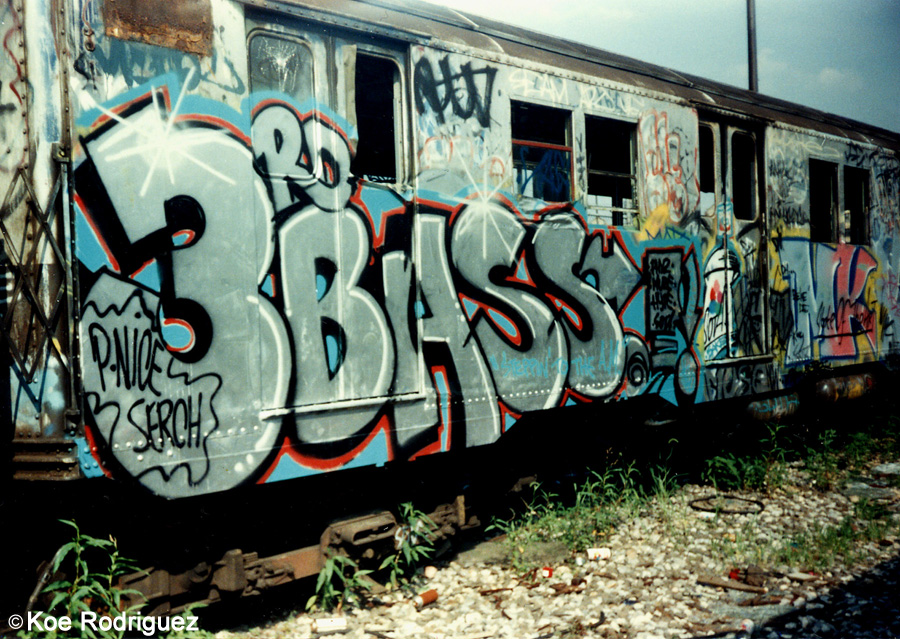
Nothing is ever random. Not even the fact that my cousin’s husband, who I have only met twice, used to bomb on Staten Island back in the days. Though I missed the glory days, I’ve been catching flicks on Facebook and thought it was time to post up. Tom Petronzio aka TAP, representing SI, telling it like it was ~

.

When did you start writing? & what was the scene like in SI back in the days?

.

TAP: I first started writing in late 1980. I was a freshman in HS. I happened to like this girl Melissa.B. I wanted to get her attention so I started writing Tom loves Missy. everywhere. As I pursued this M/O. In HS I sat next to this Black Girl named Kecia. She would write Kecia Kee -N- Easy Gee. I then became T-A-P -N- Missy B. Eventually Missy had no interest so she was dropped.

.

I created this toy connecto which looked more like a logo than a tag. In the beginning it was TAP, KELP 3 and STAR 2. Those were my initial partners. We would Tag fire boxes and NYC busses with these Hurt Tags. Eventually people started giving me recognition of seeing my Tag and the fire was lit. I think I stayed with the connecto for about 2 years.

.

In HS dudes with style noticed I had an uncanny knack for getting up. They would tell me. “Yo TAP drop the connecto the shit is hurt”. OMEN 2 was a West Brighton cat who brought me up to par. EROS, who wrote CAM at the time was another dude who was always showing me tagging style. I got better but more importantly I was getting up.

.

I think in 1981, 98.7 KISS FM first went on the AIR. I remember Fantastic Voyage was the first song I heard on this brand new station. Suede Pumas were in and, in fact, I remember bringing a toothbrush in to clean mine. The Heartbeat trilogy was out. Sweet GEE, Tanya Gardner, Treacherous 3 . We would go up to the Old Forty Duece and watch Kung Fu flicks. Saw the Nesting up there and all the black dudes in the theatre were adding there own ad libs to the scenes, We brought that skill back to our suburban movie theatres (LOL).

.

I could say so much more about how the commercialization of Hip Hop was just taking place. I had the Nylon BVDs, The Adidas, The windbreakers, Fat Laces, Le Tigre shirts. The sewed in creases in my Lees. I was the only MF in my area to wear that gear prior to 83 and caught alot of shit for it.

.


What were your favorite spots ? What was your greatest hit of all time ?

.

TAP: The Train Tracks on SI were peaceful. As i got more into it, I used my climbing ability to get on bridges, We had a bus yard under wraps for awhile and we would kill it. We went off schedule one evening and it was game over. Stakeout.

.

My greatest hit off all time was for me the Train Bridge cause I went solo on the 4th of July. Giant snow owls migrate there in the summer as I found out at the top of my climb. There are far more talented artists in the city but I got a pic with the Twin Towers in the Background that can never be duplicated. Its my moment in time. Now that I think of it. I will probably be cremated with that pic in my pocket (LOL).

.

Another hit which was pretty cool to me was the road to Great Adventure. I did it with a non graf friend but put Richie LUF for him. He died several years later and I am on that road alot. Even though the Tag has been buffed for years. I think of him immediatly. I actually got a tear in my eye writing about that. He was a punk rocker and he had a pet rat that he dyed Tiger stripes (LOL).

.

My final is a dumb one there was an old NYPD car that was bought by a security company. It still was Blue and White but I rocked a tag on it and at first glance people thought I hit the 5 O’s car. Its all smoke and mirrors (LOL).

.


You describe yourself as a bomber — what inspired you to take that approach to graff ?

.

TAP: There are artists and bombers, some are blessed to be both. As for my peers (dudes I competed with) MARS, LASK, GANO had both talents. There are alot of older dudes that carried that role but I will tackle that in Next question. I got alot of props for the older cats. ART takes talent for one and if you are not talented alot of patience and practice. First off I only got the fire cause I liked seeing my name on things, as recognition comes your ego gets involved. I didnt like putting my time and energy into something and it get buffed. To me it was heartbreaking watching pieces get buffed.

.

I put a 1000 tags you cant clean them all in one night (LOL). I was destructive by nature, I guess I picked quantity over quality. As far as bombers go the heavy hitters are to some degree loners. I never got caught on my own, it was always someone else’s misstep that jammed me up.

.


Whose work do you most admire, both artists and bombers ?

.

TAP: For work I admire most, for artists I am gonna stay on Staten Island. There was and is enough talented artists to occupy my memory bank for a lifetime. I am gonna pay props to different dudes for different reasons. If I miss someone its cause im alittle burnt LOL. Well I admire CASPER out of West Brighton first and foremost. He had unbelievable work on the west Brighton Pool. I was 15 and just learning the beginnings. I got all my friends to go to the West and see his work. I CAN”T BELIEVE NO ONE HAS POSTED ANY CASPER PICS ON FB.

.

AIDONE, I admire his work from the Late 70s. He did some styles in the his day that were way ahead of his time. His pieces were cool but more than that he was a ferocious bomber, i look at old pics and I know how hot those spots were. He definetly was a ballsy writer in his day.

.

RINONE. Is The KING of SI GRAFF to me. He killed the North shore/ brought it to the South Shore which was like Waltons Mountain in the 70s. He had big 5 boro respect. He made a nasty one/ two punch with AID but then also ran with what I Regard as Hall of Famers from Stapleton. MENIC, SAINT, BASIC, BENO, SIK, FLEX. RINONE just killed it before Grafff was glamourous.

.

BRAZE, Was another Legend to me, Great artist and Bomber, did pieces in Ballsy spots as well. His style to me is one of a kind.

.

MIRAGE,MONIE,were great artists who took chances. Thats the mark of greatness to me.

.

JADE and KEKA were south shore Pioneers, I remember searching the train trestles for new work from these 2.

.

There are plenty of old school cats I missed especially from North Shore and I apologize.

.

My era, who I regarded as flat out competition was LASK and CEAL. LASK was that duel bomber/artist, We got together once and tore shit up. I will always see LASK fat cap tags when I think Bombers,

.

My man CEAL, He achieved BOMBING fame with 2 names. Definite BUS KING on SI in his day. LIKE ME, wasnt into the artist side of things, MAD BOMBER, WE got together on several occasions. To me one of the best friendships I made in graff.

.

I admire CASTER a phenomenol Artist, SYRE (RIP) who was a real good friend of mine, that CEAL introduced me to.

.

GANO IS EVERYONES ERA. GREAT ARTIST/ GREAT BOMBER. What I really respect about Him is he knows the ART of self promotion. He is a smart Dude. I cant walk away from North Shore Bombers without Giving ON2, ROM, and TIN there props, I know I forget many from my era but these guys stood out to me

.

Now my fellow South Shore brothers who I hit with. RAD3, NS and MARS, MARS is that BOMBER/ARTIST super talented and if you could call a MF a graffitti genius its him,

.

I started out with KELP3, who later became GE, KART and STAR2. I pay them respect because they were there when we were battling to be king of the Great Kills Train Station LOL.

.

The final admiration is for My Man KID who doesnt settle for 2nd Best. KID and PK are kings as we read.

.

There are so many bigtime bombers in the 5 Boros to name but OE3 P13, GMAN and BS 119 plus SES from BKLYN were the biggest bombing inspirations for me .

.

All adult responsibilities aside, do you ever get the old urge to go bombing ?

.

TAP: Yes, I think talking to this younger Dude from SI, EVEN and the Original Gangster AID ONE make me realize what good times it was. Maybe someday, right now I got 3 teenagers to raise. (LOL).

.

Graff gave me friendships that will last a lifetime, You make new friendships with dudes because your common thread is the passion of your past.. Graff makes you determined wether Artist or Bomber. You wanna be the best.. As a bomber on SI, I strived for all out.. I peaked in 85 but you know because of my graff intensity I know there is no quit in everyday life. Graff, short of my wife giving birth to my 3 kids was the best times of my life..

Categories: 1980s, Art, Graffiti

I Want to Go Home

Posted on September 19, 2011

Frida Kahlo. The Wounded Deer, 1946.

.

My grandfather, who gave me his name and his intellect and his arrogance, has lung cancer. He is refusing to see an oncologist, and rightfully so. He is 96, and it is time to go. He was never a smoker, never a drinker, and being a diabetic, he had always been rather fit, but I do not know if it was sober, sugar-free living that kept him going for nearly a century. I think my grandfather is the prime example of the will to live.

.

His mind is fully intact, albeit much slower, but he is fully aware of what is happening to his body as it has been corroding rapidly over the past five years. There may be something to be said for dementia, which is a burden to the family but perhaps protects the individual. If you do not know you are dying, if your brain disconnects you from our shared reality, you might find greater peace.

.

On second thought, I take this back. My grandmother, his wife of over fifty years, died of Alzheimer’s disease, and from the little I witnessed, her final years were an agony that has filled me with pain. She had been abandoned, exiled to a home exclusively for victims of this cruel disease. My sister, in her infinite compassion, wanted to visit my grandmother. I did not.

.

I was twelve, maybe thirteen, at the time and my heart had grown so cold that the only thing I wanted was to sunbathe in Boca, watch soap operas, and eat Entemann’s chocolate chip cookies. Somehow, I knew what I would witness and the apprehension tore at me. I nervously chewed my fingers and silently cursed my sister, thinking her foolish for caring.

.

We entered the home, me fresh with resentment, my sister hopeful and excited, my grandfather detached and officious. The smell of fresh ammonia remains in my nose today and I can still feel it numbing the front of my brain. As always, the air conditioning was much too high, and everyone was dressed accordingly. I stood there in my oversized Betty Boop shirt, short shorts, and Keds thinking more about how I looked in order to block out what was happening around me.

.

The wait was interminable and I could not relax. A patient, an elderly man wearing his pajamas and bathrobe sat in a chair and did not move once while I was there. I watched him with a kind of painful awe. But it became too much, so I looked away and began chipping away at the nail polish on my index finger. I could hear the sounds of nurses bossing and cajoling their patients into submission while the patients were as docile and helpless as newborn babies. But unlike babies, I didn’t hear any of them cry out. They seemed to have accepted their fates and retired to a place deep inside themselves that no one could reach. I began chipping away at the nail polish on my thumb.

.

Perhaps the wait was not so long as I thought. Time play tricks where pain is concerned. At some point we were allowed to go to my grandmother’s room. The door was wide open, which seemed strange. I peered in and saw a nurse helping my grandmother into a long white slip. A rush of embarrassment swept over me. Here was a woman whose appearance meant everything to her, a woman who took great pride in being put together, and now she was fully exposed. I stood at the door struck dumb, wanting to run but having nowhere to go.

.

Frida Kahlo, Self Portrait as a Tehuana, Diego in My Thoughts

.

The nurse was having a hell of a time getting my grandmother dressed. Submissive throughout her life, the disease had released her from my grandfather’s control and a she-cat was born. With all of the attendant mewling and hissing and clawing that comes from a feral animal, my grandmother resisted all instruction. When she realized there were visitors at her door, she recognized my grandfather but seemed confused by the sight of two adolescent girls. “Is that my sister?” she asked, looking at me and my throat closed while my heart soared. A very strong part of me was cheering for her.

.

“Rose, these are your granddaughters,” my grandfather corrected, as though the facts at this point still mattered. Let her think I am her sister, I wanted to shout. My grandmother didn’t quite follow, but that’s okay because she had other things on her mind. As we took a thirty-foot stroll through the small and enclosed garden of home, my grandmother gripped my grandfathers’ arm and repeatedly pleaded, “I want to go home.”

.

I want to go home.
I want to go home.
I want to go home.

.

Her voice echoes in my ear as I write this. My stomach clenches just as it did that day. My grandmother, who never had a mean word for anyone, who accepted her domination in a way I never understood, could no longer be controlled. Her knuckles were white as she cling to my grandfather for her life. “I want to go home.”

.

My grandfather had had enough. Not even ten minutes into the visit, and we were through. He handed her back to the nurse, saying he would call or something equally irrelevant and he told us to wait by the car while he sorted out something at the front desk.

.

Under the scorching Florida sun we stood on the asphalt, besides the Lincoln Town Car that my grandfather drove to the early bird specials. My sister and I exchanged no words, which was probably for the best because I desperately wanted to blame her for making me see this.

.

I never saw my grandmother again.

.

www.missrosen.us

Categories: Art, Bronx

Jianai Jenny Chen: Suzhou, China

Posted on October 18, 2010

Suzhou, China, is one of Jianai Jenny Chen’s many hometowns, and the subject of a current series of photographs she has been taking, documenting a world that is unlike any I have ever seen. Combining the East and the West in an incredibly original way, Suzhou is a city near the Yangtzhe River on the central east coast of China, a half hour (very fast) train ride away from shanghai. It’s famous for it’s amazing gardens and pagodas and elaborate stoned bridges, silk commodities (and fried silk worms), pearl farms and markets and canals, deeming it the Venice of China. Besides the ancient town is a huge are of modern developments, full of malls, high rise buildings and hotels, restaurants and bars from around the world, and international schools and universities.I thank Miss Chen for sharing these incredible images with us.

 .

Old-fashioned fire extinguishers, for a parking lot. These are actually buckets that are flat on the other side along the wall, and quite rusty and old. They look like they haven’t been used in years. Photograph © Jianai Jenny Chen


Famous part of the canals in downtown Suzhou. Photograph © Jianai Jenny Chen

This is at the Humble Administrator’s Garden, one of China’s four greatest gardens. It’s even a UNESCO World Heritage Site! Photograph © Jianai Jenny Chen

Inside a pagoda at the Humble Administrator’s Garden. Photograph © Jianai Jenny Chen

Elaborate electric lanterns at Suzhou’s Times Square, a large outdoor shopping mall. Photograph © Jianai Jenny Chen

An IMAX theater modeled after the Beijing National Stadium built for the 2008 Summer Olympics called “The Bird’s Nest”. Photograph © Jianai Jenny Chen

A giant Ferris Wheel in Suzhou Industrial Park (SIP) that lights up at night and features LCD commercials at it’s center, such as this one for Estée Lauder. Photograph © Jianai Jenny Chen


www.simplychen.com

Categories: Photography

Tetsugo Hyakutake: Pathos

Posted on October 7, 2010

Photograph © Tetsugo Hyakutake

.

I first discovered Tetsugo Hyakutake’s photographs when curating the 2009 IPA Best of Show exhibition. His photographs of post-war industrial Japan were at once graphically arresting images of a landscape that was both familiar and alien, powerful and exhausting, brilliant and stressful. I am fortunate Tetsugo contacted me recently, to let me know about “Pathos”, an exhibition of the works at Alan Klotz Gallery, NY, now through October 30 as I had the chance to speak with him about his ideas about modern day Japan.

.

Please talk about your ideas of “Pathos and Irony” as they pertain to power post-war Japan. What has been gained and what has been lost during this radical period of industrial and economic growth?

.

The post-war Japanese nation believed that industrialization and economic growth was the only way to recovery from defeat, catch up with the West, and revive national confidence.  Despite the loss of human lives, destruction of more than 60 cities, and a lack of raw materials, Japan became the second largest economy in the world in less than 30 years after the war ended. However, in the early 1990s, rising stock and real estate prices following industrialization caused the economic bubble to burst and since then the Japanese economy ceased growing, which is known as “Lost Decade”. I think the collapse of the economy and the “Lost Decade” have left little room to reflect upon and contemplate what was post-war development and what it means to be uniquely Japanese. By looking back on history, I want to bring light to the present.

.

Although rapid economic growth was in a sense successful and made living standards rise materially, at the same time we sacrificed lot of things, such as beautiful landscapes, agriculture, human lives, and we also suffered from things such as air pollution and water contamination.

.

I focus on the ironic duality of beauty and dehumanization inherent in industrialization. “Pathos and Irony” lies between them, and while there is no visual evidence of human life, the industrial structures cannot be stripped of the sense of humanity that surrounds them. These opposing values epitomize the paradox of society after industrialization. Also I give a tribute to those who toiled to make it possible for Japan to become an economic superpower after World War II. I strive to depict this “pathos” as well as other emotional complexities that go hand in hand with the advancement of modern society.

.

Embedded in my images is also the investigation of “pathos” in relation to historical, social, and economic issues involving industrialization and urban development. By expressing feelings of isolation, loneliness, and emptiness that underlie this “development,” I seek to provoke the question of whether society is truly advancing through industrialization.

.

Photograph © Tetsugo Hyakutake

.

Why did you decide to focus on documenting the industrialization of Japan?

 .

From the 1970’s to 1990’s, my father had been involved in the Japanese car industry as a car designer. When I was twenty years old, he died from cancer caused mainly by overworking. When I see industrial buildings in Japan or even in other countries, it always reminds me of my father. I still remember how hard he was working during my childhood. Japan obtained strong economic power by the development of industrials, however personally I sacrificed my father’s life. I wanted to express my complicated emotions through my photography to monumentalize his life. That was the beginning of this project. Afterwards I began to focus on post-war development led by industrialization.

.

Photograph © Tetsugo Hyakutake

.

How do these images represent the aesthetic of contemporary Japanese culture, politics, and thought?

.

I think contemporary Japanese culture is based on cultural traditions, embracing western culture, individual interpretations, and industrialization. I am not sure how these images represent the aesthetic of “contemporary” Japanese culture. I attempt to connect historical, economic, and social issues of post-war Japan with personal experiences and the voices of my generation by showing the photographs of industrial and urban structures as a symbol of contemporary Japanese culture. By doing so I am trying to forge my Japanese identity, which is what means to be Japanese in post-war Japanese society.

.

My photographs visually depict how chaotically Japan was re-constructed after the war; in contrast they also show exquisiteness in the complex structures, and I think this duality of issues is one aspect of the aesthetic of contemporary Japanese culture.

.

Photograph © Tetsugo Hyakutake

.

What do you see as the relationship between the beauty and dehumanization of industrialized Japan?

.

There are dual issues of beauty and dehumanization in industrialization. In these photographs of industrial and urban structures, I emphasize its beauty by altering visual elements to accentuate the grief of industrialization. The more beautiful the photograph looks, the deeper the grief becomes. This concept of beauty originates one of the concepts of traditional Japanese culture such as “Wabi”. I have been looking for Japanese identity, so I embed the essence of Japanese aesthetics into my work.

.

Photograph © Tetsugo Hyakutake

Photograph © Tetsugo Hyakutake

Photograph © Tetsugo Hyakutake

 .

How have your photographs been received in Japan?

.

I have not shown any of my work in Japan yet. But I will look forward to doing so. I did not choose the audience, but I would like to show my work to Japanese people and look forward to hearing their response.

.

One day I contacted the executive of a certain shipbuilding firm to ask a permission to photograph their shipyard, explaining my theme and concept. He did not like the idea of pathos upon post-war development. He was in his mid 50’s, among a generation that achieved spectacular economic growth and experienced economic prosperity. I assume that he wants to believe the post-war development was absolutely right.

.

Categories: Books, Japan, Photography

Cacy Forgenie: Jaded

Posted on September 7, 2010

Photograph © Cacy Forgenie

.

I met Cacy Forgenie back when he worked at Mass Appeal, and though it’s been years since we’ve last spoke, it’s amazing how easy it is to resume the conversation mid flow. On September 11, “Jaded” a collection of Cacy’s photos, opens at Chi Chiz, 135 Christopher Street. The moment I saw these photos, I had all sorts of questions for him. Check it out…

.

This collection of work is called “Jaded” which resonates strongly with me as a New Yorker. Why did you select this title to accompany these scenes of disaster, distress, and mayhem ?

.


When I was approached to do the show a few months ago I was prepared to show  images that  I thought corresponded with the space and what being in that  space, a bar frequented by intergenerational  black, gay or bi-sexual men of different socio-economic backgrounds,  implied: escape and  desire. After some discussion with my partner,  I  realized that the folks who frequent Chi Chiz are probably people who have seen it or done it all in regards to sex and eroticism in NYC and New Jersey.

.

I decided to show images of a type of  experience that  may have been  internalized but not necessarily discussed: violence, harassment and police terror, things and experience that may retard  compassion. I thought it would be too conventional to show things like a sex act or an implied sex act, to people who were so sophisticated.  Very few people have seen my disaster photographs in New York outside of newspapers and magazines and galleries in Chelsea. I wanted a new audience, and  I wanted to infuse a sense of recognition and compassion in the space. I wanted to build a type of solidarity from our shared experiences as black men  becoming numb by the things we witnessed and experienced. I wanted to say this is what we’re not talking about with each other in this space.

.

Photograph © Cacy Forgenie

.

Were these images you consciously sought out, or were they something, that over time, you realized were a collection unto themselves ?

.

I don’t seek these images,  I stumble upon them. If something is in progress I run towards it, I chase it.

.

One of my earliest supporters was Derrick Adams. He saw something that I didn’t really pay  much attention to because photographing mayhem had become ordinary for me. It was normal for me to walk out of my apt and see someone with a gunshot wound. It was normal for me to cross Atlantic Avenue and see a body in the middle of the road. It was normal for me to see a car crash.  I would just “run into things” or have something, like the police car crash pointed out Carmen Hammons, pointed  to me. 9 out of 10 times, I happen on the scene intuitively or unconsciously. My only Control is the camera I have and how I chose to compose the image.  Whenever I would photograph something crazy, I’d  ring  up Derrick and say, “Guess what I photographed today!”

.

Back in 2007-2008 I was nominated for a Rema Hort Mann Foundation Award and Derrick suggested I show these images to them and also at The RUSH ARTS Gallery Project Space.  I knew the images were there but I didn’t think about organizing them in this way. Originally,  I imagined publishing them in a book alongside  my photographs of rappers, models and actors partying in NYC and Miami.


Photograph © Cacy Forgenie

Why do you think it is we “enjoy” looking at photographs like these?

.

Danger is exciting from a distance, and looking at images like these offers us a thrill and a wonder.  They’re like mini-horror movies, some of these images are. Some of them make your heart race. Theres also an aspect of nostalgia, especially as a New Yorker because you remember a kinetic NY before 9/11 happened.

.

I am particularly struck by the photo of the cab on fire. Please talk about what is happening in that image.

.

I call it “The Fire Next Time”  because it makes me think about the James Baldwin book and the Jim Crow stuff black people, black men, deal with trying to get around NYC in cabs.

.

There are many frames of this event but I chose to print this frame  because of the nonchalance of NYers on the sidewalk: they didn’t care too much. I photographed that image with a Kodak Disposable Camera. I think I was living in Queens or in The Bronx in 1999, and I was a year and a half back from living in the UK, trying to break into the NYC magazine market while simultaneously trying to launch a fashion magazine called IFF with a girl from Denmark that Summer. We’d finished a meeting and I was on my way to B&H to look at cameras. At this time I was using a Polaroid SX-70 Alpha and an broken Olympus Stylus Zoom. The Polaroid was a burden to carry and the Olympus was useless.  Some photographer friends suggested I graduate to a larger format and try  studio work so I was off to B&H to look at used Hassleblads.

.

As I am walking up 8th Avenue I see smoke. Curious, I run toward the smoke and there it was. I didn’t have a camera so I  looked for, and found, a  newsstand and bought a disposable and started photographing the scene from the middle of 8th Avenue  until I got close to the flames which were on 34th Street. Disposables have fixed lenses.  If I wanted a better picture I would have to get closer and thats what I did. To get close to the cab  I had to hop a barricade that was part of a street construction site blocking 34th Street.  And as I am running and jumping I can feel this surge of energy course through me. My heart is thumping wildly and I could feel the heat kissing my face.This might sound corny but  I am an Aries, a fire element,  and I am not afraid of fire. In fact Cacy means brave in Gaelic.  It sounds all kinds of wrong but fire and I are OK.

.

Getting the picture was thrilling but around me, people were afraid for me, they thought  the cab would explode, they thought I would  be burned or choke from the smoke.  I had to get the picture.  It was the first time I felt  pleasure photographing a disaster. As for why the cab was on fire, it was the engine. It burst into flames. The driver left the scene before the cops came. I saw him take his stuff and walk away.  I stayed and photographed everything I could, until there was nothing left for the fire to burn. All that was left was a steel frame on the corner of 34th & 8th.

.


.

Why did you decide to include photographs from 9/11 in this series ? How do you think we as New Yorkers now frame 9/11 as part of our experience in this city?

.

When 9/11 happened,  I was contributing to an Italian hip hop magazine based in Milan. The editor called to check up on me on the day I decided to stop photographing Ground Zero. As I was describing what I saw to her,  I burst into tears. I was on auto pilot until then. Recounting what I saw helped me I realize what happened. It was weird. I must have tucked myself away during the photographic process because I wasn’t grieving while there. And I chose to be there.

.

I was in bed in the Bronx, listening to Howard Stern when Howard announced that a plane had crashed into one of the Towers. I got out of bed, hopped in the shower, got dressed, caught the D before service ended at 59th Street, hopped on a bus to Times Square, ran from Times Square to Lower Manhattan via the West Side Highway, stood on what was a Tower and photographed what I saw. For hours and hours. And I did the same thing the next day until I had enough.

.

I wanted to show bodies in distress, experiencing trauma or in recovery in Jaded. And even tho I spent about two and a half days photographing Ground Zero, I didn’t have those images explicitly. Those photographs have  phantoms.  I try to limit my inclusion of those images when doing projects because I am not comfortable looking at them. 9/11 was both a psychic and physical disturbance.

.

During our studio visit I showed the curator a proof of a book I was working on; it had just two images from that time. He’d also saw a print (one of the two) from my LIVE! From New York show at RUSH and thought they would work well together. It an unconscious assemblage of time and image, really. Fate.  After we nailed  the date and the time for the show,  I realized that images from 9/11 will be shown on 9/11, the show’s opening date. This is the first time this has happened within my control. The Associated Press had a show in 9/11/02 with one or two of my photographs and the BBC had something, too. It’s on my CV but I didn’t actively participate in their shows or even know about it until years later.

.

Do they work in the show? I think they do. Theres a series of  scales happening in those images. There’s the scale of what was captured, the scale of what’s missing, the scale of time, and the scale of what we are doing to cope with what has happened.  People have fled my shows in tears when they encounter these image.

.

9/11 is what we think of whenever  something unexpected happens in the city, something loud like a manhole cover blowing up,  a building collapsing, a  plane flying low or a crane toppling. Its altered our consciousness to what was once a  normalcy within the boundaries of a metropolis.  I think NYers were hyper-terrorized by 9/11.

.

cacyforgenie.com

Categories: Manhattan, Photography

Brian Kenny: So Help You God

Posted on August 20, 2010

Artwork © Brian Kenny

.

I recently met up with Brian Kenny, and while he was showing me some of his new work, he began talking about his time spent on grand jury duty, sketching the scenes like a subversive court reporter in order to keep himself awake. Having done my utmost to escape sitting in judgment of anyone, I am simultaneously fascinated and repelled by our court system, one which is more a function of bureaucracy rather than democracy. With questions spilling from my fingertips, Brian graciously agreed to speak on his experience here.

.

Please talk about your experience sitting in grand jury—how does the process work? What were you, as a grand juror, responsible for, and how did you feel about sitting in judgment of other people?

.

BK: To give you some background, there are two kinds of juries in the criminal justice system, a Petit/Trial jury (like you see on TV) and a Grand Jury. I was selected as a Grand Juror.  A Grand Jury decides whether there is enough evidence for an actual trial and issues formal indictments (or charges) for alleged crimes against defendants by examining evidence presented by the prosecution. Before a Grand Jury actually passes an indictment, criminal charges against someone are only “theories”.

.

Only the US has Grand Juries anymore and it functions as part of the system of checks and balances, so that people don’t go to trial under official criminal charges based on only the Prosecutors bare word.  In New York State, a Grand Jury is made up of a quorum of 23 Jurors and a  “yay” vote of at least 12 jurors is required to pass a formal indictment against the defendant, so the vote by jurors does not have to be unanimous.  If passed, then the case goes to trial, if not, the case is thrown out.

.

Artwork © Brian Kenny

Now, unlike a Petit Jury which only focuses on one trial, I examined and voted on hundreds of cases, one after another, for two weeks, fulltime. They move so quickly because only the prosecution presents evidence (although a defendant is allowed to speak for themselves, but almost never does and are not required to be present), and the evidence is minimal. Grand Juries only require enough evidence to support ‘reasonable cause” that the defendant committed a crime, not “reason beyond a doubt” like a trial jury.

So a typical case in the Grand Jury plays out as follows:

The District Attorney (prosecution) will say “I’d like you to consider charges of felony possession of a controlled substance in the 3rd degree against (let’s say) Mr. Smith. We have three witness that will testify that Mr. Smith was found in possession of Heroin on January 21st on Houston Street”

Then two undercover cops will come in one by one and tell us how they saw Mr. Smith exchange money for a small baggie on the corner and after approaching and searching the defendant, they recovered a small bag with 4 vials of what they believe to be Heroin and placed the Mr. Smith under arrest. Then the DA will call in the lab analyst or read the lab analyst’s letter confirming that the substance was tested and is in fact Heroin.

After that the DA will read out loud all the legal mumbo jumbo concerning criminal drug possession laws, which is by far the most boring part and finally the DA will ask us if we have any questions and leaves the room while we the jury deliberates.  We all vote, “yay” or “nay” to indict, and call the DA back in to give our answer. If 12 or more vote “yay” the charges become official and the defendant goes to trial, most likely to be found guilty and sent to jail. Next case.

Artwork © Brian Kenny

.

That’s basically how it worked, over and over. It wasn’t hard to be in judgement of others, but it was frustrating that nearly half the jurors could disagree with the evidence and indictments are still passed. I also found it kind of annoying that although the District Attorney were presenting evidence to us jurors, real live people, but everything they said was really ‘for the record’, so they were actually talking at us in this impersonal, over-explained way to satisfy the stenographers documenting every word.

.

I love that for all intents and purposes, you were the courtroom artist, illustrating the scenes as they do not allow cameras in. Yet your perspective was very distinct from how this work is usually done as the images are less narrative, and more metaphorical. How did you decide you wanted to begin drawing in court? What were some of the ideas you began exploring through your sketches?

.

BK: I started drawing on day one without really making a deliberate decision to document everyone. I tend to draw compulsively; sitting still is hard for me and I tend to listen better if I can keep my hands busy.  There were moments, like the rape or abuse cases that were very intense and heartbreaking,  (almost like being inside an episode of ‘Law and Order’), but most of the jury duty was super boring; endless droning by the District Attorney reading definitions and procedures from the law books. Thus, drawing was a good way for me to stay awake and engaged. Soon after I began drawing I realized this was a perfect opportunity to use all the DA’s cops, lawyers, witnesses, defendant as live models for drawings because here I was sitting in the front row of a kind of small auditorium and one by one, all sorts of people kept sitting at the table in front of me every couple minutes. I didn’t really have any ideas I was exploring other than trying to draw them quickly before they got up and left the stand!

.

Artwork © Brian Kenny

Did the act of sketching alter your perception of the events as they unfolded in court ?

.

BK: Yes in way.  Because I was looking at each person very closely in order to draw them accurately, I noticed a lot of distinct and subtle body language, personal hygiene factors, and fashion sensibilities that did affect my own opinions of them in regards to their integrity or self-esteem.

.

For example, although all of the DA’s and lawyers dressed and acted in very formal almost detached robotic manner, as I drew closer, I noticed how some were actually very insecure, wringing their hands or not making eye contact while others seemed to relish dishing out justice, their eyes sparkling, reciting law from memory and adding little pieces of flair to their suits like 3 point breast pocket hankies! Most of the undercover cops, (and there were TONS of them) dressed poorly; food stained sweats, drab K-mart styles, oversize jackets, unshaven, beady eyed, thick accents, over-weight. This kind of unkempt appearance in addition to not being very well spoken, definitely affected my opinion of their credibility considering many of them mirrored the criminals they arrested.  Often, the only evidence we received to indict someone of a crime, especially in the drug cases, came from these messy figures whose integrity looked questionable.

.

Artwork © Brian Kenny

Did anyone in the jury box or court notice you were sketching ? If not, what did you observe them to be doing?

.

BK: Yes, the jurors and warden noticed I was drawing everyone who took the stand. The other jurors loved it and luckily so did the Jury Warden. I was afraid the warden would tell me to stop or confiscate my drawings because the Handbook actually states that even private notes made by jurors during duty are confidential and cannot be shared or leave the courtroom. But after a couple days, the warden was offering me nicer drawing paper and some jurors asked me to email them scans of drawings I made.  About half of the people I was drawing noticed I was looking at them very closely, but no one spoke up about it or even seemed to care. A whole room full of people was also staring at them and they probably assumed I was just taking notes.

.

Artwork © Brian Kenny

What did you find most eye opening about being a part of the American legal system ?

.

BK: My Jury Duty experience was eye-opening and in many ways. Artistically, it was expansive because I was drawing outside of my comfort zone. In my own practice I usually draw myself or guys who look like me endlessly, so it was a challenging departure to draw all types of people live; old ladies, children, fat men and sexy young women.

.

I also learned a lot about the American Justice system and New York City criminal politics but left with a lot of mixed feelings about it. I noticed that virtually 90% of all criminal activity in New York City is either theft or drugs, essentially non-violent crimes. The drugs cases were the most frustrating part of being a juror. I view drug addictions as more of a health issue than a criminal issue and so I refused to vote to indict anyone on drug charges, as did a few other young jurors, but we were always outvoted by the majority and it was sad to know most of them will end up in jail where they do not belong.

.

Although I respect and believe in the system of checks and balances as part of a true democratic judicial process, I also felt like the Grand Jury system was designed to pass indictments. We only ever heard from the prosecution, which makes the presentation of criminal evidences one-sided. Defendants themselves do have a right to speak on their own behalf, but I doubt most of them realize this because out of the hundreds of case I saw, only a handful of defendants actually used that opportunity. Unfortunately the defendant’s lawyers are not allowed to speak to the Grand Jury. In addition, a Grand Jury only examines the most obvious evidence because it seeks only ‘reasonable cause’ for an indictment. So the whole picture of a possible crime is not presented.

.

Add to that the fact that the majority of witness and evidence to criminal allegations were testimonies by undercover cops. As I said earlier, these cop’s appearance already aroused my suspicions of their credibility. Besides, cops are required to make arrests and so it’s in their own career interest to make as many arrests as possible. Especially in the drug cases, I often noticed that their testimonies seemed suspicious.

.

Artwork © Brian Kenny

.

For example, one cop described how he was walking on the street and saw through the window of a car someone exchange money and drugs. When the suspect exited the car, he approached him and after searching him, found drugs. However, another cop who was involved in the arrest but did not see the transaction, told us after we questioned him separately that the car was a big black SUV with tinted windows. So how did the first cop actually see what was happening? Someone was lying. Of course, that still did not stop the jury from indicting the defendant.

.

Many testimonies like this were strange or somewhat incomplete.  It made me wonder whether many of these drugs arrests actually traps set up by undercover police to increase arrests.  Perhaps I’m just paranoid but a recent unrelated event only deepens my suspicions. Last week, Slava and I were coming home and as we crossed Chistopher and 7th avenue  (a corner that at night always have some shady characters loitering around) and Slava noticed a shiny penny near the corner. Slava picked it up and began to examine it because it’s one of those new 2010 pennies where they have replaced the Lincoln Memorial with a shield that says “E pluribus Unum”.  He showed it to me and we continued walking down the street. Then out of nowhere a green van speeds backwards down the street and screeches to a halt in front of us. Three undercover cops jump out of the car and start yelling at us “Police, Don’t move! Keep you hands where we can see them!” They rush over to Slava saying “Show us what you’ve got in your hands!” Slava opens his hand and shows them the penny we just picked up, and the cops stop and say “Oh, sorry, we thought it was drugs, umm, sorry about that, have a good night” and got back into the car and drove off just as quickly.

.

The whole incident was so shocking and unexpected that we both wondered if the cops had actually placed drugs on the street nearby waiting for someone to pick it up. I could be wrong but the whole incident just felt like we had walked into a trap.

.

Overall, my jury duty experience was worthwhile artistically and I really learned a lot about crime and punishment in New York City. I do believe in the use of Juries made up of real citizens and was proud to do my part, but also feel that the system is totally vulnerable to manipulation, and that the drug laws especially need to be re-examined in favor of rehabilitation or community service over worthless punishment or revenue.

.

Artwork © Brian Kenny

briankenny.blogspot.com
www.brian-kenny.com

Categories: Art, Manhattan

Jianai Jenny Chen: Party People in the Place to Be

Posted on August 18, 2010

Eric Firestone Gallery, East Hampton, Photograph © Jianai Jenny Chen

Portia aka Madame Blade, Photograph © Jianai Jenny Chen

T-kid 170, Photograph © Jianai Jenny Chen

Eric Haze, Photograph © Jianai Jenny Chen

Mare 139, Leo, and Eric Haze, Photograph © Jianai Jenny Chen

Leo, Photograph © Jianai Jenny Chen

Indie 184 + Cope 2, Photograph © Jianai Jenny Chen

Marty Cooper + Mark Seliger, Photograph © Jianai Jenny Chen

Daze + Co., Photograph © Jianai Jenny Chen

Henry Chalfant + Portia Ogburn, Photograph © Jianai Jenny Chen

Sharp, Photograph © Jianai Jenny Chen

Photograph © Jianai Jenny Chen

More Party Photos at simplychen.com

Categories: Art, Exhibitions, Graffiti, Music, Painting, Photography

Jianai Jenny Chen: Down by Law ~Party Photos~

Posted on August 17, 2010

Eric Firestone Gallery, East Hampton, Photograph © Jianai Jenny Chen

Photograph © Jianai Jenny Chen

Photograph © Jianai Jenny Chen

Photograph © Jianai Jenny Chen

Photograph © Jianai Jenny Chen

Grandmaster Caz, Photograph © Jianai Jenny Chen

Martha Cooper, Photograph © Jianai Jenny Chen

Photograph © Jianai Jenny Chen

Miss Rosen + Miss Outlaw, Photograph © Jianai Jenny Chen

Grandmaster Caz, Photograph © Jianai Jenny Chen

Yes Yes Y’all, Photograph © Jianai Jenny Chen

Photograph © Jianai Jenny Chen

Indie 184 + Charlie Ahearn, Photograph © Jianai Jenny Chen

Photograph © Jianai Jenny Chen

More Party Photos at simplychen.com

Categories: Art, Exhibitions, Graffiti, Music, Painting, Photography

Koe Rodriguez: Return of the Foto King

Posted on August 17, 2010

Courtesy of Koe Rodriguez

.

I have known Koe Rodriguez for the longest, but only recently discovered his treasure trove of graff history. I’ll let Koe get into it…

.

How did you first get into graff? Did you write, or have you always been more of an aficionado?

.

I got into Graff during the early 80s because Hip-Hop was in full effect and everybody was goin’ for theirs.  My older cousin and his friends where into it, the media was giving it some exposure and I was personally blown away by it.  I was into drawing at the time, so I gravitated towards the element of Hip-Hop that resonated with me the most.  I started off like everyone else, a young toy, getting’ up with El Marko markers and Wet Look spray paint.

.

By the mid-80s, I began trying my hand at painting.  My name was originally “Coe,” but I later changed it to “Koe” after discovering there was a Coe in the Bronx.  When it came to piecing, I enjoyed rockin’ the letter “K” much better than the letter “C” as well.  As I was actively writing, I began documenting the art as well – this was in 1985 at the age of 15.

.

Being a true Gemini and having that insatiable appetite to absorb knowledge, I was also consuming as much information as I could about Hip-Hop and Graffiti in general.  This went on for many years and by the time I was in my 20 and 30s, cats were calling me a Hip-Hop encyclopedia and later a scholar.  When I was filmed for the movie “Just For Kicks,” they actually gave me that “Hip-Hop Scholar” credit, I never requested it.  I’m a pretty humble cat and rarely ride my own jock.

.

Courtesy of Koe Rodriguez

.

When did you begin collecting materials on graff culture? Where has this path taken you?

.

I began collecting graff related items dating back to the early 80s.  Newspaper clippings came first and then books like Subway Art and Steven Hager’s Hip-Hop came next.  My family was fortunate enough to cop a VCR around 1984 and I began recording anything I could on Hip-Hop culture, especially Graffiti.  ABC (Channel 7) ran a few good specials on Hip-Hop early on like 20/20’s “Rappin’ To The Beat,” “The Big Break Contest,” “New York Hot Tracks” and a made for TV movie called “Dreams Don’t Die” featuring Graff by the late, great Dondi White.  In the late 80s, I would cut my high school classes, jump on a Path Train and head to the original Soho Zat to boost IGT Magazines and Vaughn Bode comics.

.

The 80s were a really special time for consuming all things Hip-Hop.  I remember heading over to comic book hot spot Forbidden Planet to rack comics with my lil’ homie and Vulcan (who was working there) had the drop on us and told us to forget about boosting anything.  It was actually pretty cool (and funny) being busted by a popular graff writer of the time.  Vulcan was cool about the situation and after asking him what would be a good spot to photograph subway burners he put us on to a good spot uptown to bench and catch flicks.  As for the path that collecting and being down with Hip-Hop in general has taken me, its allowed me to have a pretty nice career in Hip-Hop.  Truthfully, I feel blessed to be doing what I’ve always loved doing, and getting paid for it.  Life is a trip.

.

Courtesy of Koe Rodriguez

.

Which piece is the pride of your collection and why?

.

A: Wow – there’s just so many. lol I have vintage Krylon cans for colors that have been discontinued for quite some time.  I have my collection of original graff magazines and books.  I have thousands of graff related photos dating back to the 80s and more importantly, I have all the great memories.  My collection of archives and paraphernalia isn’t exclusive to graff related items.  I’ve collected pretty much anything that deals with Hip-Hop culture in general.  My home office is a serious omage to the culture.  My file cabinet is covered in Hip-Hop related stickers alone – anything from an original “OPP” sticker or Yo MTV trading cards to Hip-Hop apparel hang tags that I customized into magnets.  I have some real conversation pieces.

.

Having observed graff for three decades, what would you say is the most impressive thing about how the culture has developed during this time? What has been the most surprising?

.

Graff culture never ceases to amaze me.  Its essentially gone from a secret society of outlaw artists to an internationally recognized artform with a global contingency.  It went from being eradicated below ground to blowing up something crazy above ground.  I’m always impressed at how Graff’s evolution, be its style or its lifestyle has maintained immense resiliency, cleverness, inventiveness and steady progression.  Graff writers are pop culture’s new rock stars.  Guys like Lee and Cope 2 who were considered outlaws and their works considered urban blight, are global celebrity’s and bankable talent.

.

Graff culture is unstoppable and it’s gonna continue to grow and radiate for many years to come.  With corporations still eager to get in between the sheets with graff artists to promote or sell their products and/or services, more and more writers are seeing a reason to stick to their guns and take their craft to much higher levels.  Hip-Hop is big business and rappers shouldn’t be the only ones prospering from it anymore; not when art is one of the most provocative, respected and lucrative mediums on the planet.

.

Courtesy of Koe Rodriguez

 .

You mention you have pen pal letters! What’s that all about?

.

A: Back in the late 80s, myself and some of my graff friends like: Ket, Cole, Nic 1, Cavs, and John The Greek were communicating with other writers around the globe and engaging in photo trading, which was essentially swapping your graff photos for other writer’s photos – kinda like trading baseball cards.  My foray into photo trading started off around 1987 after reaching out to West Coast graff magazine “Ghetto Art” (which later became “Spray Can Art”) and starting a friendship with the rag’s publishers, Charlie DTK and Tim “Power.”  Charlie, who is now considered a West Coast graff legend, would send me dope graff flicks by him and hot LA writers and I would send him hot graff flicks from New York.  We would always include a letter with all of our flicks to exchange information, gossip or to simply shoot the shit.

.

Sometimes we would even send each other packages containing VHS and audio tapes of graff related stuff like “Style Wars” and Hip-Hop mix shows by Red Alert, Chuck Chillout and Mr. Magic.  This is all pre-Internet and if you wanted to holler at anyone out of town or abroad, you sat down and wrote a letter or you hollered at them on the phone.  Eventually, more cats started getting down with photo trading and the next thing you knew, I was writing cats from New York to Holland…it was crazy! I have a huge folder of all the original letters I ever received from the cats I wrote to dating back to the late 80s.  Looking back, it’s bugged-out how committed we were to our craft.

.

Courtesy of Koe Rodriguez

.

What are your plans for the collection?

.

I recently took a bunch of my Hip-Hop collectibles to the Las Vegas apparel show “Magic.” I consult for the heritage Hip-Hop brand Sedgwick & Cedar and laced our booth with some of my vintage Hip-Hop pieces.  I was instrumental in laying out the booth’s overall flavor and had some of  my prize pieces like an old name buckle, vintage Krylon cans and markers and Cazal glasses in these hot trophy cases.  The booth looked like a Hip-Hop museum and mad heads were drawn to it on the strength of its funky true school flavor.  It worked well with baggin’ sales and it definitely let cats know that there were some real vets in the house.  Some of my graff related collectibles are featured in a book that I began working on with my old shooting partner from Brooklyn, John The Greek.

.

This book features some of our greatest NY Graff flicks from the late 80s to 1993.  The book has a lot of shots of dope subway graff during its twilight on the New York subway system, which is significant in itself.  It also features the “Foto Kingz,” the crew of graff writers who also documented graffiti culture for crazy years.  That crew consisted of Cavs, Ket, Cole, John The Greek, Nic 1, Charlie DTK and later me.  I’m hoping we really get a chance to publish the book as its content is not just culturally and historically significant, but just a hot slice of true Hip-Hop culture.

.

Courtesy of Koe Rodriguez

Categories: 1980s, Art, Graffiti, Photography

Chris Pape aka FREEDOM: Down by Law

Posted on August 12, 2010

.

CHRIS PAPE AKA FREEDOM: DOWN BY LAW

.

Eric Firestone Gallery, East Hampton
August 14–September 26, 2010

.

Chris Pape (aka Freedom) is an American painter and graffiti artist. Pape started tagging subway tunnels and subway cars in 1974 as “Gen II” before adopting the tag “Freedom”. He was a witness and a participant to the 20-year run of the New York subway graffiti movement.

.

He began writing as Gen II in 1974 and finished his career on the trains in 1983 with the tag Freedom.

.

Pape is best known for his numerous paintings in the eponymous Freedom Tunnel, an Amtrak tunnel running underneath Manhattan’s Riverside Park. Prominent paintings in the Freedom Tunnel attributed to Pape include his “self-portrait” featuring a male torso with a spray-can head and “There’s No Way Like the American Way” (aka “The Coca-Cola Mural”), a parody of Coca-Cola advertising and tribute to the evicted homeless of the tunnel. Another theme of Freedom’s work is black and silver recreations of classical art, including a reinterpretation of the Venus de Milo and a full train car recreation of the iconic hands from Michelangelo’s Sistine Chapel.

.

Pape will be exhibiting a self portrait from the Freedom Tunnel in “Down by Law” at the Eric Firestone Gallery, East Hampton, opening on August 14, 2010. He has graciously agreed to speak about his work here.

.

New York in the 1970s and 1980s was a city bursting with originality, innovation, and experimentation. Please talk about how you see the relationship between your early work as an artist and the environment in which it took hold.

.

The great cities of the 20th century are Paris in the 20s, Berlin in the 30s, and New York in the 70s; and I guarantee you, there will never be another city like New York in the 70s. The gay rights movement, the feminist movement, punk rock, hip hop, graffiti, the blackout, Son of Sam, tabloid journalism, street gangs (in 1977 it became fashionable for gang members to walk through the streets with golf clubs), the blackout, Saturday Night Fever — Saturday Night Live — it all came out of New York!

.

If there were one particular moment that defined my later work it would have to be in the 1960s. In 1965, at the age of five, my parents wouldn’t let me leave the block alone. I was allowed to go “subway fishing”, this meant laying atop a subway grating and swinging a string with gum affixed to it until it hovered over a lost coin or some other treasure and hoisting them up. These were long summer days that seemed to go on endlessly. I pulled up Indian head pennies, buffalo nickels, matchbooks, a baseball card, and other bits of junk that somehow stayed in the back of my brain until the early 80s.

.

In 1980 I was already a graffiti writer doing letters on the sides of trains, I quickly found out that I could paint realistic images with spraypaint and looked for a place to do it. There was a freight train tunnel in Riverside Park where trains still ran, the gratings formed 15-foot high canvasses of light against the walls, and in those beams of light I repainted the images of my youth including a baseball card. In 1986 the homeless moved in and became known as the “Mole People”, I stopped painting and documented their lives for three years. I finished my mural work in 1995. I tell the story because I can’t think of any other city in America where something like that could’ve happened. That was New York back in the day.

.

It has recently been suggested to me that the term “graffiti” is marginalizing, and loaded with negative connotations. How do you feel about the use of the word in general, as well as application to your work as an artist?

.


The graffiti word is offensive, but it was the only word to describe the early stages of the movement. In 1974 the word “graffiti artist” was coined in the New York Times—that seems like a happy marriage. I don’t lose any sleep over this stuff.

.

As a working artist over the past three decades, you have seen first hand how the art world—from galleries and dealers to museums and collectors—responds and reacts to contemporary American art. What are your thoughts on the differences (and similarities, if applicable) between the US, European, and Asian markets?

.


I think the art world as a whole views the works of artists as commodities. Let’s not forget the lessons of the 1980s when graffiti canvases were sold for huge amounts right up until the stock market crash. Things do seem a lot more liberal in Europe where graffiti artists from New York are celebrated and have been for years.

.

Who are your artistic inspirations, and how have they influenced your ideas, aesthetics, and actions through the course of your career?

.


Hopper is my favorite painter, I think he tapped into the American psyche more then any other painter of the last century, but I don’t think he inspires me. I’ve bitten generously from Warhol, Oldenburg and Rosenquist, you can see the Rosenquist influence in the “Buy American” painting. Warhol and Oldenburg are there on a more spiritual level.

.

Self Portrait in The Freedom Tunnel, Artwork © Chris Pape

Self Portrait inspired by The Freedom Tunnel, Artwork © Chris Pape

For “Down by Law” you will be exhibiting your self portrait from the Freedom Tunnel. Please talk about the importance of this piece, and the context in which it was created.

.


The self portrait for the show was originally painted in the tunnel in 1984. At the time it wasn’t THE FREEDOM TUNNEL, it was just me doing my thing, which allowed me to fail a lot. This painting didn’t really fit in with the themes I had established, but it seemed to work and was published in a number of books. It’s a self portrait. The jacket was given to me by my parents in 1976, I left home in ’77 and lived in the jacket, quite literally. The spraycan head is an old graffiti device that seemed to describe my life at the time.

.

There has been a wide array of artists to emerge from the early graffiti movement. How have your earlier experiences influenced you ideas about art, and in what direction would you like to go?

.


When I left the tunnel in 1995 I was a little bit dazed. I was stuck as a painter, although I continued my visual journalism work. I did my new paintings large, and then small, in color, with a sable brush – it seemed as though nothing worked. Of course the answer was that it couldn’t work. The paintings in the tunnel are just that, there in a tunnel. In the same way that if you buy a subway graffiti artist’s work it’s best to buy an entire subway car or it loses context. I think that’s a battle that all graffiti writers that started on trains have had. I’m not saying I’ve fully overcome it but I’ve come close.

.

www.ericfirestonegallery.com

Categories: 1970s, 1980s, Art, Exhibitions, Graffiti, Manhattan, Painting

Jane Dickson: The Architecture of Distraction

Posted on August 11, 2010

At the end of May, Jane Dickson and I took a bus from Baltimore to New York, which is the perfect highway journey for a tete-a-tete on topics about everything from art and ideas to happiness and success. It was on this ride that she told me about her new work, “The Architecture of Distraction”, inspired by a trip to Las Vegas. Being fascinated with forms of distraction, I wanted to take this opportunity to chat with Jane about her new paintings and where they are taking her.

.

Artwork © Jane Dickson

I love the title, “The Architecture of Distraction” as it implies an intention that goes beyond the more congenial term, “entertainment.” Please talk about what has attracted you to the idea of distraction and the forms in which it manifests in American life.

.


I’m struggling daily to focus, to think my own thoughts clearly without interruptions and  to follow through on those ideas. Yet I reject being a recluse because I’m as seduced  as anyone by the overwhelming energy of the city, my brilliant friends, the internet… I’m driven to distraction by my desire to keep up with more than is humanly possible.

.

I’ve been thinking about how this attraction/seduction/distraction paradox is structural to our hyper-commercialized culture. Our attention is hijacked every few seconds by systems designed by the best minds money can buy.  Like everyone else, I’m struggling with the internet’s huge new layers of virtual info/distractions.

.

You know, every time I sit down to write an email I find an hour has gone by, I’ve signed petitions to save whales, seen strange videos, read about art projects in Greenland  and I’ve forgotten to do that one email I went online for in the first place. This is not news but it’s an ever-increasing challenge to find strategies to cope with. I understand the world by painting my dillemas so my current question is how to visualize distraction.

.


Artwork © Jane Dickson
Your new project focuses on Las Vegas, which is distraction on the largest possible scale. What is it about Las Vegas that you find in turns compelling and challenging in the desire to represent it visually ?

.


I was at loose ends last year and a friend invited me to Vegas.  Entering that seemingly endless maze of disorienting patterns and shapes, flashing lights and crazy music, what Rem Koolhaas called the Synthetic Reality of Fantastic Technology, I realized I had entered the 3-D precursor to the internet’s labyrinth of temptations. I took hundreds of pictures, many of people at slot machines. When I got home and looked at them I realized what interested me was the architecture and the way it swallows everyone. Slot machines look like computer terminals. We get away from work and then are riveted by these screens, losing money, thinking we’re having fun.

.

You mentioned that you are also working on paintings of an amusement park ride in Vienna, and that this work recalls a project you did 25 years ago. What is it like to work on a similar subject through the lens of “distraction” ?

.

Most of my work has focused on  prefab entertainment zones since my first paintings of Times Square. One of my first jobs was working there as a computer billboard animator on weekend nights.  I wandered around wondering why everyone, including me, wanted to be in a place that was so raw. I began to paint it from every angle I could, trying to capture the edges of it’s attractive/repulsiveness,  when I was pregnant and couldn’t stand the smell of Times Square I moved on to Demolition Derbies, street fairs, …..asking, why this? Why does this signify fun? What does this have to tell me about myself, my culture, the world ?

.

When I embrace a new subject it feels electric, like new love, totally fascinating. Eventually I get to know it too well and I’m done. With carnivals I’m revisiting an old subject from a fresh perspective. I’m a different person than I was when I first painted it. I see things I didn’t register before. Early on, besides glorying in the artificiality of the lights, I focused mostly on alienated individuals. Now I’m entranced by the geometric meta-structures that determine the scope of the “freedom” each ride offers. I’m observing about the architectural structures as framework for, creation of, limitation to, and distraction from desires and choices, reflecting the larger invisible structures, natural, political and economic that are reshaping my world every day.

.

Artwork © Jane Dickson

I love how you had said about the Vienna work that the paintings were like potato chips, and that you couldn’t do just one. Please talk about the difference between this vibe and the more challenging aspects of the Las Vegas project.

.

A lot of art making is a long hard slog into the unknown. “How the hell do I treat this? What do I put it on? What paint do I use? How thick, how big, how many…?” This is a process of trial and error requiring enormous faith to engage the biggest question; “Is this project really worth doing at all?”

.

But sometimes there are moments of grace when I feel fluent with the subject and the materials and the work just flies. It feels like the push-ups are over and now I can dance.  When the work is really flowing I feel like I’m gorging myself on colors and marks. “just one more…just one more…” I don’t want to stop.

.

( I always imagine I’m eating colors.)

.

With Las Vegas I’m still exploring, everything is in question. With amusement park rides I’m at home even if these paintings are on smooth square panels which I’ve never used before. That’s an important point. As an artist I can’t stay long in the familiar zone or I begin to fall asleep creatively. The architecture of these rides is exciting right now because I beat my head against the wall all last year exploring them with the wrong materials and it just felt dead. Now I know the subject well,  I’ve finally found a congruent approach technically and it’s beginning to sing.

.

Lastly I have to confess that whatever subject I am focusing on can begin to feel like a job. I start to push myself, make mental demands and commitments, get hyper-critical of the work in progress…..So the distraction of a side project feels like play. I haven’t promised it to anyone. I don’t have expectations for it. It can surprise me. Sometimes I switch which project is my main one in my head to trick myself into lightening the burden of expectations I’ve put on it. The one I don’t care about is always easiest.

.

Artwork © Jane Dickson

Do you have your own favorite distractions, and in what form do they take?

.

Right now reading, swimming, hip hop and indie music events, crossword puzzles, facebook and “Mad Men.”

.

www.janedickson.com

Categories: 1980s, Art, Painting

« Older entries    Newer entries »

Categories

Archives

Top Posts

  • Home
  • About
  • Marketing
  • Blog
  • Azucar! The Life of Celia Cruz Comes to Netflix in an Epic Series
  • Eli Reed: The Formative Years
  • Bill Ray: Watts 1966
  • Jonas Mekas: I Seem to Live: The New York Diaries 1950-1969, Volume 1
  • Mark Rothko: The Color Field Paintings
  • Imprint

Return to top

© Copyright 2004–2025

Duet Theme by The Theme Foundry