Miss Rosen
  • Home
  • About
  • Imprint
  • Writing
    • Books
    • Magazines
    • Websites
    • Interviews
  • Marketing
    • Publicity
    • Exhibitions & Events
    • Branding
  • Blog

Posts tagged “Hip Hop”

Harry Allen: The Media Assassin

Posted on March 18, 2013

Run-DMC and Doctor Dre, outside of WBAU/90.3 FM, in the Adelphi University Center, Garden City NY, July 1983, Photograph © Harry Allen

Run-DMC and Doctor Dre, outside of WBAU/90.3 FM, in the Adelphi University Center, Garden City NY, July 1983, Photograph © Harry Allen

Pebblee-Poo at Home, Photograph © Harry Allen

Pebblee-Poo at Home, Photograph © Harry Allen

T La Rock, Benjamin Franklin H.S., South Bronx, Photograph © Harry Allen

T La Rock, Benjamin Franklin H.S., South Bronx, Photograph © Harry Allen

.

Harry Allen is the Media Assassin. Be it print, radio or digital; written or spoken word; or in the medium of photography Allen ihas had a hand in hip-hop culture dating back to 1982, when he first met Carlton “Chuck D” Ridenhour in 1982, when the two took an animation class at Adelphi University. Ridenhour, then a member of the Hip Hop group Sepctrum City introduced Allen Flavor Flav and Terminator X (who, along with Chuck D, would form the core of Public Enemy), Spectrum City founders Hank and Keith Shocklee  (who, along with Chuck D and Eric “Vietnam” Sadler , would form PE’s legendary production team, The Bomb Squad ), future Def Jam President Bill Stephney, and Andre “Doctor Dre” Brown, best known for later co-hosting Yo! MTV Raps.

.

It was during this time that Allen began his work in photography, capturing the local scene and visiting New York City stars, before he began writing professionally in 1987. Allen’s first published article was one of the first pieces to illuminate the political ideology behind Public Enemy. After a 1989 Washington Times interview with Professor Griff brought accusations of anti-Semitism against PE, Allen began identifying himself as a “hip hop activist and media assassin”, becoming the group’s publicist as “director of Enemy relations.”

.

An early proponent of the Internet, creating an online presence for PE in 1991, Allen was recently named “social media curator” by Fast Company recently named Allen a “social media curator” and one of “11 People Who Could Make Your Twitter Experience More Interesting.” Currently hosting NONFICTION, a Friday afternoon radio show on WBAI-NY/99.5 FM (the flagship of the non-commercial Pacifica radio network), Allen has always had a great affinity for photography. It’s no small feat to host a radio show with photographers as your guests, and successfully convey the nature of their work through ideas, rather than images. But time and again Allen does this, and it is a testament to his innate ability to understand the various forms in which reportage takes place. I am grateful to have the opportunity to speak with Harry Allen about his career in the media, and spotlight his work as a photographer.

.

Your title “Media Assassin” is incredibly powerful. I have lots of questions about this… How did you come to this idea early in your career? How has it developed over the course of time? Has that changed as you have become a part of the media? And, ultimately, what is your responsibility to your listeners and readers?

.

Harry Allen: I created the title, Media Assassin, as a way of denoting a certain kind of aggression and intensity in my work. I see it as emblematic of the language employed by great thinkers I admire: Malcolm X, Frederick Douglass, David Walker, and others. Over time, the title has become better known, but I can’t say that my objectives for my work have changed in this regard. Ultimately, I consider my responsibility to not “pull punches,” and to communicate in a way that conforms with my operative motto: Educate and excite, inform and infuriate.

.

You’ve always taken a very intellectual and political approach to Hip Hop, something that existed back in the days, but seems to have vanished as money become an object of desire. What is the impetus to maintain your integrity as the culture evolves in another direction?

.

I can answer this question two related ways:

.

1) I think my approach to hip-hop is a reflection of who I am, and what I value. I am very much in touch with my own thoughts, and I am confident about them. As such, “maintaining” the approach you describe is merely a matter of doing what comes naturally to me. See this April 2010 interview Dr. Craig Werner and I did with Wisconsin Public Radio

.

2) I was brought up in, and continue to practice, Seventh-day Adventism as a spiritual system. SDAism has many values, but I think a core one is the idea that God-led people must commit to correct behavior, and not waver. Biblical characters who did this made a strong impression on me, early on, and continue to do so.

.

But even more, a kind of relentlessness about one’s position, if one believes it to be right and honorable, has become an aspect of my character. Growing up, I did not learn that “money” had an unlimited value. I learned that correct behavior was of higher value than money, and that this notion had a Godly basis. So, practicing correct ideas, and holding to correct standards, as I understand them—a relative kind of inflexibility about this—may be part of what you detect.

.

I love that you were taking photographs all along! It’s like discovering your house has another room you didn’t even know about. Where did your desire to photograph come from? Who are your inspirations and influences ? How does your visual work play into your mission? How did your subjects relate to you wielding a camera? And what has surprised you most about the public’s reception to your work when Bill Adler exhibited your collection, Part of the Permanent Record: Photos From the Previous Century?

.

I’ve always enjoyed taking pictures, from the days of dropping B&W 126 cartridges into the back of a cheap camera we had in the house. It got turned up in high school, though, when I was loaned a Canon Canonet GIII-17 rangefinder for a project, and learned I dug the process of making slide shows.

.

Around the time I left high school for college, I bought a Polaroid SX-70 Special Edition, and a Polaroid 600 SE. Later, I bought a used, match-needle Canon TX w/ a 50mm 1.8 lens and a Canon 577G “potato masher” automatic flash. It was with this basic rig that I shot the pictures you’ve noted.

.

My inspirations are anyone who has shot and printed a B&W image beautifully. I love the work of Arnold Newman, Henri-Cartier Bresson, Helmut Newton, Ansel Adams, and lots of others.

.

I think the connection between my photography and other work is that all are centered around the individual. That is, my favorite photography is portraiture. My favorite journalism is the profile, or the Q&A. The act of revealing a person, and their nuances, compels me, in all media.

.

The people of whom I tended to take pictures possessed big personalities, to begin. so, making images of them tended to be a straightforward task.

.

Part of the Permanent Record: Photos From the Previous Century was an immensely gratifying event. About 99% of the images we chose had never been printed before. I’d never seen them except on a contact sheet.

.

Though it was, sadly, Eyejammie Fine Art’s final photo show, getting the exhibit gave me a greater sense of my work and its value. I’d always thought that I had some photographic talent, and that there were people who’d like my work, but seeing people actually show up to look at my pictures was a big moment. Having people buy prints took it to another level.

.

Now, I’ve been taking some of those images around to colleges and universities, as part of a presentation titled Shooting the Enemy: My Life in Pictures with the People Who Became Public Enemy. See:

.

http://harryallen.info/?p=7317
http://harryallen.info/?p=7360

.

This has become an especially gratifying experience, as it gives me an opportunity not only to show the images, and to talk about them, but to discuss my ideas about hip-hop with interested audiences.

.

You’ve been in radio for nearly 30 years! I love Nonfiction on WBAI. Who have been some of your most memorable interviews? And who are your dream interview subjects?

.

I’ve been writing professionally since June 1987, and broadcasting since June 2003 on my Friday, 2 pm show, NONFICTION.

.

I’ve interviewed everyone from Harvard African and African American Studies head Dr. Henry Louis Gates to Black Panther Party activist Kathleen Cleaver; director David Cronenberg to dance music diva Ultra Naté.

.

I don’t have a favorite interview, or dream interviewee, but I most value those interviews where I learn something new and valuable that I didn’t know; where the subject reveals something of themselves that they’ve not said before; or where I ask them a question they say is so original that it stops them in their tracks.

.

My business is cultivating conversations. It’s my passion, and it’s something, thank God, I do well. The next part of my life is bringing together my God-given abilities in a way that drives a bigger, deeper, more profound conversation about human culture. That is what I’m onto now and next.

.

Grandmaster Flash On-Stage at the Ritz, NYC, Photograph © Harry Allen

Grandmaster Flash On-Stage at the Ritz, NYC, Photograph © Harry Allen

Categories: 1980s, Art, Fashion, Music, Photography

We Have Come

Posted on March 6, 2012

by way of the stars, by way of the Nile evermore
(We have come..)

speaking the tongue of the Pharaohs, descending from such
(We have come..)

in love of the ancestor, the struggle continues

Loving heart, strong sun, firm fist

We are those

.

~*~

Photographs by Daniel Amazu Wasser
Masks from the Chokwe
Lyrics from Tribal Jam / X Clan

Categories: Africa, Art, Bronx, Photography

Afrika Bambaataa

Posted on December 7, 2011

.

The wonderful Joe Conzo arranged an interview for me with Afrika Bambaataa back in the Fall of 2006, when I was working on That 70s Show. I went in with just two questions: What was the Bronx like back in the day, and what was Hip Hop like before it even had a name. From this came an incomparable story as told to me for issue 2 of powerHouse Magazine, and later featured in Joe Conzo’s book, Born in the Bronx. Dig how Bam is a Buddha and only says the sword “I” twice. Nice. Hip Hop, such as it is meant to be, is the world where You are one with We.

.

Afrika Bambaataa on New York City in the 1970s:

.

The Bronx went through different changes. In the 60s, the Bronx had city planning, and organizations made sure you had city planning. You had the blacks and Latinos in the South Bronx, Irish and Italians in the North Bronx, in the Castle Hill area—and they were jumping all the way over to the West Bronx, Broadway, Kingsbridge. In between you had us tokens living in certain areas that would get the racism, trying to “move on up” as they say in The Jeffersons.

.

You had areas (like the Southeast and South Bronx) with housing development projects, which were like cities in their own right. In these places you had certain street gangs that ruled the areas, or so-called ruled the areas, fighting for what turf was theirs. You had youth gangs that were always mixed with blacks, Puerto Ricans, Dominicans, and so forth. You had people that were searching for their roots, when so-called black people were Negroes, coloreds, and niggers, and people who spoke Spanish were spics or niggers. Then you had your radicals, your pimps and players, and hookers, and you had people who were construction workers, doctors, lawyers, nurses, taxi cab drivers…

.

There was politics—those trying to change life in certain parts of the Bronx—the fighters, the warriors for the community. You had people that were against the police—the radicals and revolutionaries that were part of the Black Panther Party, part of the Young Lords Party, some were even part of the crazy radical group that was blowing things up, The Weathermen. You had certain radical street gangs, some were more political and others were just to sell drugs and others just to cause destruction. Then you had a street gang within the police department called the Purple Mothers that was out to destroy the street gangs. It was ex-veterans, out to assassinate them. They would take one group and stick you in an area with a group that hated you, or in a white area and drop you off, and you had to make your way home—almost like the way it was in the movie The Warriors.

.

That was a time when people were fighting for their civil rights and their human rights. We had great leaders that were waking us up. From Malcolm X, Minister Farrakhan, the most honorable Elijah Muhammad, Huey P. Newton, Bobby Seale, Angela Davis, Richie Perez, Pablo Guzman. They showed all of the things that the community was going through, the life and times of the struggle. So when the drug epidemic hit, messing many of our people up, people unified against it. They were together to move the drug dealers out of the community, All this to the movement called hip hop. Hip hop saved a lot of lives, and brought the unification of many different people together under the banner of hip hop culture. There was my group, which became the Zulu Nation, and we went out and started organizing the people. I used to speak to the different leaders, the gang leaders, and the warriors for the community, and asked them to join this thing I was making. Once you get the leaders in, you start getting the followers and the members behind you, and that’s how we started getting larger than the Bronx, stretching into Manhattan and the rest of the city, then to other states and the rest of the world.

.

You had areas that were nice and areas that were totally messed up; some would say F’ed up. It was so bad in the South Bronx, they said it was the worst place in the United States. And there was the culture of hip hop, this music. We always had the musical aspect in the Bronx. And we had the drugs, the dope, the coke—all that was plaguing the community. In going from Negro, to colored, to black, to African American, we had certain songs that used to grab the community and make everybody happy. That was the time you would see everybody do some salsa, some calypso, or do each others’ ways—people still trying to find their culture. That’s when books like Down these Mean Streets by Piri Thomas or ManChild in the Promised Land came out, with everybody still trying to find their roots. James Brown came out with “Say it Loud, I’m Black and Proud.”

.

You had the new birth of salsa that started to get strong on the scene, then came Salsoul with brother Joe Bataan, the Joe Cuba Sextet—they were doing rap back then with that. You could see the salsa and soul at the Apollo, all of that on one stage. Joe Bataan with Dionne Warwick, the James Brown Revue and the Motown sound—all that was happening. It was a sight to see. You had the salsa, the Salsoul, a lot of the calypso, reggae or ska music from the West Indies.

.

.

People get so caught up not knowing the true mentality of their roots. Like if you say you’re Puerto Rican, you’re still West Indian, you’re still in the Caribbean. That’s why there was interest in books like Down These Mean Streets, where you are trying to find your roots—was he black, was he Puerto Rican, was he white? Everybody was so caught up on what race or nationality you belong to, like, “If I speak Spanish, am I Hispanic?” People were trying to find themselves—and are still trying to find themselves today. But the music always played a good role in our community.  With the blacks and Latinos, every three months you had a new dance. Whites were just finding that they could get that soul—and that they got that soul. You had the radio stations, the good ones, WWRL, WWLIB, WNJR, WABC.

.

In the black and Latino community, you’re born into music. In your mother’s belly, you’re already feeling the vibrations of what they’re feeling. The rhythm of life comes and hits you. So when you’re born and take that breath of air, calling the Creator’s name, you already feel the vibrations of music. By 1 or 2, we have already started shaking something, by 5 we are in full swing. Getting older, in learning to dance you mimic adults, and then we start to do our own thing, make our own steps and dances that then come into our community.

.

In the early 70s, we started to bring the house turntables. In the house, you would have a whole component set, and you would have to break it all up first. You would bring this big box—or this little box, trying to put the record on. You had the spindle that dropped six 45s at one time, or you could take the spindle off and just play it manually. You had the close and play. You had the big, retarded 8-tracks, sticking out your car. When they turned to cassettes, everybody was happy because they thought this was the new thing. These 8-tracks were always clogging up all your seats, all your stuff. Before that, you had the reel-to-reel, funny radios with two channels. You would think that you were in the 40s and 50s with that type of stuff. Then they started getting more progressive when they started making better radios. FM came in the 70s, because it was all about AM in the 60s. FM was a cleaner, clearer sound. AM was where you would hear more about what was going on in the community. WLIB was the first black-owned radio station. Gary Byrd on WILL used to do the GBE Experience. There was Cousin Brucie on WABC.

.

We always had rap in our community. You had Joe Cuba, Gil Scott-Heron, Last Poets. Shirley Ellis with “Clap Your Hands,” “The Name Game,” Pigmeat Markham who came up with “Here Comes the Judge.” You also had your rock records that had a rap to them, like “Joy to the World.” Sly and the Family Stone had a rap on their second album. There was rapping that was done on the radio. You can see how far the rapping, call-and-response thing goes back, even before our time. Back to Cab Calloway and all those cats, all the way to Isaac Hayes and Barry White. You had the poet-rappers, Wanda Robinson, Maya Angelou.

.

It was basically from seeing so many great teachers that came and taught us how to unify, knowing how to speak to our people, going into different communities, saying let’s make something happen. That and giving community parties, as well as what we added in the 80s, what we called the fifth element: knowledge.

.

You had that strong black core. That was a time when we would respect each other’s momma. Certain people had that status in the community–don’t mess around, you’ll get your butt whipped. It was interesting to see how these things started to change into the disrespect, or how the brainwashing techniques have started to seep in this day and time, where the youth will just cuss or even try to make a move on their elders, when they are trying to teach them something.

.

.

It’s 33 years for the Universal Zulu Nation, 32 years for what we’re calling hip hop culture, but it goes even further than that to years when we might of said the Go-Off, or the Beat-Bop when it didn’t have no name. Add the Zulu Nation’s years to the Black Spades’ five or six years of being organized, and it’s really been organized for quite awhile now.

.

Hip hop keeps it all together, but you know it’s the fifth element that gets people from different nationalities and places to speak about different subjects—mythologies, AIDS, diseases, politics, the universe, subterranean worlds. That’s the interesting part, changing different views, the ideologies, respecting all of the different religions. It’s something where we can, and whether it’s right or wrong, sit and talk to each other—and not kill each other.

.

You’re dealing with a machine that is controlling the minds of the masses of the people and keeping the people in poverty, teaching them to be greedy, stealing from each other’s land. That is the cause for so much of the chaos on our planet today. People of color get sick and tired and start to rise, and the people in power see this rising and try to hold on to power, doing all types of evilness in the name of their Creator to keep their power. Everybody talks about the war in Iraq. These people love Allah the Supreme Force, where others claim to love Jesus, but do everything except what’s in The Book. Everybody says that this is my holy book, but they don’t really follow it, so who are you following?

.

People got to go back and research who they are, their roots, and what happened. The biggest thing is the fear factor. They have made it now so you’re fearful to open your mouth, or to protest. When they first started the war, everybody thought if you were against the war, you would lose your job, they would lock you up. Everybody was nervous at first. But then you see the people get tired, the people hitting the streets again, all races and nationalities hitting it. People are still wondering how Bush stole the election.

.

What is really going on in your government, and what’s really behind your government, and who is controlling your mind, using mind control tactics? We’ve got to reevaluate what is really going on. In Africa, there is no way that anybody should go hungry, starving there, when the Creator blessed Africa with everything in it, every animal and being in it, the farmland, the trees…. Who is paying all that money to make sure that Africa stays starving or messed up when the whole world took their civilization from Africa? And really, for everyone on the planet, their mother really is African, if they go back and check the roots of it all.

.

The people in power are tricking the people; that they’ve got you under their rule, that you are my Hispanic, you are my black. If you try to go find it, where is black land, white land, yellow land—you can’t find it. It’s really about your status and your nationality and where you come from. Humans are the only ones that have this bugged out thing—that they are colors. Everybody has a place set for us, where we won’t be ourselves. They have wiped out history. When our Spanish brother says, ‘Look at that Mulatto, or the Moor,” you don’t know that you are mulatto, too. It’s going to take a big cleaning of our minds, our mentality, to go back to what it was like when people were trying to wake up, because they have done a great brainwash job on all of us, to make us hate ourselves or be fearful of ourselves. Or we have to move into their community to say that we finally made it, that we’re moving on up, like The Jeffersons.

.

Born in the Bronx

Categories: 1960s, 1970s, 1980s, Art, Photography

Koe Rodriguez: Return of the Foto King

Posted on August 17, 2010

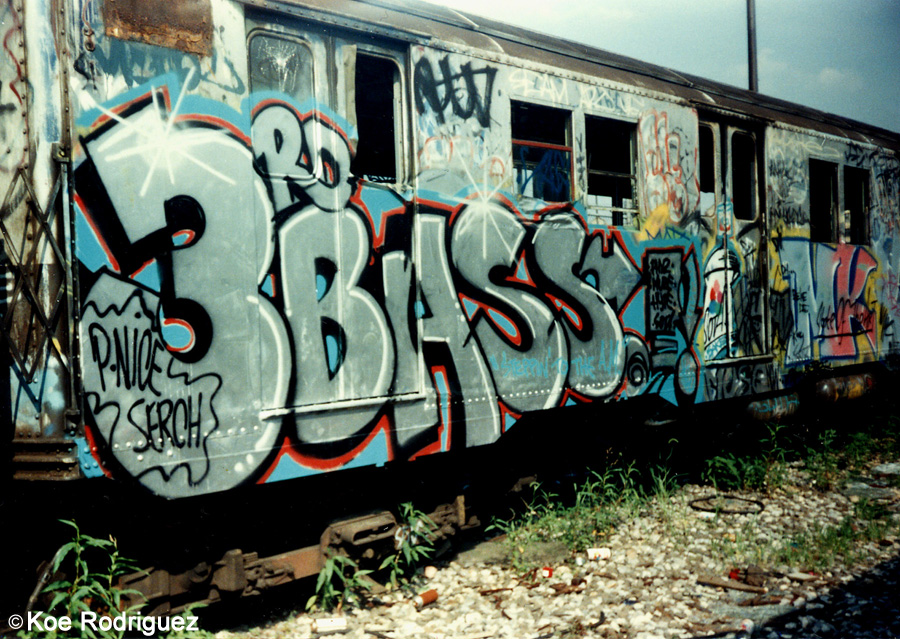
Courtesy of Koe Rodriguez

.

I have known Koe Rodriguez for the longest, but only recently discovered his treasure trove of graff history. I’ll let Koe get into it…

.

How did you first get into graff? Did you write, or have you always been more of an aficionado?

.

I got into Graff during the early 80s because Hip-Hop was in full effect and everybody was goin’ for theirs.  My older cousin and his friends where into it, the media was giving it some exposure and I was personally blown away by it.  I was into drawing at the time, so I gravitated towards the element of Hip-Hop that resonated with me the most.  I started off like everyone else, a young toy, getting’ up with El Marko markers and Wet Look spray paint.

.

By the mid-80s, I began trying my hand at painting.  My name was originally “Coe,” but I later changed it to “Koe” after discovering there was a Coe in the Bronx.  When it came to piecing, I enjoyed rockin’ the letter “K” much better than the letter “C” as well.  As I was actively writing, I began documenting the art as well – this was in 1985 at the age of 15.

.

Being a true Gemini and having that insatiable appetite to absorb knowledge, I was also consuming as much information as I could about Hip-Hop and Graffiti in general.  This went on for many years and by the time I was in my 20 and 30s, cats were calling me a Hip-Hop encyclopedia and later a scholar.  When I was filmed for the movie “Just For Kicks,” they actually gave me that “Hip-Hop Scholar” credit, I never requested it.  I’m a pretty humble cat and rarely ride my own jock.

.

Courtesy of Koe Rodriguez

.

When did you begin collecting materials on graff culture? Where has this path taken you?

.

I began collecting graff related items dating back to the early 80s.  Newspaper clippings came first and then books like Subway Art and Steven Hager’s Hip-Hop came next.  My family was fortunate enough to cop a VCR around 1984 and I began recording anything I could on Hip-Hop culture, especially Graffiti.  ABC (Channel 7) ran a few good specials on Hip-Hop early on like 20/20’s “Rappin’ To The Beat,” “The Big Break Contest,” “New York Hot Tracks” and a made for TV movie called “Dreams Don’t Die” featuring Graff by the late, great Dondi White.  In the late 80s, I would cut my high school classes, jump on a Path Train and head to the original Soho Zat to boost IGT Magazines and Vaughn Bode comics.

.

The 80s were a really special time for consuming all things Hip-Hop.  I remember heading over to comic book hot spot Forbidden Planet to rack comics with my lil’ homie and Vulcan (who was working there) had the drop on us and told us to forget about boosting anything.  It was actually pretty cool (and funny) being busted by a popular graff writer of the time.  Vulcan was cool about the situation and after asking him what would be a good spot to photograph subway burners he put us on to a good spot uptown to bench and catch flicks.  As for the path that collecting and being down with Hip-Hop in general has taken me, its allowed me to have a pretty nice career in Hip-Hop.  Truthfully, I feel blessed to be doing what I’ve always loved doing, and getting paid for it.  Life is a trip.

.

Courtesy of Koe Rodriguez

.

Which piece is the pride of your collection and why?

.

A: Wow – there’s just so many. lol I have vintage Krylon cans for colors that have been discontinued for quite some time.  I have my collection of original graff magazines and books.  I have thousands of graff related photos dating back to the 80s and more importantly, I have all the great memories.  My collection of archives and paraphernalia isn’t exclusive to graff related items.  I’ve collected pretty much anything that deals with Hip-Hop culture in general.  My home office is a serious omage to the culture.  My file cabinet is covered in Hip-Hop related stickers alone – anything from an original “OPP” sticker or Yo MTV trading cards to Hip-Hop apparel hang tags that I customized into magnets.  I have some real conversation pieces.

.

Having observed graff for three decades, what would you say is the most impressive thing about how the culture has developed during this time? What has been the most surprising?

.

Graff culture never ceases to amaze me.  Its essentially gone from a secret society of outlaw artists to an internationally recognized artform with a global contingency.  It went from being eradicated below ground to blowing up something crazy above ground.  I’m always impressed at how Graff’s evolution, be its style or its lifestyle has maintained immense resiliency, cleverness, inventiveness and steady progression.  Graff writers are pop culture’s new rock stars.  Guys like Lee and Cope 2 who were considered outlaws and their works considered urban blight, are global celebrity’s and bankable talent.

.

Graff culture is unstoppable and it’s gonna continue to grow and radiate for many years to come.  With corporations still eager to get in between the sheets with graff artists to promote or sell their products and/or services, more and more writers are seeing a reason to stick to their guns and take their craft to much higher levels.  Hip-Hop is big business and rappers shouldn’t be the only ones prospering from it anymore; not when art is one of the most provocative, respected and lucrative mediums on the planet.

.

Courtesy of Koe Rodriguez

 .

You mention you have pen pal letters! What’s that all about?

.

A: Back in the late 80s, myself and some of my graff friends like: Ket, Cole, Nic 1, Cavs, and John The Greek were communicating with other writers around the globe and engaging in photo trading, which was essentially swapping your graff photos for other writer’s photos – kinda like trading baseball cards.  My foray into photo trading started off around 1987 after reaching out to West Coast graff magazine “Ghetto Art” (which later became “Spray Can Art”) and starting a friendship with the rag’s publishers, Charlie DTK and Tim “Power.”  Charlie, who is now considered a West Coast graff legend, would send me dope graff flicks by him and hot LA writers and I would send him hot graff flicks from New York.  We would always include a letter with all of our flicks to exchange information, gossip or to simply shoot the shit.

.

Sometimes we would even send each other packages containing VHS and audio tapes of graff related stuff like “Style Wars” and Hip-Hop mix shows by Red Alert, Chuck Chillout and Mr. Magic.  This is all pre-Internet and if you wanted to holler at anyone out of town or abroad, you sat down and wrote a letter or you hollered at them on the phone.  Eventually, more cats started getting down with photo trading and the next thing you knew, I was writing cats from New York to Holland…it was crazy! I have a huge folder of all the original letters I ever received from the cats I wrote to dating back to the late 80s.  Looking back, it’s bugged-out how committed we were to our craft.

.

Courtesy of Koe Rodriguez

.

What are your plans for the collection?

.

I recently took a bunch of my Hip-Hop collectibles to the Las Vegas apparel show “Magic.” I consult for the heritage Hip-Hop brand Sedgwick & Cedar and laced our booth with some of my vintage Hip-Hop pieces.  I was instrumental in laying out the booth’s overall flavor and had some of  my prize pieces like an old name buckle, vintage Krylon cans and markers and Cazal glasses in these hot trophy cases.  The booth looked like a Hip-Hop museum and mad heads were drawn to it on the strength of its funky true school flavor.  It worked well with baggin’ sales and it definitely let cats know that there were some real vets in the house.  Some of my graff related collectibles are featured in a book that I began working on with my old shooting partner from Brooklyn, John The Greek.

.

This book features some of our greatest NY Graff flicks from the late 80s to 1993.  The book has a lot of shots of dope subway graff during its twilight on the New York subway system, which is significant in itself.  It also features the “Foto Kingz,” the crew of graff writers who also documented graffiti culture for crazy years.  That crew consisted of Cavs, Ket, Cole, John The Greek, Nic 1, Charlie DTK and later me.  I’m hoping we really get a chance to publish the book as its content is not just culturally and historically significant, but just a hot slice of true Hip-Hop culture.

.

Courtesy of Koe Rodriguez

Categories: 1980s, Art, Graffiti, Photography

DJ Disco Wiz: The $99,000 Question

Posted on June 14, 2010

Flyer courtesy of DJ Disco Wiz

DJ Disco Wiz has been collecting original Hip Hop party flyers dating back to the earliest days in the game. Back in the days, these flyers were made by hand, and their painstaking precision is just one part of their charm. Both an art form unto themselves as well as a part of our culture’s history, these party flyers take us back to a time and a place that is unlike any other.

.

Many of these flyers are now in the collection of the Experience Music Project in Seattle. But don’t worry, if you can’t get across the country that quickly, you can still check them out in the incomparable oral history of Hip Hop’s early years, Yes Yes Y’all by  Jim Fricke and Charlie Ahearn.

.

In conjunction with his June 24 book signing event at Fat Beats, Wiz agreed to chat about his mind blowing collection.

.

Flyer courtesy of DJ Disco Wiz


Please talk about the inspiration to donate your collection of original Hip-Hop flyers to the Experience Music Project.

.

DJ Disco Wiz: I had just started recovering from my first of two bouts with thyroid cancer in 1999, when Grandmaster Caz strongly suggested that I attend an interview session taking place in Harlem moderated by Jim Fricke the senior curator of The Experience Music Project in Seattle.

.

That was the beginning of a series of events that followed, our oral interviews were used as part of the museums opening Hip-Hop Oral History series and later transcribed onto text in Jim Fricke and Charlie Ahearn’s book Yes Yes Y’all. The Experience Music Project Oral History of Hip-Hop’s First Decade.

.

70% of my flyer collection was also used in the book. I made a donation of flyers to the museum on behalf of myself and Caz. The caption reads: “Donated solely for the preservation of Hip-Hop Culture, may no man take away what we created. —DJ Disco Wiz/Luis Cedeño and Grandmaster Caz/Curtis Brown.”

.

How do you feel about having your collection part of a major museum?

.

Honestly it goes beyond words for me, the preservation aspect happened for me because of personal health reasons and the sheer notion of not knowing how many tomorrows were left..

.

The feeling of wanting to leave something behind for future generations is overwhelming and transcending. I am thankful and fortunate to have my archives in a respected institution.

.

Back in the days—before InDesign and Photoshop and Kinkos—flyers were a handmade artform. Please talk about what it took to make these pieces, and what it was like to receive them?

.

This was the beginning of an unforeseen unstoppable movement/culture and it was not televised. It was “each one teach one, each one reach one” it was definitely a process for sure…

.

In the early days most flyers were simply hand written with a marker then it evolved with the use of stencils and elaborate tags/throw ups by legendary graffiti artist, along with common phases of the times. One of my favorites were Afrika Bambaataa’s flyers which used the phase “Come in Peace.”

.

How did you and Grandmaster Caz come together to design the flyers for your events?

.

Creation of our event flyers was Caz’s thing 100%. I pretty much just co-signed them as we went along…

.

Why did you decide to collect the flyers for the parties that were happening back in the days?

.

That’s the $99,000.00 question! I really don’t know why? and honestly don’t care to know I’m just so glad and thank God everyday that I did…

.

I do remember coming home in February of 1982 after being away for more than four years. Hip-Hop was then hitting the radio airwaves and making its maiden voyage around the globe. I opened a box containing 100s of my flyers from the 70’s… It was absolutely magical  to say the least…

.

Are there any flyers you collect today?

.

Yes! of course, am not a hoarder.. but I do love to collect—flyers, banners, event ticket stubs, etc, because as history has clearly taught us… you’ll never know.

.


.

Don’t Miss This!
Thursday, June 24 at 7pm
DJ Disco Wiz at Fat Beats, New York
Signing Copies of His Autobiography
IT’S JUST BEGUN

Categories: 1970s, 1980s, Art, Books, Bronx, Music, Photography

Janette Beckman: “When I First Arrived in NYC in 1982, Hip Hop was New and Fresh”

Posted on May 19, 2010

Grandmixer DST, Photograph © Janette Beckman

Janette Beckman and I were invited to appear on WFMU’s “Coffee Break for Heroes and Villains with Noah” on Tuesday, June 1 from 9am–noon, to discuss the art of Hip Hop photography. I first met Janette back when we were working on Made in the UK: The Music of Attitude, 1977–1983, a retrospective of her career documenting the Punk, Mod, Skinhead, 2 Tone, and Rockabilly culture in the UK.

.

It was during that time that Janette showed me a copy of her first book, Rap, with Bill Adler, showcasing her work from the burgeoning Hip Hop scene during the 1980s. Needless to say, I fell off my chair when I caught a glimpse of her photographs, many of which have become icons unto themselves. From this, inspiration was born, and Janette published her third book, The Breaks: Stylin’ and Profilin’ 1982–1990, which she kindly allowed me to subtitle after her original subtitle, Kickin It Old School, appeared as the name of a corny Jamie Kennedy movie coming out at the same time.

.

Janette has photographed the likes of… EVERYONE. Check out this list, it is legendary: Afrika Bambaataa, GrandMaster Flash and the Furious Five, the Fearless Four, the World Famous Supreme Team, Lovebug Starski, Salt’n’Pepa, Run-DMC, Stetsasonic, UTFO, Roxanne Shante, Sweet T, Jazzy Joyce, Slick Rick, Boogie Down Productions, Eric B. and Rakim, EPMD, NWA, Ice-T, 2 Live Crew, Tone Loc, Gang Starr, Ultramagnetic MCs, Rob Base and DJ EZ Rock, Special Ed, Leaders of the New School, Jungle Brothers, Beastie Boys, Rick Rubin—and more! Hell, honey, even shot Jomanda! That’s for real. Got a love for you. You know, I just had to do this interview…

.


How did you get into shooting Hip Hop?

.

Janette Beckman: I was working for a British music magazine called Melody Maker when I saw my first Hip Hop show back in 1982 in London. The show featured Afrika Bambaata, Grandmixer DST, Futura 2000, Dondi White, breakdancers, and double dutch girls.  It was absolutely mind blowing—we had never seen anything like it—and it seemed to me to be the new Renaissance in music, art, fashion and dance.

.

FUTURA and DONDI, Photograph © Janette Beckman

Being from the UK punk scene what did you make of it?

.

JB: The punk scene in London had reached it’s peak and I think everyone was looking for the next new thing. Hip Hop was much like the UK punk scene when it first started: so creative, groundbreaking, and in many ways both movements came from the streets—art and music created by “working class” kids who were inventing new things never seen before.

.

What was Hip Hop like back in the days, when artists were first getting record deals, but still didn’t have the marketing machine behind them?

.

JB: When I first arrived in NYC in 1982, Hip Hop was new and fresh. It seemed to me as an outsider coming from UK that the artists were free to do what they wanted, the music came from the streets and really told stories of what was happening in peoples lives, from the political like “The Message” and Public Enemy, to the raps about love, girls, sex, sneakers.

.

Anything seemed possible and the small record companies were much more interested allowing the artists to have creative freedom from the way they dressed to the beats and the raps. There was an amazing creative energy—riding on the train hearing some kid rhyming, seeing girls wearing the first giant hoop earrings, the fake LV outfits, the new way to lace your sneakers, the graffiti. Of course this was before MTV, stylists, the Internet started to dictate the way you were supposed to look.

.


Looking through The Breaks, I am totally blown away. You shot some of the photos that have long been burned into my brain. What was your favorite shoot, and why?

.

JB: My favorite shoot was for the British magazine The Face. They asked me to photograph the emerging Hip Hop scene and sent me out to Queens on a warm summer day in 1984 to photograph a group called Run-DMC. I took the subway to Hollis where Jam Master Jay met me at the station and walked me to the leafy block where they were hanging out with some friends. I just took out my camera and started shooting. The photo of Run DMC and posse is one of my favorites because it is such a moment in time. Totally unposed.

.

Photograph © Janette Beckman

Please talk about your Ladies of Hip Hop shoot for Paper, as that photo is a classic!

.

JB: I had been working for Paper magazine since their first issue. They told me they were gong to get the Ladies of Hip Hop together for a shoot. I think it was in a Mexican restaurant on West Broadway. The ladies started to arrive and the boys were told they had to leave. Ladies only this time. What an amazing group—all getting along so well and having fun—and Millie Jackson was there, the “Godmother” of it all.

.

Eazy-E, Photograph © Janette Beckman

Please talk about shooting Eazy E, as I find this photo so touching. No profiling, no posing, no gangsterism in Eric. I love it…

.

JB: I was working on the final shots for my first book and had traveled to LA to shoot the important West Coast scene. NWA were recording their new album in a studio in Torrance and had agreed to have me shoot them. There was an alley at the side of the studio and I asked the group to pose for me. I only took a couple of shots of each of them.

.

We were talking about the recording. They liked my British accent and asked if I would be up for reading some lyrics on their album (it turned out to be lyrics about how to give the perfect blow job, which I thought maybe would not be right for my debut in the recording industry).

.

What do you think about the way Hip Hop has changed—as an economic force, a global culture, an art form, and a way of life for so many people of all ages?

.

JB: Hip Hop has really changed the world. I love the idea that people are rhyming in Africa, India, France in every language. What some people thought was a fad is a now, thirty years later, a worldwide phenomena used for advertising, soundtracks, TV, billboards. Artists like M.I.A, Ben Watt, and Santogold are mixing Hip Hop with their own beats and making some thing completey new—much like Hip Hop artists took disco and R&B beats and made them their own. And still kids on the street
around the world are keeping Hip Hop real.

.

.

www.janettebeckman.com
Don’t Stop! Get It! Get It!

Categories: 1980s, Art, Books, Bronx, Brooklyn, Fashion, Manhattan, Music, Photography

Jamel Shabazz: “Everything You Do Today Will Reflect on Your Future.”

Posted on May 1, 2010

The Art of War, 1980, Photograph © Jamel Shabazz

.

On a slow, sunny summer day during 2000, while working at powerHouse Books, there was a knock on the door. I jumped up to open it. A tall and stylish man stood before me, graciously introducing himself as Jamel Shabazz.

.

As Jamel recalled for this interview, “I decided that it was time to move forward and produce my first monograph, so I found the address to powerHouse Books and took a chance. Once I arrived, I remember standing outside the hallway to the office for a few minutes, going over my strategy, one final time. I then took a deep breath and knocked on the door. My world would never be the same. Once in, I introduced myself to the vibrant, Miss Sara Rosen, who greeted me with a million dollar smile, she then referred to Craig Cohen, Associate Publisher, whose disposition was warm and genuine.”

.

Although Jamel did not have an appointment to meet with us, when he showed us a catalogue from an exhibition of his work in Paris, Craig and I nearly fell over from excitement. We had never seen anything like his work before—bold portraits of people on the streets of New York City during the 1980s revealing the original style and fierce pride as hip hop first made its way into the culture. I remembered my childhood in the Bronx; Craig recalled that of his in Brooklyn; and we both decided to publish Jamel Shabazz’s first book, Back in the Days, the following year.

.

Nearly ten years have passed since that fateful day, and powerHouse published additional books by Jamel Shabazz including The Last Sunday in June, a ten-year retrospective of New York’s Gay Pride Parade, Seconds of My Life, a thirty-year career retrospective, and my personal favorite: A Time Before Crack, which revisits Jamel’s archive and reaches new depth and understanding of street culture with a collection of images which span 1975–1985. I am honored to have helped introduce Jamel and his work to the world, and humbled by the outpouring of love and admiration his photographs have inspired. I thank him for giving me the opportunity to speak with him about his work. Enjoy the interview!

.

Best Friends, Photograph © Jamel Shabazz

.

I developed a theory a long time ago about why your work inspires so much love among people who see it. I believe every photographer is “in” their photographs just as much as their subject is. For example, when you see a cold photograph, you also see a cold photographer. I always thought what was amazing about your photographs was that you had first spoken and connected with the people in the photos by engaging them in conversations about pride, self-love, respect, and self-empowerment. And after your conversations, you had taken their photos. So when they looked into your camera, they radiated back to you the positive energy with which you imbued them. And that we, as viewers, look at these people looking at us with so much love, pride, respect—power—that we get a jolt. It is as if what you said to the people in these photographs is now being then transferred to us, the viewers.

.

So that’s a long theory yes, but it is the only way I can understand how people react so strongly to these photographs. Believe you me, I have seen a lot of people look at a lot of photos but never have I seen the reaction your photos get. And I don’t think it’s because of the shoes, or the glasses, or the coats. I think it is because there is something about Jamel that is coming back through these photographs, and we feel it when we look at it. But I wanted to ask you: why do you think people have had the reaction to the work?

.

Jamel Shabazz: Your observation is 100% right on. Before each photograph, I took the time to engage most of my subjects about life and making the right choices, in order to survive. I did this because when I was younger, the older guys, in my community did it to me, so it was ingrained in me as a young child to give back, and I vowed that I would reach out to the youth in my community at all cost. They respected me because I wasn’t afraid of them, and I took an interest in their lives. It was beyond the photograph—I help many make career choices; I spoke to them about diet, education, and  how  to select the right mate.

.

Each image that you see in my book is a visual record, of the countless encounters that I had with young people. I did it out of love and concern. I saw  the crack epidemic making it’s way to my community and I wanted to avert as many as I could away from its destruction. So when you study the faces of those in my book, you are seeing faces of young men, women and children, who I just finished bonding with, young people who I told were special and were our future.

.

Often times I would departed them with the words, “Everything you do today will reflect on your future.”

.

Fly Guy, Photograph © Jamel Shabazz

.

When you began work on A Time Before Crack, you were adamant that this book not through of as Back in the Days Part II. Please elaborate.

.

Jamel Shabazz: The book was originally called Strictly Old School and I decided to change not only the name, but the images. With the success of Back in the Days, I felt at first that a continuation would be a good ideal, however I didn’t want to be pigeon-holed as a fashion photographer, so I came up with a title that reflected a social condition rather than trying to make a fashion statement.

.

To make the book different from my first, I used photographs that I took in the mid-70’s and that alone separated it from Back in the Days. In addition I included more group shots, women, children, and families. Using the collage in the front and back gave it a little more edge and allowed me to have over a thousand faces in this work.

.

I enlisted four writers (Claude Gruntizky, Charlie Ahearn, James “Koe” Rodriguez, and Terrence Jennings) to give commentary of their choice, each one from a different racial back ground, African, White, Latin, and African American.

.

A Time Before Crack is about a people who lived in a time before crack cocaine destroyed communities, and ruined lives. This book books serves as visual medicine for those that were affected by the epidemic.

.

Homeboys, 1980, Photograph © Jamel Shabazz

.

You have been labeled a “Hip-Hop fashion photographer,” but you would prefer to be recognized as a street and documentary photographer. Please explain why.

.

Jamel Shabazz: I have been called a Hip-Hop photographer on countless occasions and those that see me that way really don’t understand my history or work. Yes, I have shot Hip-Hop fashion for magazines but that only represents such a small body of my work. I started taking photographs, when the term “Hip Hop” wasn’t even in the dictionary. To accept this label would limit my creativity.

.

Photo documentarian is the proper term for my work. It’s broader and has greater leverage. For thirty years have traveled travel both far and near and document varies people and cultures. I have shot homelessness, prostitution, military culture, the law enforcement community ,the horror of 911, and so much more. I look forward to the day, when I can share that part of my work. Every chance I get, I make it a point to display images that reflect that side of my craft.

.

The international success of hip hop has allowed me to share it’s platform. I am very grateful for that and I will continue to incorporate it in all I do—but there is so many other things that needs to be recorded as well. For example, I have a desire to go to Vietnam and document the children of American service men that were left behind over thirty years ago. No one really knows that side of me.

.

East Flatbush, Brooklyn, 1980, Photograph © Jamel Shabazz

.

What do you hope the publication of these photographs, taken over 20 years ago, will do for the people and the culture today?

.

Jamel Shabazz: My objective with A Time Before Crack is to create conversation about how  life was before the great crack and AIDS plagues of the 1980s—when women were treated with respect,  when the majority of us had two-parent house holds.

.

Crack cocaine snatched the lives of so many innocent souls. Thousands of young men and women have had their lives ruined by drugs, and many linger in prisons through out America today due to them.

.

I have heard on numerous occasions how people broke down and cried while looking at my photographs, remembering a better time.

.

My goal is to make being positive and caring popular again.

.

Tupac, 1998, Photograph © Jamel Shabazz

www.jamelshabazz.com

Categories: 1970s, 1980s, Art, Books, Photography


Categories

Archives

Top Posts

  • Home
  • About
  • Marketing
  • Blog
  • Azucar! The Life of Celia Cruz Comes to Netflix in an Epic Series
  • Eli Reed: The Formative Years
  • Bill Ray: Watts 1966
  • Jonas Mekas: I Seem to Live: The New York Diaries 1950-1969, Volume 1
  • Mark Rothko: The Color Field Paintings
  • Imprint

Return to top

© Copyright 2004–2025

Duet Theme by The Theme Foundry