

Photograph © Ellen Jong
.
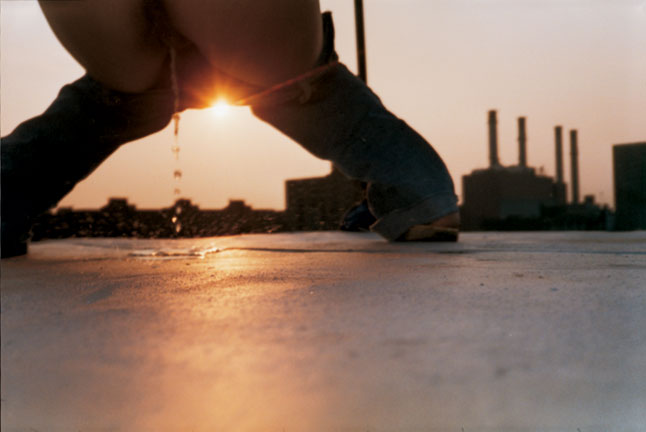
I’ve always had bit of penis envy, but only when it comes to peeing in public. I’ve admired how men could just whip it out and go with no hassle—unlike us ladies who have to find somewhere discreet to pee, and make sure we don’t splash our shoes. So, needless to say, when I met Ellen Jong, who has been taking self-portraits for the past ten years while pissing wherever the damn well hell she wants, I was fully in awe. Jong has shamelessly leveled the playing field, proving women can do anything guys can do—and not ruin their shoes.
.
Miss Rosen: What is your favorite part of taking photos of yourself peeing in public?
.
Ellen Jong: What is the most incredible is that these photos bring a smile to everyone’s face because everyone’s got their own story, both men and women. The smile seems not to be a response to my photos but a smile at themselves while remembering their own stories, which always makes me so happy. Peeing is harmless. There are some things that you just can’t take too seriously about yourself.
.
MR: I’ve noticed a range of reactions to the pictures, all of which are very strong. It’s not exactly a subject that goes unnoticed. As the photographer and subject, how do you feel about exposing yourself—to people’s opinions be it positive or negative?
.
EJ: I take many of the responses very personally. While creating the book, I was on the verge of insanity grasping on to the little bit of self I could hold onto. I’ve exposed myself a great deal and pushed even more to reveal what is in the book’s text. It’s difficult to remain distant from criticism when I feel so vulnerable. But, I prefer to hear all the reactions, good and bad. I can’t get the taste of sweet without the bitter.
.
MR: My mother got a little uptight when I told her about the book, and my 91-year-old grandfather was in shock. And I’m just the publisher! How does your family feel about your work?
.
EJ: My mom and dad are my biggest fans. Though my parents were always really worried about me, when these photos became an expressive body of work and an identifiable thing that I can own, my parents could do nothing but support me. During my first show at Vice, we got shut down by the police because we’d blocked traffic on the street. There were people everywhere. I can even remember a drum circle. It was a crazy party. My parents sat at the window of a nearby restaurant the entire time, watching the mayhem with smiles on their faces. My boyfriend at the time got arrested that night for failure to control the crowd and my mom giggled.
.
Photograph © Ellen Jong
.
MR: Speaking of arrests, I understand you have quite a story.
.
EJ: While I was living in Miami, I came up to New York for a photo shoot in Times Square. While location scouting, I came across a storefront with red, white, and blue neon verticals in the window. It was 9:00 p.m. on a weekday and there was sidewalk traffic but I figured I’d seen way more crazy things on the street than someone taking a pee, especially in the Times Square area. I propped the camera on the sidewalk and set the self-timer while unbuttoning my pants. I ran to position and peed so fast that by the time I picked up the camera, I was dry and buttoned up. Then a pair of cops came out of nowhere with jaws dropped, asking, “Did you just do what we think you did?”
.
I couldn’t tell if they were more shocked from witnessing the actual urination or by my blatancy. Or were they shocked to see me, a face of innocence, behaving so provocatively? I explained my work while talking into the eyes of the female cop, telling her that my photos are not meant to be offensive: “I pee in cityscapes as if in nature, like we were once able to do as children…” I don’t remember exactly what I said, but she was willing to let me go. But then her supervisor rolled by and told her to write me up. Instead of giving me a ticket, she gave me a summons thinking she was giving me a break.
.
A couple of years later, after I had moved to New York, I was at a summer festival at the East River Park with an open bottle of tequila. The cops came up, took my license, and discovered I had a warrant for arrest because I had ignored the summons. They handcuffed me and escorted me a patrol car. Mind you, it was summer. I was wearing a mini skirt, a tank top (no bra), and flip-flops. I must have looked 12 if not younger. And, since the offense doesn’t come up in their system, they were expecting the worst. Did they think I was dangerous?
.
I went thru the system; I sat in the cell at the police station while waiting for my identity verification to get back from Albany. It hit midnight and I was taken to Central Booking for another round of fingerprints, mug shots, and paperwork, with all the other men and women arrested that evening. They finally took off the handcuffs and put me into a cell with four other chicks sleeping on floor mats. I took a bench.
.
The first thing in the morning, I was given a lawyer—she was awesome. When I told her that I was arrested for public urination, she shut her folder and said, “Well no woman should be arrested for that,” then disappeared into the courtroom. When we got in front of the judge, I was surprised to find that no one recognized the offense code. Once revealed there was a chuckle amongst them; even the judge laughed. I had to swear to behave for the next six months. Then my lawyer said I was free to go and directed me to the wooden gate held shut by a small hook latch. I just walked out. I can still hear the giggling in the courtroom. It has been six months and my record should now be cleared.
.

Photograph © Ellen Jong
.
MR: It’s a little shocking to think this is how our law enforcement system works.
.
EJ: It’s easy to forget that peeing in public is illegal since it’s something everyone does; when you gotta go, you just gotta go. I might’ve taken it a little far considering some of the places I’ve peed (the phone booth is pretty crass). But I hope the combination of those crass moments and the serenity of the landscapes in nature create a bigger picture. I express my wild and quiet contemplative sides through these pictures. They’re my insides pouring itself onto film.
.


