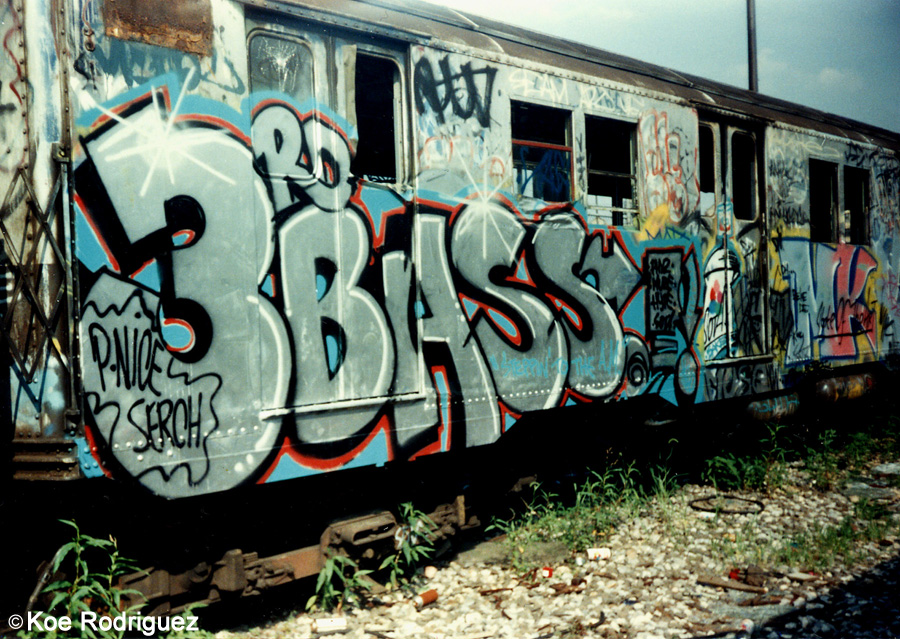
I have known Koe Rodriguez for the longest, but only recently discovered his treasure trove of graff history. I’ll let Koe get into it…
.
How did you first get into graff? Did you write, or have you always been more of an aficionado?
.
I got into Graff during the early 80s because Hip-Hop was in full effect and everybody was goin’ for theirs. My older cousin and his friends where into it, the media was giving it some exposure and I was personally blown away by it. I was into drawing at the time, so I gravitated towards the element of Hip-Hop that resonated with me the most. I started off like everyone else, a young toy, getting’ up with El Marko markers and Wet Look spray paint.
.
By the mid-80s, I began trying my hand at painting. My name was originally “Coe,” but I later changed it to “Koe” after discovering there was a Coe in the Bronx. When it came to piecing, I enjoyed rockin’ the letter “K” much better than the letter “C” as well. As I was actively writing, I began documenting the art as well – this was in 1985 at the age of 15.
.
Being a true Gemini and having that insatiable appetite to absorb knowledge, I was also consuming as much information as I could about Hip-Hop and Graffiti in general. This went on for many years and by the time I was in my 20 and 30s, cats were calling me a Hip-Hop encyclopedia and later a scholar. When I was filmed for the movie “Just For Kicks,” they actually gave me that “Hip-Hop Scholar” credit, I never requested it. I’m a pretty humble cat and rarely ride my own jock.
.
Courtesy of Koe Rodriguez
.
When did you begin collecting materials on graff culture? Where has this path taken you?
.
I began collecting graff related items dating back to the early 80s. Newspaper clippings came first and then books like Subway Art and Steven Hager’s Hip-Hop came next. My family was fortunate enough to cop a VCR around 1984 and I began recording anything I could on Hip-Hop culture, especially Graffiti. ABC (Channel 7) ran a few good specials on Hip-Hop early on like 20/20’s “Rappin’ To The Beat,” “The Big Break Contest,” “New York Hot Tracks” and a made for TV movie called “Dreams Don’t Die” featuring Graff by the late, great Dondi White. In the late 80s, I would cut my high school classes, jump on a Path Train and head to the original Soho Zat to boost IGT Magazines and Vaughn Bode comics.
.
The 80s were a really special time for consuming all things Hip-Hop. I remember heading over to comic book hot spot Forbidden Planet to rack comics with my lil’ homie and Vulcan (who was working there) had the drop on us and told us to forget about boosting anything. It was actually pretty cool (and funny) being busted by a popular graff writer of the time. Vulcan was cool about the situation and after asking him what would be a good spot to photograph subway burners he put us on to a good spot uptown to bench and catch flicks. As for the path that collecting and being down with Hip-Hop in general has taken me, its allowed me to have a pretty nice career in Hip-Hop. Truthfully, I feel blessed to be doing what I’ve always loved doing, and getting paid for it. Life is a trip.
.
Courtesy of Koe Rodriguez
.
Which piece is the pride of your collection and why?
.
A: Wow – there’s just so many. lol I have vintage Krylon cans for colors that have been discontinued for quite some time. I have my collection of original graff magazines and books. I have thousands of graff related photos dating back to the 80s and more importantly, I have all the great memories. My collection of archives and paraphernalia isn’t exclusive to graff related items. I’ve collected pretty much anything that deals with Hip-Hop culture in general. My home office is a serious omage to the culture. My file cabinet is covered in Hip-Hop related stickers alone – anything from an original “OPP” sticker or Yo MTV trading cards to Hip-Hop apparel hang tags that I customized into magnets. I have some real conversation pieces.
.
Having observed graff for three decades, what would you say is the most impressive thing about how the culture has developed during this time? What has been the most surprising?
.
Graff culture never ceases to amaze me. Its essentially gone from a secret society of outlaw artists to an internationally recognized artform with a global contingency. It went from being eradicated below ground to blowing up something crazy above ground. I’m always impressed at how Graff’s evolution, be its style or its lifestyle has maintained immense resiliency, cleverness, inventiveness and steady progression. Graff writers are pop culture’s new rock stars. Guys like Lee and Cope 2 who were considered outlaws and their works considered urban blight, are global celebrity’s and bankable talent.
.
Graff culture is unstoppable and it’s gonna continue to grow and radiate for many years to come. With corporations still eager to get in between the sheets with graff artists to promote or sell their products and/or services, more and more writers are seeing a reason to stick to their guns and take their craft to much higher levels. Hip-Hop is big business and rappers shouldn’t be the only ones prospering from it anymore; not when art is one of the most provocative, respected and lucrative mediums on the planet.
.
Courtesy of Koe Rodriguez
.
You mention you have pen pal letters! What’s that all about?
.
A: Back in the late 80s, myself and some of my graff friends like: Ket, Cole, Nic 1, Cavs, and John The Greek were communicating with other writers around the globe and engaging in photo trading, which was essentially swapping your graff photos for other writer’s photos – kinda like trading baseball cards. My foray into photo trading started off around 1987 after reaching out to West Coast graff magazine “Ghetto Art” (which later became “Spray Can Art”) and starting a friendship with the rag’s publishers, Charlie DTK and Tim “Power.” Charlie, who is now considered a West Coast graff legend, would send me dope graff flicks by him and hot LA writers and I would send him hot graff flicks from New York. We would always include a letter with all of our flicks to exchange information, gossip or to simply shoot the shit.
.
Sometimes we would even send each other packages containing VHS and audio tapes of graff related stuff like “Style Wars” and Hip-Hop mix shows by Red Alert, Chuck Chillout and Mr. Magic. This is all pre-Internet and if you wanted to holler at anyone out of town or abroad, you sat down and wrote a letter or you hollered at them on the phone. Eventually, more cats started getting down with photo trading and the next thing you knew, I was writing cats from New York to Holland…it was crazy! I have a huge folder of all the original letters I ever received from the cats I wrote to dating back to the late 80s. Looking back, it’s bugged-out how committed we were to our craft.
.
Courtesy of Koe Rodriguez
.
What are your plans for the collection?
.
I recently took a bunch of my Hip-Hop collectibles to the Las Vegas apparel show “Magic.” I consult for the heritage Hip-Hop brand Sedgwick & Cedar and laced our booth with some of my vintage Hip-Hop pieces. I was instrumental in laying out the booth’s overall flavor and had some of my prize pieces like an old name buckle, vintage Krylon cans and markers and Cazal glasses in these hot trophy cases. The booth looked like a Hip-Hop museum and mad heads were drawn to it on the strength of its funky true school flavor. It worked well with baggin’ sales and it definitely let cats know that there were some real vets in the house. Some of my graff related collectibles are featured in a book that I began working on with my old shooting partner from Brooklyn, John The Greek.
.
This book features some of our greatest NY Graff flicks from the late 80s to 1993. The book has a lot of shots of dope subway graff during its twilight on the New York subway system, which is significant in itself. It also features the “Foto Kingz,” the crew of graff writers who also documented graffiti culture for crazy years. That crew consisted of Cavs, Ket, Cole, John The Greek, Nic 1, Charlie DTK and later me. I’m hoping we really get a chance to publish the book as its content is not just culturally and historically significant, but just a hot slice of true Hip-Hop culture.
Eric Firestone Gallery, East Hampton
August 14–September 26, 2010
.
Martha Cooper is a documentary photographer born in the 1940s in Baltimore, Maryland. She began photographing in nursery school after her father gave her a camera. She graduated from high school at the age of 16, and from Grinnell College with a degree in art at age 19. From 1963-65, she taught English as a Peace Corps volunteer in Thailand and then journeyed by motorcycle from Bangkok to England where she received an ethnology diploma from Oxford. She was a photography intern at National Geographic Magazine in the 1960s, and worked as a staff photographer for the Narragansett Times in Rhode Island and at the New York Post in the 1940s.
.
Martha is perhaps best known for documenting the New York graffiti scene of the late 1970s and early 80s. While working for the New York Post she began taking photos of creative play on the Lower Eastside in order to use up the remaining film in her camera each day before developing it. One day she met a young boy named Edwin who showed her his drawings and explained that he was practicing to write his nickname on walls. Edwin offered to introduce her to a graffiti king. This is how she met the great stylemaster, Dondi, who eventually allowed her to photograph him in the yards at night while he was painting. In 1984, with Henry Chalfant, she published Subway Art, a landmark photo book that subsequently spread graffiti art around the world.
.
In addition to publishing more than a dozen books, Martha’s photographs have appeared in innumerable magazines including National Geographic, Smithsonian and Vibe. She is the Director of Photography at City Lore, the New York Center for Urban Folk Culture. She still lives in Manhattan but is currently working on a photo project in Sowebo, a Southwest Baltimore neighborhood.
.
Cooper will be exhibiting four silver gelatin prints from her early b-boy documentary work in “Down by Law” at the Eric Firestone Gallery, East Hampton, opening on August 14, 2010. She has graciously agreed to speak about her work here.
New York in the 1970s and 1980s was a city bursting with originality, innovation, and experimentation. Please talk about how you see the relationship between your early work as a photographer and the environment in which it took hold.
.
I’ve long been drawn to anything made by hand perhaps because my parents always encouraged creative play. In 1977 I began working as a staff photographer for the New York Post and the job required that we cruise around the city all day in our cars with two-way radio contact to the news desk in case there was a breaking assignment. When not on assignment we were supposed to look for feature “weather” photos. My favorite neighborhood for photos was Alphabet City on the Lower Eastside where I could almost always find kids making something from nothing.
.
It has recently been suggested to me that the term “graffiti” is marginalizing, and loaded with negative connotations. How do you feel about the use of the word in general, as well as application to your work?
.
Writers probably enjoy being associated with “negative connotations”. Being bad can be cool. Of course the term graffiti has been around much longer than markers and spray paint. In NYC, it’s most fitting for tags but less appropriate for sophisticated spray painted walls. Words and their connotations change over time. Just let me know what you want me to call it and I’ll be happy to oblige. If you prefer the term aerosol art, I’ll go with that stilted though it may be.
.
As a working photographer over the past three decades, you have seen first hand how the art world—from galleries and dealers to museums and collectors—responds and reacts to contemporary American art. What are your thoughts on the differences (and similarities, if applicable) between the US, European, and Asian markets?
.
As a documentary photographer I’ve always been more interested in publishing my photos in books and magazines than showing them in galleries. I never paid much attention to the art market until very recently. Collectors in Europe and Japan seem more eager to collect “graffiti” (should I say aerosol?) related work. I’m just happy that people anywhere enjoy looking at my pictures.
.
Who are your artistic inspirations, and how have they influenced your ideas, aesthetics, and actions through the course of your career?
.
My dad was an amateur photographer and he used to take me on “camera runs” with the Baltimore Camera Club so my first experience with photography was just going out looking for pictures and that’s still my approach today…
.
I’m from a generation of street photographers who never studied photography. I grew up seeing photojournalism magazines like Look and Life and National Geographic and wanted to become a professional photographer so that I could travel the world. I was always more interested in thinking about what I wanted to photograph than how I was going to shoot it. It was never my intention to make art.
.
For “Down by Law” you will be exhibiting your silver gelatin prints of Rock Steady Crew members Frosty Freeze, Ken Swift, Crazy Legs, and Doze Green . Please talk about your work documenting the b-boy movement, and the way in which these photographs—in particular that of Frosty—have become historic markers of the culture.
.
I first encountered b-boys by chance in 1980 in Washington Heights and was so impressed that I contacted Sally Banes, a dance writer, to help me document them. It took us a year before we had enough material to publish a story. We asked Henry Chalfant to help us find dancers. He was organizing an event with graffiti, rapping and DJing and thought dance would be a great addition. Through his graffiti contacts, we met Crazy Legs.
.
The resulting story in the Village Voice in April 1981 with Frosty Freeze on the cover introduced breaking and Rock Steady to the world. Because NYC is a media town, magazines and film crews quickly covered the “new” dance. Henry filmed them for his movie Style Wars as did Charlie Ahearn for Wild Style. The words “Hip Hop” were not in general use at the time but as people became more aware of the culture, breaking was included as an integral part and the Rock Steady Crew became worldwide celebrities. As far as I know my photos are the earliest documentation of b-boying.
.
There has been a wide array of artists to emerge from the early graffiti and Hip-Hop movement. How have your earlier experiences documenting b-boys, young writers in the yards, and trains running along the lines influenced you ideas about art, and in what direction would you like to go?
.
I don’t think a lot about art. Still photography is a wonderful way to document. In a fraction of a second the camera can capture and preserve a million details. I’m interested in using photography for historic preservation. I want people to look at my photos and get a sense of what life was like at a specific time and place.
.
I’ve seen New York City change radically over the past 30 years and my photos are appreciated because they are a record of a different time. For the past 4 1/2 years I’ve been documenting a difficult neighborhood in Baltimore with a vibrant street life. My hope is that in thirty years these photos will similarly be enjoyed.
There’s so much I could say about Anton Perich, but it’s altogether too much for me to try to put it into words. I’ll leave it to the incomparable Mr. Perich to do this better than I ever could.
.
Your life history is fascinating! Please talk about your work running an underground film program in Paris in the late 1960s.
.
AP: Thank you. I was making some super 8 movies then. All lost now, except one, “Le retour d’ Eurydice”, in which I was starring. Raphael Bassan directed it. An early French underground film, recently screened at Beaubourg. This was 16mm production, and well preserved.
.
Anyway, there was this wonderful villa with gardens on Boulevard Raspail, just a few short blocks from La Coupolle. It was housing the old American Center, a complex of art studios and various music and theater activities. Later they tore it down to put the Carier skyscraper. I saw there many international productions and created a few. But one thing was missing, underground films. So I proposed to show films there one night weekly, in a small studio in the basement, and sometimes in the gardens, on the grass. It was a success. I was making films and my friends were making films and there was no place to show them regularly in Paris.
.
Of course, we were all spoiled by La Cinematheque, spending days there watching classics and contemporary films. But there was no room there for our “little short marginal works”. And of course, revolutions are always made by the marginals.
.
In the Sixties, the New York Underground cinema were well defined by Warhol, Mekas, Jack Smith, Brackage and others. A whole different scenario was happening in Paris. There was Godard and his gods reigning on the Parnassus, making a wonderful narrative movies, not much questioning Cinema itself. There was also Garell, Clemanti, And there was Etienne O’Leary and Michel Auder. The great Michel Auder, who questioned everything. In 1970 he abandoned film totally and converted to video. I screened his films there the very first night, and often afterwards. He supplied the projector that he somehow inherited from the French Army, I guess he knew de Gaulle, or was his nephew. Another great French underground filmmaker was Raphael Bassan. But the real revolution in Paris film world were maid in the Fifties by the last great god of the avant-garde, Isidore Isou and his prophet Maurice Lemaitre. In the early Fifties they made movies with the found footage, various acids and paints. They made the cinema discrepant, totally separating the sound track from the visual content, as if telling two different stories in the same time. Of course, most of the audience walked out. No one ever did it before. Debord took it all from them. Debord was Lettrist before he became Situationist.
.
Anyway, I screened some of those films too.
.
I was associated with Lettristes from 1967 to 1970. I worked with Lemaitre and Isou, painting, writing poetry, shooting films, doing the shows. Lettrism was my school. I was educated by the two greatest artists and thinkers of that time. Of course Isou predicted the 1968 revolution and went mad. We did some performances at L’Odeon, it was occupied, Non-stop 24 hours spectacle. I spent few nights there.
.
I think that the Revolution of 68, the Paris Spring is grossly misunderstood today. It was not the flesh and blood revolution, no guillotines. It was the revolution of spirit, of the young, so unique in the history of revolutions. It paved the way for other bloodless revolution in the Eastern Europe. Imagine, the Communism died the bloodless death. Tell it to Stalin, or Lenin.
.
I lived my own revolution there. I became something else at 23. It is difficult to transform oneself, only fantasy and revolution will do it. And spirit. And resurrection. And the fire in Paris streets. And “sous les paves la plage”. The greatest slogan ever written.
.
To get back to films, I did show some Warhol films, and Mekas.
.
The legendary Pierro Heliczer came from New York and introduced his films. Taka IImura came there with his films as well, and many other underground filmmakers, French and international.
Why did you decide to come to New York in the 1970s? What was the city like back then, particularly for artists and radicals?
.
AP: I came to New York in 1970. At that time I was interested in many things that were coming from New York. Underground films. Pop Art. Experimental theater. Warhol’s Factory. Jonas Mekas. Julian Beck. John Cage. John Chamberlain. Minimal Art. Earth Works. All of that new, foreign to the Europeans, miraculous and fascinating. It was all so American. Paris didn’t have any of that. It had a vacuum and suffocating atmosphere. They were mourning the revolution of 68 instead celebrating it.
.
In NY it was all celebration, non stop celebration of the young, creative and the free. Woodstock was a celebration. Max’s Kansas City was celebration. Punk was celebration, music, fashion and attitude. NY Dolls was celebration. Transvestites were celebration. Taylor Mead was celebration, Warhol, Factory, Candy Darling, Jackie Curtis, Wayne County, Andrea Feldman, John Waters, John Chamberlain, John Cage. Lou Reed. Forest Myers was celebration. His SOHO wall was much better than that other wall in Berlin. And it is there forever in the full glory. Smithson and Heiser were doing God’s work, transforming the landscapes in the great vacuums of America.
In 1973, you produced the first underground TV show which ran on Manhattan public access television. Please talk about your ideas about video art and how you made use of public access TV to explore them.
.
AP: I quit film and was shooting video. I realized that it was the gun of the future. I realized that the freedom to bear video was the same as the freedom to bear arms. And with a such powerful instrument you dream of changing the world. You dream revolution. You remember I came to NY via Paris and brought a symbolic cobble stone with me, you remember: “under the cobble stones the beach…”Other so called video artists were showing their videos at the galleries and museums, the most safe places in the world. I never had a video show in a gallery or museum. I would be ashamed of it. Such bourgeois establishments. Suffocating the freedoms that video was to bring.
.
I saw the video camera as the most subversive weapon on the world, and you don’t take it to the gallery, you take it to the American TV. There was Cronkite there and Barbara Walters, but you replace them with Taylor Mead, Danny Fields and Susan Blond. Naked aggressive and radical, hating everything the TV had to offer until that day. I did it on Public Access in January 1973, in the prehistoric times of video. I took my one hour weekly show “Anton Perich Presents” there.
.
I realized then that the free Public Access was like youtube today. As the matter of fact, like the Internet today. No one realized that it was so powerful, radical and transformative. TV was the last stronghold of American comfort and the superficial perfection. Clean as the soap commercials. But while the soap washed clothes, the TV bleached the brains. The absolute pristine color TV meets the badly produced black and white airings, badly filmed and with bad sound, badly dressed and badly behaved stars of the underground. The Television has never seen this content before. It was the first. Yes, I broke the ice. After me came the flood. Look at the cable today. Yes we made a revolution, single handedly. It was about freedom.
Please talk about the inspiration to start NIGHT Magazine in 1978. Why did you decide to get into publishing, and what was it like to produce print back in the days?
.
AP: Yes, it was all about inspiration. It was about poetry of the photograph. NIGHT was this wonderful title idea for a new, oversized underground publication. I designed it and published it. Absolutely oversized, glamorous, elegant, sensual on a smooth almost a bed sheet-size beautiful white paper. It was in 1978. I was at the Studio 54 shooting every night fabulous pictures of the most fabulous people in the World. For me photography is an obsession, the white substance.
.
I was shooting for the Warhol’s Interview magazine and for me that was not enough, so I had to self-publish, as it is called today. Well, it was marvelous to capture all this nightly energy on the pages of NIGHT. Hundreds, thousands of photos. From Victor Hugo to Patty Hansen and Jerry Hall. Bianca, Esme, Carole Bouquet. All dressed on the covers of VOGUE and topless in NIGHT.
.
I wanted to publish every photo I ever took. It was the Facebook for the Studio 54 regulars. But my photography here is something else. It is celebrated now, looking so fresh and contemporary, as if it was taken today. All great photography is timeless, looks like taken today, and not yesterday. The dated photographs don’t speak to me, cannot establish a communication with them. It is like yesterday’s papers. The paparazzi work. NIGHT is not a yesterday’s paper. It told the future over 30 years ago.
.
I still publish NIGHT today. It is my way of questioning the Internet. If we don’t question it and if we don’t doubt it we will end up in the near future having everything on our fingertips and nothing in our arms. NIGHT is not on your fingertips, it is in our arms, big beautiful, physical, not virtual. Hand-made, and not LED device.
Throughout this time you were also taking photographs of everyone on the scene, from Andy Warhol, Candy Darling, and Jean-Michel Basquiat to Patti Smith, Robert Mapplethrope, and Tennessee Williams. What was it like to photograph celebrities and personalities at that time?
.
AP: I didn’t photograph much celebrities, they were mostly tourists. At Studio 54 and Max’s. Truman was a regular, Bianca was a regular. I took only 2 photos of Basquiqt, one published on the first page and the other on the last page of his giant Milano catalogue. I photographed Andy for the only one reason, to capture his shyness. I photographed Candy endlessly just to capture the tranquility of her eyes. I photographed Mapplethorpe to capture l’enfant terrible. I photographed Patti Smith to capture Rimbaud or perhaps to capture the rainbow in the darkest corners of Max’s.
A couple of years ago, Carlo McCormick introduced me to Ruby Ray, understanding that she and I were destined to connect as her photographs of punk as it first exploded on the West Coast are unlike anything else out there. A regular contributor to Search & Destroy, Ruby Ray’s work defined a look and a vibe that has long since gone by. What remains are her photographs, which continue to evoke and inspire a do-it-yourself ethos that is more relevant than ever. I thank Ruby Ray for chatting about her work.
.
Please talk about the punk scene when it was coming up on the West coast in the 70s.
.
There was just an explosion of energy and so many great bands and shows up and down the whole coast. And a good number of NYC and UK bands came out here. We were playing a postindustrial game and had already decided that we were the winners! It was an awakening to all the lies – we weren’t caught in the matrix! SF was so cool because it was a small city with plenty of spaces and cheap rent. Anyone with guts could put on a show or start a band.
.
.
Please talk about your work for Search & Destroy magazine. What was it like to be a part of underground publishing?
.
We published S&D on newsprint and laid out all the pages by hand using miniscule typewritten pages and rubber cement. The text was usually Xeroxed several times in case the glue rubbed the type off! We had these giant flats that we had to carefully place and glue all the text and photos on, like a giant collage. Cartoonists came in and volunteered hand draw logos or headlines. What should it look like, what would punk visuals consist of? These were things influencing us subconsciously; we made it up as we went along. We had books all over for ideas –situationists, punk from other places, Russian constructivists, surrealists. The hippie paper the Oracle was an inspiration, too. Layout sessions happened on tables and the floor of our apartment with everyone helping out. It was a lot of work, but invigorating! We all felt very alive and part of something important. I learned so much and met so many great people! We tried to push the limits…
.
.
Do you see any connection between the DIY ethos of that era and today’s move trends digital self-publishing and promotions?
.
Totally, and it’s funny you ask me that because I have only just become involved with a cartoonist/games creator in developing a worldwide, online artist gallery and self-publishing website that hasn’t launched yet. I’m planning to publish my book Punk Passage there this fall in a print-on-demand edition and other formats. This method gives me so much freedom to publish the book just as I want it. It’s the future of new media and power to the people publishing. With billions of people in the digital landscape, there is always an audience for talent. Zeitgeist of the times impels us to find new forms. We have got to find different ways for artists to survive and thrive by their works.
.
How did it feel to be documenting a brand new scene and subculture? What was it like seeing your work in print as things were happening?
.
It was fabulous and exciting! I am a person who learns by doing and punk was my art school! It challenged me to become a better photographer and allowed me free use of my creativity to come up with whatever I wanted. It was a wonderful time of experimentation. And it gave me a forum which is what any artist wants. It’s fun to collaborate. We didn’t have to be worried about sales or whether the advertisers liked what we produced, we just put it out there.
.
How did your photographs influence and connect to a broader audience?
.
Well, for a while, I thought I was doomed to obscurity! But my big punk exhibit at the SF library in 2009 showed me differently. Almost 10,000 people came to the exhibit and granted, punk is a big draw. But I found a growing number of people had who claimed inspiration from my work, and that was very gratifying. My recent punk exhibit in LA took my work to yet another level. Sometimes, you have just got to hang in there… It may be awhile before those fans accept my new images.
.
Who were your favorite subjects to photograph?
.
Penelope of the Avengers was so photogenic and very easy to work with. Everyone was in love with her back then. The Mutants were so much fun, everything they did and said was instant art! I adored meeting and photographing John Cooper Clarke in London. It was always a different experience – at the clubs you had to be surreptitious because “punks” were not into posing per se. I always tried to think of everyone as my peer so I wouldn’t become intimidated. I had to make it interesting for them too.
.
.
What is the story behind the William Burroughs photograph?
.
When Search & Destroy stopped publishing, we started RE/Search and were putting out a magabook on Burroughs and his work. He was glad to oblige the photographer because he knew we would do a great book on him. I was a nervous wreck and only had about 10 minutes to shoot him and I had to make do with the location where he was attending a party. We brought the guns that were the props and I choose the garden to contrast the guns with. I kept praying the whole time that the film was exposed properly, and prayed again when I had to develop it. It wasn’t like with digital cameras where every photo comes out perfectly exposed; you really have to think when using film and natural light. Bill was at ease with me and I love the way the pictures came out. I am still shooting film, by the way!
DJ Disco Wiz has been collecting original Hip Hop party flyers dating back to the earliest days in the game. Back in the days, these flyers were made by hand, and their painstaking precision is just one part of their charm. Both an art form unto themselves as well as a part of our culture’s history, these party flyers take us back to a time and a place that is unlike any other.
.
Many of these flyers are now in the collection of the Experience Music Project in Seattle. But don’t worry, if you can’t get across the country that quickly, you can still check them out in the incomparable oral history of Hip Hop’s early years, Yes Yes Y’allby Jim Fricke and Charlie Ahearn.
.
In conjunction with his June 24 book signing event at Fat Beats, Wiz agreed to chat about his mind blowing collection.
.
Flyer courtesy of DJ Disco Wiz
Please talk about the inspiration to donate your collection of original Hip-Hop flyers to the Experience Music Project.
.
DJ Disco Wiz: I had just started recovering from my first of two bouts with thyroid cancer in 1999, when Grandmaster Caz strongly suggested that I attend an interview session taking place in Harlem moderated by Jim Fricke the senior curator of The Experience Music Project in Seattle.
.
That was the beginning of a series of events that followed, our oral interviews were used as part of the museums opening Hip-Hop Oral History series and later transcribed onto text in Jim Fricke and Charlie Ahearn’s book Yes Yes Y’all. The Experience Music Project Oral History of Hip-Hop’s First Decade.
.
70% of my flyer collection was also used in the book. I made a donation of flyers to the museum on behalf of myself and Caz. The caption reads: “Donated solely for the preservation of Hip-Hop Culture, may no man take away what we created. —DJ Disco Wiz/Luis Cedeño and Grandmaster Caz/Curtis Brown.”
.
How do you feel about having your collection part of a major museum?
.
Honestly it goes beyond words for me, the preservation aspect happened for me because of personal health reasons and the sheer notion of not knowing how many tomorrows were left..
.
The feeling of wanting to leave something behind for future generations is overwhelming and transcending. I am thankful and fortunate to have my archives in a respected institution.
.
Back in the days—before InDesign and Photoshop and Kinkos—flyers were a handmade artform. Please talk about what it took to make these pieces, and what it was like to receive them?
.
This was the beginning of an unforeseen unstoppable movement/culture and it was not televised. It was “each one teach one, each one reach one” it was definitely a process for sure…
.
In the early days most flyers were simply hand written with a marker then it evolved with the use of stencils and elaborate tags/throw ups by legendary graffiti artist, along with common phases of the times. One of my favorites were Afrika Bambaataa’s flyers which used the phase “Come in Peace.”
.
How did you and Grandmaster Caz come together to design the flyers for your events?
.
Creation of our event flyers was Caz’s thing 100%. I pretty much just co-signed them as we went along…
.
Why did you decide to collect the flyers for the parties that were happening back in the days?
.
That’s the $99,000.00 question! I really don’t know why? and honestly don’t care to know I’m just so glad and thank God everyday that I did…
.
I do remember coming home in February of 1982 after being away for more than four years. Hip-Hop was then hitting the radio airwaves and making its maiden voyage around the globe. I opened a box containing 100s of my flyers from the 70’s… It was absolutely magical to say the least…
.
Are there any flyers you collect today?
.
Yes! of course, am not a hoarder.. but I do love to collect—flyers, banners, event ticket stubs, etc, because as history has clearly taught us… you’ll never know.
.
.
Don’t Miss This!
Thursday, June 24 at 7pm
DJ Disco Wiz at Fat Beats, New York
Signing Copies of His Autobiography IT’S JUST BEGUN
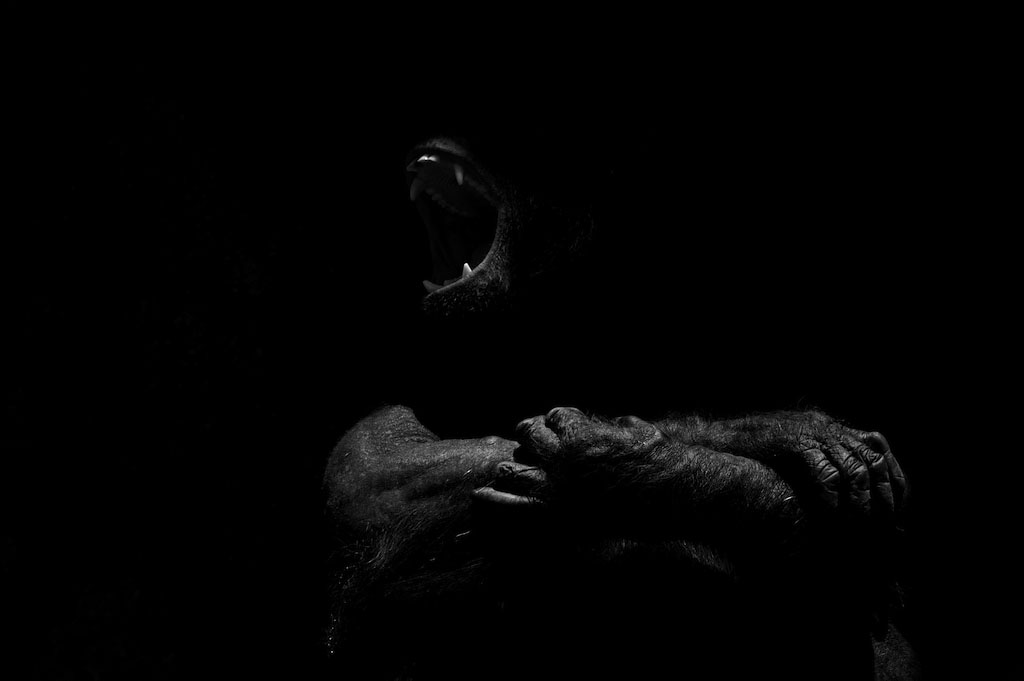
I first met Boza Ivanovic years ago, looking at his photographs of people living with HIV and AIDS around the world. The work was powerful in its ability to show the pathos of daily life for people burdened with this disease, people living in poverty in Africa, Russia, and the United States. We had been chatting about the possibility of doing a book, but then, things changed. Boza was in a motorcycle accident, and had been laid up for months. I hadn’t heard from him for some time, until he began to send me these stark and stunning portraits of animals he had started taking during his recovery.
.
The images, at once beautiful and captivating, were also very sad in many ways. The more I gazed upon these magnificent creatures, the more I began to notice I was looking at photographs of the incarcerated, sentenced to life behind bars and required to display themselves for our entertainment. And while I have always loved animals, the idea that they exist for our benefit, in conditions that would be inhuman if we confined people to them, was something that I can never forget when looking at these portraits.
.
I am thankful to Boza Ivanovic for granting this interview and sharing his work.
Please talk in full about how this series came into being.
.
Boza Ivanovic: Since I first got a camera in my hands, people were not my primary interest. In my late teens early twenties, living it what is now known as the former Yugoslavia, I used to jump the walls in the zoos to get in, since I did not have enough money to pay for the ticket, to be able to photograph animals. These walls were at least six feet tall and were lined with broken glass and barb wire.
.
I would then spend at least half day taking pictures of the animals on display. I always felt deep sorrow for this encaged animals since I though they were in terrible unnatural conditions. Of course, the quality of my work back then does not compare with my work today but when I look back, these humble beginnings were the start of what I portrait today.
.
I did not focus on animals until after I was recuperating from a motorcycle accident. The picture that rekindled my love for animal photography was taken at the San Diego zoo in Southern California when I was there for the sole purpose of taking my then six year-old son. It was a photograph of a tiger. The beast, as I saw it, was in a perfect, mysterious combination of darkness and light.
.
Since then on, I focused all my energy to develop the kind of animal photography that would portrait the beauty, traits and characteristics of these encaged animas. I have come to know and develop great admiration and respect for all the animals I have photographed since it requires quite a large amount of time and patients to have all the necessary elements to come together.
I remember when I first saw the photos, there was a natural joy to looking at the animals, but as time went on I began to see how miserable these creatures are, basically being in jail for their entire lives. In many of your photos, there is a feeling that you are photographing inmates sentenced to life, with no chance of parole. Having spent so much time looking carefully at these animals, did you notice their emotional states, and how would you describe them?
.
Yes. If you think about it, these animals are in very unnatural situations. Limited to what the enclosed, and most of the time, inadequate dwellings. And this I say regardless of the fancy we may perceive in some of the zoos. The endless pacing of bears, leopards, wolves; the endless rocking-like motion of the elephant’s head. I have seen animal in their natural environment when in one assignment in Africa and I can tell the difference in behavior. This is very disturbing to me and specially the fact that some of these animals when born in captivity will never know what freedom means. What is it more cruel, the animal that has lost his natural environment after being captured, or the one that has been born in captivity?
Your blackening out of the background further serves to underscore an unnatural environment, and focuses in on the animals themselves. What was your inspiration to focus exclusively on the animals?
.
I consider the majority of my photographs to be portraits. As such, I want people to “see” what I captured about that animal. By “blackening out” as you described it, unnatural elements such as bars and glass, I feel is the way to enhance the beauty, power, or any other characteristic of the animal. By being a documentary photographer, I don’t want to disturb the surrounding, I just want to capture the moment as it is. I want the animal to speak for itself.
.
Are there any particular animals to which you keep returning, and why ?
.
Absolutely. Chimps. I keep returning because there is always something happening with or around them. Gorillas because I am not yet completely satisfied with what I have so far. They are also my favorite apes. And of course, I come back to those animal I have not yet captured and portrayed at all or to my satisfaction.
Having spent so much time at zoos, what are your thoughts on the concept of locking up and displaying animals for our entertainment ?
.
Zoos are businesses and they exploit the natural desire we as humans have to see different animals specially those from the wild. However, I have observed many people at the zoo who do not know the difference between a cheetah and a jaguar, a gorilla and a chimpanzee. There are better and more economical ways to educate ourselves and our children about animals. It is cruel and egotistic from our part to capture these animals for our entertainment.
.
How do people react to your work? Do they see the pathos in these portraits, or are they, like the zoo-goer, simply enjoying the voyeuristic thrill of looking at animals up close ?
.
I have encounter both. People from the art field (magazine, books, galleries) tend to have a more sympathetic approach towards the animal. The common zoo-goer see them as interesting pictures and want to know how I got the picture, instead of being concern about the animal itself.
Curse of the Black Gold: 50 Years of Oil in the Niger Delta documents the profound cost of oil exploitation in West Africa. Photographer Ed Kashi and professor Michael Watts trace the environmental, economic, political, and social degradation of Nigeria following its independence from colonial rule. This is a new kind of humanitarian disaster, one to which the world turns a blind eye as they fill their pockets with profits.
.
Ed Kashi graciously agreed to speak about just some of the problems plaguing the nation, which is number 4 (following Canada, Mexico, and Venezuela) for U.S. Foreign crude oil imports with 948,000 barrels per day imported in 2010—which is nearly double the 473,000 barrels per day imported in 2009.
It’s funny (actually, not so funny) that when we were initially working on this book, the media response was fairly quiet, despite the importance of examining the practices of this industry. Now that the BP disaster has brought home just how dangerous this industry is, maybe there’s the opportunity for us to reexamine the way in which oil production destroys the environment in very really ways. What do you think has been the most dangerous aspect about oil production in Nigeria?
.
Ed Kashi: The most dangerous aspect of oil production in Nigeria is probably flaring of gas. The Niger Delta produces the largest amount of pollution in the world associated with gas flaring. Besides it being a waste of energy resource, it also creates acid rain for the local environment, air pollution and heat pollution. I would venture to say that the environmental problems don’t stop there and the local people might consider the pollution of their lands and waters, which as traditional fishermen, they were dependent on, carries the greatest burden.
I remember when you were giving a talk about this subject, you explained how difficult, if not impossible, it is for changes to be made, given the political and economic powers that support oil production. Please talk about the situation in Nigeria; how do U.S. interests support—if not exploit—Nigeria’s natural resources?
.
EK: American and British interests in the oil and gas resources of Nigeria have a tremendous impact on the ground in the Niger Delta. There is this unholy alliance between the international oil companies, the Nigerian government and military and in essence and practice the US and British governments. As long as the oil and gas flows outbound to American markets, which incidentally take 50% of Nigeria’s oil, then there is a nasty tendency to look beyond the troubling issues of the Delta. This is an insidious trend in most places in the world that produce sizable quantities of oil and gas.
.
For me it more profoundly prods one to want a change of how we do business. A change away from fossil fuels and towards renewables. Let’s face it, the profits are too huge and our dependency too great to stop this ugly alliance, but it’s certainly not sustainable for the long haul.
How has the struggle on the part of the Nigerians to fight against the oil industry played out over the years? Is it possible for an internal rebellion to drive out the oil companies?
.
EK: While an internal rebellion could have grave consequences on the oil industry and hence, on the stability of the Nigerian government, I don’t think it’s possible to completely shut down the oil and gas industry in the Delta. Before that would be allowed to happen I suspect that American military force would be brought in. And even before that, the Nigerian military would go to even further lengths to snuff out any insurgency. This scenario would create an ugly and destructive situation that would destabilize Nigeria. To consider that Nigeria is the most populace country in Africa with over 140 million people, it’s unthinkable for this to occur. Before the oil companies would be forced to leave, there would be much worse consequences for all of West Africa.
Please talk about the standard of living in Nigeria, and how this compares to the value of the product that is exported. Why do you think the Nigerian government does not support its infrastructure and its people with the possible earnings of its major product?
.
EK: The Niger Delta is a very poor and underdeveloped place. In fact, since the discovery of oil in the late 1950s the standard of living for the people there has gone down. It’s unimaginable to consider that in the past 51 years more than 700 billion dollars of wealth has been generated from oil and gas in Nigeria and the fate of the people and environment in the region where that rich resource comes from has been hurt economically.
.
The reasons are many but mainly stem from a lack of consideration for the people of Nigeria. Let’s face it, the Niger Delta is not any poorer than the poorest parts of Africa. What makes the lack of development and economic gain for the people of this region so profound is this “poverty amidst plenty.” Successive governments in Nigeria has plundered the region, disregarding the needs of the people. Certainly corruption plays a central role in this sad fate. Both systemic and personal corruption on a scale that is hard to imagine.
.
Further is the ethnic racism that informs this dynamic. The people who control Nigeria tend to be from the Muslim north, or at the very least from different ethnic groups in this diverse and divisive nation. This further fuels the lack of desire to create parity, let alone share the wealth to a degree that would enable the locals to develop their region. To consider that in 50 years not one technical institute has been created in the Niger Delta to train the locals says it all.
G. Ugo Nwokeji’s essay, “Slave Ships to Oil Tankers” draws a parallel between the two major industries of Nigerian history that were designed to service Western interests, and asserts “A time may come when oil will be viewed in a manner not unlike eighteenth-century slavery, the greenhouse gases emitted from hydrocarbons perhaps akin to slave-produced sugar, and free labor as a parable for renewable energy.” Do you believe it is possible for our global economy to function without oil, or would it take something like the Civil War for change to happen here?
.
EK: I dream of a day where we have moved past oil and gas. I know that dream will not be realized during my time on this earth but it is possible to witness the first steps of this dream to be realized. What it will take is the vision, strength of leadership and coordinated efforts of many nations to realize the need for this to happen. A civil war would not bring this change, nor will a collapse of our economic system. Unfortunately nor will the catastrophe in the Gulf of Mexico we are helplessly watching develop.
.
I fear we are destined to be cursed by our addiction to a drug that is destructive at every point of it’s process. We don’t seem to learn from our mistakes and the greed of humans continues to hold sway over reason. But isn’t this how addicts behave? Furthermore, who is willing to give up the lifestyle we have become accustomed to in large parts of the world? The hydrocarbon myth has been beautifully perpetrated on us all, especially in America were the cost of this addiction is relatively cheap.
Janette Beckman and I were invited to appear on WFMU’s “Coffee Break for Heroes and Villains with Noah” on Tuesday, June 1 from 9am–noon, to discuss the art of Hip Hop photography. I first met Janette back when we were working on Made in the UK: The Music of Attitude, 1977–1983, a retrospective of her career documenting the Punk, Mod, Skinhead, 2 Tone, and Rockabilly culture in the UK.
.
It was during that time that Janette showed me a copy of her first book, Rap, with Bill Adler, showcasing her work from the burgeoning Hip Hop scene during the 1980s. Needless to say, I fell off my chair when I caught a glimpse of her photographs, many of which have become icons unto themselves. From this, inspiration was born, and Janette published her third book, The Breaks: Stylin’ and Profilin’ 1982–1990, which she kindly allowed me to subtitle after her original subtitle, Kickin It Old School, appeared as the name of a corny Jamie Kennedy movie coming out at the same time.
.
Janette has photographed the likes of… EVERYONE. Check out this list, it is legendary: Afrika Bambaataa, GrandMaster Flash and the Furious Five, the Fearless Four, the World Famous Supreme Team, Lovebug Starski, Salt’n’Pepa, Run-DMC, Stetsasonic, UTFO, Roxanne Shante, Sweet T, Jazzy Joyce, Slick Rick, Boogie Down Productions, Eric B. and Rakim, EPMD, NWA, Ice-T, 2 Live Crew, Tone Loc, Gang Starr, Ultramagnetic MCs, Rob Base and DJ EZ Rock, Special Ed, Leaders of the New School, Jungle Brothers, Beastie Boys, Rick Rubin—and more! Hell, honey, even shot Jomanda! That’s for real. Got a love for you. You know, I just had to do this interview…
.
How did you get into shooting Hip Hop?
.
Janette Beckman: I was working for a British music magazine called Melody Maker when I saw my first Hip Hop show back in 1982 in London. The show featured Afrika Bambaata, Grandmixer DST, Futura 2000, Dondi White, breakdancers, and double dutch girls. It was absolutely mind blowing—we had never seen anything like it—and it seemed to me to be the new Renaissance in music, art, fashion and dance.
Being from the UK punk scene what did you make of it?
.
JB: The punk scene in London had reached it’s peak and I think everyone was looking for the next new thing. Hip Hop was much like the UK punk scene when it first started: so creative, groundbreaking, and in many ways both movements came from the streets—art and music created by “working class” kids who were inventing new things never seen before.
.
What was Hip Hop like back in the days, when artists were first getting record deals, but still didn’t have the marketing machine behind them?
.
JB: When I first arrived in NYC in 1982, Hip Hop was new and fresh. It seemed to me as an outsider coming from UK that the artists were free to do what they wanted, the music came from the streets and really told stories of what was happening in peoples lives, from the political like “The Message” and Public Enemy, to the raps about love, girls, sex, sneakers.
.
Anything seemed possible and the small record companies were much more interested allowing the artists to have creative freedom from the way they dressed to the beats and the raps. There was an amazing creative energy—riding on the train hearing some kid rhyming, seeing girls wearing the first giant hoop earrings, the fake LV outfits, the new way to lace your sneakers, the graffiti. Of course this was before MTV, stylists, the Internet started to dictate the way you were supposed to look.
.
Looking through The Breaks, I am totally blown away. You shot some of the photos that have long been burned into my brain. What was your favorite shoot, and why?
.
JB: My favorite shoot was for the British magazine The Face. They asked me to photograph the emerging Hip Hop scene and sent me out to Queens on a warm summer day in 1984 to photograph a group called Run-DMC. I took the subway to Hollis where Jam Master Jay met me at the station and walked me to the leafy block where they were hanging out with some friends. I just took out my camera and started shooting. The photo of Run DMC and posse is one of my favorites because it is such a moment in time. Totally unposed.
Please talk about your Ladies of Hip Hop shoot for Paper, as that photo is a classic!
.
JB: I had been working for Paper magazine since their first issue. They told me they were gong to get the Ladies of Hip Hop together for a shoot. I think it was in a Mexican restaurant on West Broadway. The ladies started to arrive and the boys were told they had to leave. Ladies only this time. What an amazing group—all getting along so well and having fun—and Millie Jackson was there, the “Godmother” of it all.
Please talk about shooting Eazy E, as I find this photo so touching. No profiling, no posing, no gangsterism in Eric. I love it…
.
JB: I was working on the final shots for my first book and had traveled to LA to shoot the important West Coast scene. NWA were recording their new album in a studio in Torrance and had agreed to have me shoot them. There was an alley at the side of the studio and I asked the group to pose for me. I only took a couple of shots of each of them.
.
We were talking about the recording. They liked my British accent and asked if I would be up for reading some lyrics on their album (it turned out to be lyrics about how to give the perfect blow job, which I thought maybe would not be right for my debut in the recording industry).
.
What do you think about the way Hip Hop has changed—as an economic force, a global culture, an art form, and a way of life for so many people of all ages?
.
JB: Hip Hop has really changed the world. I love the idea that people are rhyming in Africa, India, France in every language. What some people thought was a fad is a now, thirty years later, a worldwide phenomena used for advertising, soundtracks, TV, billboards. Artists like M.I.A, Ben Watt, and Santogold are mixing Hip Hop with their own beats and making some thing completey new—much like Hip Hop artists took disco and R&B beats and made them their own. And still kids on the street
around the world are keeping Hip Hop real.
I first met Dustin Pittman when curing an exhibition about New York City in the 1970s. The depth of his archive was so profound, I felt like I traveled back in time. Since then, Dustin has been shooting New York’s never-ending parade of characters unlike anyone else in the world today. Dustin graciously agreed to do an interview showcasing his old and new school CAST OF CHARACTERS.
.
.
WoW! Your perspective on New York nightlife is truly your own and makes me think “The more things change, the more they remain the same.” Does this ring true or false to you?
.
Dustin Pittman: I think that it definitely rings true. As a photographer I am always looking to fill my frame and capture new and fresh thoughts and concepts from my subjects. It doesn’t matter if I stood in the middle of the dance floor at Studio 54, or Paradise Garage in 1978 or backstage shooting fashion in 1976 or working with International designers in their atelier or the Boom Boom Room at the Standard in 2010. I’m always searching, looking, always ready, on guard to capture the moment. I have been photographing people for over 40 years. In the studio. On the streets. Way Uptown. Way Downtown. New York, Paris, London, Milan, Tokyo, Europe, Africa, India, Middle East, the entire World. Day for Night. Night for Day.
.
I love the way people look. It is their individual “look” and they “own it”. They are influenced by their history, their customs, their beliefs. You can’t take that away from them. They are who they are. The way they “carry” themselves. Their body language. The way they stand. Their heads, necks, arms, backs, shoulders, torsos, legs, feet and, of course, their FACES AND EXPRESSIONS. I love people for that. That’s the difference between the 70’s and now. There were no cell phones, no laptops, facebook or twitter. People connected with other people in “real people time”. They didn’t need to have their guard up all the time. They never anticipated the “snap of the shutter”. They just went about their business. People being People. Individuals being Individuals
.
.
Now with all the blogs, vlogs and instant street photography people are ready for you. They are waiting for you. They are strategically dressed and screaming “take my picture”. But, having said. That is the way it is. I accept it. It is not the 1960’s, 1970’s, 1980’s, 1990’s, etc, the time is now. I honor that. We may glamorize the past, but we honor our present. I honor that in people. New technology has ushered in new ideas and tools. People are more willing to explore themselves. They know who they are. They know their culture. I AM A HUGE FAN OF THAT.
.
Now I have the opportunity to shoot with traditional cameras as well as the latest digital cameras with HD Video output. More technology, more opportunities. Old School and New School as one.
.
.
Looking through your work, I was overwhelmed by the abundance of style. Everyone you photograph uses their face and body as a canvas. What are your thoughts on such personal expression?
.
DP: My style of photographing has always been the “Polaroid School of Photography” SPONTANEITY. I have always been in the “cinema-verite mode. What does that mean. I leave people alone. I let them “be”. I let them interact . I want them to show me their beautiful hearts and souls. I love their life. Past and Present. I don’t want to destroy that precious “moment”. I let them perform. I got that from Andy Warhol.
.
In the early days we used to go out to dinners, events and parties together with our cameras always “cocked”. I got it from shooting videos of the Warhol Superstars back in the 70’s. I got it from the countless thousands of Fashion Designers, Actors, musicians, and street people that I have photographed throughout my career. I got it from John Fairchild, the head of W. We traveled the around the world photographing inside the fashion ateliers together. I got it from Anna Wintour. I got it from Gloria Swanson. I got it from Andre Leon Talley. I got it from Carrie Donovan. We would travel Paris, Milan, London and New York together. I got it from Toni Goodman, Vogue’s Creative Director and I got it from the Masters of Street and Portrait Photography way back in the 60’s and 70’s. Photographers like William Eggelston, Robert Frank, William Klein, Eugene Smith, Larry Clark, Nan Goldin, Diane Arbus, Helen Levitt, Elliott Erwitt, Danny Lyons, Garry Winogrand, Bill Cunningham, Robert Mapplethorpe Todd Popageorge, and many more.
.
We would work the streets and rooms together all night long and into the next day, and then into the night. There was no sleep for me during those years. Sleep. Who needed it. As long as my cameras were loaded and there was enough film in my pockets, that was my “fix”. My light is always on. When I photograph my subjects I look, think and compose before I snap my shutter. I never “ponce”.. I love to respect the moment, always letting it unfold. I let it happen. Never do I go into the frame and ask my subjects to pose or to “look this way” or stand this way. That is a different photograph. That is a photograph for the “studio”. Or, dare I say the word, the “poparazzi” photographers, who I am not a fan of.
.
.
Who is your ideal subject?
.
DP: My ideal subjects are the “untouched people on the streets of the world”. People are People and I love them for just being Who They Are. People are my “Celebration of Life”. Young or Old, To photograph youth, from birth to death at any age. ROCKS.
.
.
When did you move to New York and what was the city like back then? How was it being a photographer, getting access to celebrities of all kinds?
.
DP: I moved to New York in 1968 and I was considered “street cool”. What a time it was. Right on the cusp of exploring “free expression” in the arts. Liberation and Hedonism were my themes. Film, photography, dance, performance art, theatre, music, fashion, poetry, etc was flourishing. It was a renaissance again. My renaissance. I spent 3 weeks photographing the happenings and lifesyle at the Woodstock festival before it even started. The 70’s and 80’s was a great time for photographing. Max’s Kansas City, Mudd Club, CBGB’s. I photographed the first Gay Pride parade in Greenwich Village in 1970 and the 1st Woman’s Rights parade in the early 70’s.
.
I was the very first fashion photographer photographing backstage fashion in the 70’s. It was just myself, the designers, hair and makeup and the models. Now there are thousands backstage and thousands trying to get into the tents. In the 70’s and 80’s, I used to gather bunches of people and we used to spent the rest of the entire night and into the day shooting short films, movies and photographs. It was that easy. Access to people was easier. You could do what you wanted. You didn’t have to give up your photographic rights in order to capture a person, scene or event.
Having been on the scene for three decades, how would you best define the essence of New York’s nightlife?
.
DP: I feel that New York nightlife is and always will be the driving force behind discovering and creating new ideas and trends. What propels that is the driving creative energy nightlife sucks in and out of you. Say what you want about “hanging out” at night, but one can always find something special to document happening somewhere. In the 70’s and 80’s, it was unthinkable to leave Manhattan for a party, show or event. Now the big advantage is that New York nightlife has expanded to the boroughs. Williamsburg, the Bronx, Greenpoint, Bushwick, Gowanas, Richmond Hill, Long Island City. Artists are always looking for cheap workable space for their studios, galleries and performance events and these areas fit the bill. Having said that, because of this change, it has given us more opportunities. Anything and Everything is possible.