Miss Rosen
  • Home
  • About
  • Imprint
  • Writing
    • Books
    • Magazines
    • Websites
    • Interviews
  • Marketing
    • Publicity
    • Exhibitions & Events
    • Branding
  • Blog

Posts from the “Manhattan” Category

Brian Kenny: So Help You God

Posted on August 20, 2010

Artwork © Brian Kenny

.

I recently met up with Brian Kenny, and while he was showing me some of his new work, he began talking about his time spent on grand jury duty, sketching the scenes like a subversive court reporter in order to keep himself awake. Having done my utmost to escape sitting in judgment of anyone, I am simultaneously fascinated and repelled by our court system, one which is more a function of bureaucracy rather than democracy. With questions spilling from my fingertips, Brian graciously agreed to speak on his experience here.

.

Please talk about your experience sitting in grand jury—how does the process work? What were you, as a grand juror, responsible for, and how did you feel about sitting in judgment of other people?

.

BK: To give you some background, there are two kinds of juries in the criminal justice system, a Petit/Trial jury (like you see on TV) and a Grand Jury. I was selected as a Grand Juror.  A Grand Jury decides whether there is enough evidence for an actual trial and issues formal indictments (or charges) for alleged crimes against defendants by examining evidence presented by the prosecution. Before a Grand Jury actually passes an indictment, criminal charges against someone are only “theories”.

.

Only the US has Grand Juries anymore and it functions as part of the system of checks and balances, so that people don’t go to trial under official criminal charges based on only the Prosecutors bare word.  In New York State, a Grand Jury is made up of a quorum of 23 Jurors and a  “yay” vote of at least 12 jurors is required to pass a formal indictment against the defendant, so the vote by jurors does not have to be unanimous.  If passed, then the case goes to trial, if not, the case is thrown out.

.

Artwork © Brian Kenny

Now, unlike a Petit Jury which only focuses on one trial, I examined and voted on hundreds of cases, one after another, for two weeks, fulltime. They move so quickly because only the prosecution presents evidence (although a defendant is allowed to speak for themselves, but almost never does and are not required to be present), and the evidence is minimal. Grand Juries only require enough evidence to support ‘reasonable cause” that the defendant committed a crime, not “reason beyond a doubt” like a trial jury.

So a typical case in the Grand Jury plays out as follows:

The District Attorney (prosecution) will say “I’d like you to consider charges of felony possession of a controlled substance in the 3rd degree against (let’s say) Mr. Smith. We have three witness that will testify that Mr. Smith was found in possession of Heroin on January 21st on Houston Street”

Then two undercover cops will come in one by one and tell us how they saw Mr. Smith exchange money for a small baggie on the corner and after approaching and searching the defendant, they recovered a small bag with 4 vials of what they believe to be Heroin and placed the Mr. Smith under arrest. Then the DA will call in the lab analyst or read the lab analyst’s letter confirming that the substance was tested and is in fact Heroin.

After that the DA will read out loud all the legal mumbo jumbo concerning criminal drug possession laws, which is by far the most boring part and finally the DA will ask us if we have any questions and leaves the room while we the jury deliberates.  We all vote, “yay” or “nay” to indict, and call the DA back in to give our answer. If 12 or more vote “yay” the charges become official and the defendant goes to trial, most likely to be found guilty and sent to jail. Next case.

Artwork © Brian Kenny

.

That’s basically how it worked, over and over. It wasn’t hard to be in judgement of others, but it was frustrating that nearly half the jurors could disagree with the evidence and indictments are still passed. I also found it kind of annoying that although the District Attorney were presenting evidence to us jurors, real live people, but everything they said was really ‘for the record’, so they were actually talking at us in this impersonal, over-explained way to satisfy the stenographers documenting every word.

.

I love that for all intents and purposes, you were the courtroom artist, illustrating the scenes as they do not allow cameras in. Yet your perspective was very distinct from how this work is usually done as the images are less narrative, and more metaphorical. How did you decide you wanted to begin drawing in court? What were some of the ideas you began exploring through your sketches?

.

BK: I started drawing on day one without really making a deliberate decision to document everyone. I tend to draw compulsively; sitting still is hard for me and I tend to listen better if I can keep my hands busy.  There were moments, like the rape or abuse cases that were very intense and heartbreaking,  (almost like being inside an episode of ‘Law and Order’), but most of the jury duty was super boring; endless droning by the District Attorney reading definitions and procedures from the law books. Thus, drawing was a good way for me to stay awake and engaged. Soon after I began drawing I realized this was a perfect opportunity to use all the DA’s cops, lawyers, witnesses, defendant as live models for drawings because here I was sitting in the front row of a kind of small auditorium and one by one, all sorts of people kept sitting at the table in front of me every couple minutes. I didn’t really have any ideas I was exploring other than trying to draw them quickly before they got up and left the stand!

.

Artwork © Brian Kenny

Did the act of sketching alter your perception of the events as they unfolded in court ?

.

BK: Yes in way.  Because I was looking at each person very closely in order to draw them accurately, I noticed a lot of distinct and subtle body language, personal hygiene factors, and fashion sensibilities that did affect my own opinions of them in regards to their integrity or self-esteem.

.

For example, although all of the DA’s and lawyers dressed and acted in very formal almost detached robotic manner, as I drew closer, I noticed how some were actually very insecure, wringing their hands or not making eye contact while others seemed to relish dishing out justice, their eyes sparkling, reciting law from memory and adding little pieces of flair to their suits like 3 point breast pocket hankies! Most of the undercover cops, (and there were TONS of them) dressed poorly; food stained sweats, drab K-mart styles, oversize jackets, unshaven, beady eyed, thick accents, over-weight. This kind of unkempt appearance in addition to not being very well spoken, definitely affected my opinion of their credibility considering many of them mirrored the criminals they arrested.  Often, the only evidence we received to indict someone of a crime, especially in the drug cases, came from these messy figures whose integrity looked questionable.

.

Artwork © Brian Kenny

Did anyone in the jury box or court notice you were sketching ? If not, what did you observe them to be doing?

.

BK: Yes, the jurors and warden noticed I was drawing everyone who took the stand. The other jurors loved it and luckily so did the Jury Warden. I was afraid the warden would tell me to stop or confiscate my drawings because the Handbook actually states that even private notes made by jurors during duty are confidential and cannot be shared or leave the courtroom. But after a couple days, the warden was offering me nicer drawing paper and some jurors asked me to email them scans of drawings I made.  About half of the people I was drawing noticed I was looking at them very closely, but no one spoke up about it or even seemed to care. A whole room full of people was also staring at them and they probably assumed I was just taking notes.

.

Artwork © Brian Kenny

What did you find most eye opening about being a part of the American legal system ?

.

BK: My Jury Duty experience was eye-opening and in many ways. Artistically, it was expansive because I was drawing outside of my comfort zone. In my own practice I usually draw myself or guys who look like me endlessly, so it was a challenging departure to draw all types of people live; old ladies, children, fat men and sexy young women.

.

I also learned a lot about the American Justice system and New York City criminal politics but left with a lot of mixed feelings about it. I noticed that virtually 90% of all criminal activity in New York City is either theft or drugs, essentially non-violent crimes. The drugs cases were the most frustrating part of being a juror. I view drug addictions as more of a health issue than a criminal issue and so I refused to vote to indict anyone on drug charges, as did a few other young jurors, but we were always outvoted by the majority and it was sad to know most of them will end up in jail where they do not belong.

.

Although I respect and believe in the system of checks and balances as part of a true democratic judicial process, I also felt like the Grand Jury system was designed to pass indictments. We only ever heard from the prosecution, which makes the presentation of criminal evidences one-sided. Defendants themselves do have a right to speak on their own behalf, but I doubt most of them realize this because out of the hundreds of case I saw, only a handful of defendants actually used that opportunity. Unfortunately the defendant’s lawyers are not allowed to speak to the Grand Jury. In addition, a Grand Jury only examines the most obvious evidence because it seeks only ‘reasonable cause’ for an indictment. So the whole picture of a possible crime is not presented.

.

Add to that the fact that the majority of witness and evidence to criminal allegations were testimonies by undercover cops. As I said earlier, these cop’s appearance already aroused my suspicions of their credibility. Besides, cops are required to make arrests and so it’s in their own career interest to make as many arrests as possible. Especially in the drug cases, I often noticed that their testimonies seemed suspicious.

.

Artwork © Brian Kenny

.

For example, one cop described how he was walking on the street and saw through the window of a car someone exchange money and drugs. When the suspect exited the car, he approached him and after searching him, found drugs. However, another cop who was involved in the arrest but did not see the transaction, told us after we questioned him separately that the car was a big black SUV with tinted windows. So how did the first cop actually see what was happening? Someone was lying. Of course, that still did not stop the jury from indicting the defendant.

.

Many testimonies like this were strange or somewhat incomplete.  It made me wonder whether many of these drugs arrests actually traps set up by undercover police to increase arrests.  Perhaps I’m just paranoid but a recent unrelated event only deepens my suspicions. Last week, Slava and I were coming home and as we crossed Chistopher and 7th avenue  (a corner that at night always have some shady characters loitering around) and Slava noticed a shiny penny near the corner. Slava picked it up and began to examine it because it’s one of those new 2010 pennies where they have replaced the Lincoln Memorial with a shield that says “E pluribus Unum”.  He showed it to me and we continued walking down the street. Then out of nowhere a green van speeds backwards down the street and screeches to a halt in front of us. Three undercover cops jump out of the car and start yelling at us “Police, Don’t move! Keep you hands where we can see them!” They rush over to Slava saying “Show us what you’ve got in your hands!” Slava opens his hand and shows them the penny we just picked up, and the cops stop and say “Oh, sorry, we thought it was drugs, umm, sorry about that, have a good night” and got back into the car and drove off just as quickly.

.

The whole incident was so shocking and unexpected that we both wondered if the cops had actually placed drugs on the street nearby waiting for someone to pick it up. I could be wrong but the whole incident just felt like we had walked into a trap.

.

Overall, my jury duty experience was worthwhile artistically and I really learned a lot about crime and punishment in New York City. I do believe in the use of Juries made up of real citizens and was proud to do my part, but also feel that the system is totally vulnerable to manipulation, and that the drug laws especially need to be re-examined in favor of rehabilitation or community service over worthless punishment or revenue.

.

Artwork © Brian Kenny

briankenny.blogspot.com
www.brian-kenny.com

Categories: Art, Manhattan

Chris Pape aka FREEDOM: Down by Law

Posted on August 12, 2010

.

CHRIS PAPE AKA FREEDOM: DOWN BY LAW

.

Eric Firestone Gallery, East Hampton
August 14–September 26, 2010

.

Chris Pape (aka Freedom) is an American painter and graffiti artist. Pape started tagging subway tunnels and subway cars in 1974 as “Gen II” before adopting the tag “Freedom”. He was a witness and a participant to the 20-year run of the New York subway graffiti movement.

.

He began writing as Gen II in 1974 and finished his career on the trains in 1983 with the tag Freedom.

.

Pape is best known for his numerous paintings in the eponymous Freedom Tunnel, an Amtrak tunnel running underneath Manhattan’s Riverside Park. Prominent paintings in the Freedom Tunnel attributed to Pape include his “self-portrait” featuring a male torso with a spray-can head and “There’s No Way Like the American Way” (aka “The Coca-Cola Mural”), a parody of Coca-Cola advertising and tribute to the evicted homeless of the tunnel. Another theme of Freedom’s work is black and silver recreations of classical art, including a reinterpretation of the Venus de Milo and a full train car recreation of the iconic hands from Michelangelo’s Sistine Chapel.

.

Pape will be exhibiting a self portrait from the Freedom Tunnel in “Down by Law” at the Eric Firestone Gallery, East Hampton, opening on August 14, 2010. He has graciously agreed to speak about his work here.

.

New York in the 1970s and 1980s was a city bursting with originality, innovation, and experimentation. Please talk about how you see the relationship between your early work as an artist and the environment in which it took hold.

.

The great cities of the 20th century are Paris in the 20s, Berlin in the 30s, and New York in the 70s; and I guarantee you, there will never be another city like New York in the 70s. The gay rights movement, the feminist movement, punk rock, hip hop, graffiti, the blackout, Son of Sam, tabloid journalism, street gangs (in 1977 it became fashionable for gang members to walk through the streets with golf clubs), the blackout, Saturday Night Fever — Saturday Night Live — it all came out of New York!

.

If there were one particular moment that defined my later work it would have to be in the 1960s. In 1965, at the age of five, my parents wouldn’t let me leave the block alone. I was allowed to go “subway fishing”, this meant laying atop a subway grating and swinging a string with gum affixed to it until it hovered over a lost coin or some other treasure and hoisting them up. These were long summer days that seemed to go on endlessly. I pulled up Indian head pennies, buffalo nickels, matchbooks, a baseball card, and other bits of junk that somehow stayed in the back of my brain until the early 80s.

.

In 1980 I was already a graffiti writer doing letters on the sides of trains, I quickly found out that I could paint realistic images with spraypaint and looked for a place to do it. There was a freight train tunnel in Riverside Park where trains still ran, the gratings formed 15-foot high canvasses of light against the walls, and in those beams of light I repainted the images of my youth including a baseball card. In 1986 the homeless moved in and became known as the “Mole People”, I stopped painting and documented their lives for three years. I finished my mural work in 1995. I tell the story because I can’t think of any other city in America where something like that could’ve happened. That was New York back in the day.

.

It has recently been suggested to me that the term “graffiti” is marginalizing, and loaded with negative connotations. How do you feel about the use of the word in general, as well as application to your work as an artist?

.


The graffiti word is offensive, but it was the only word to describe the early stages of the movement. In 1974 the word “graffiti artist” was coined in the New York Times—that seems like a happy marriage. I don’t lose any sleep over this stuff.

.

As a working artist over the past three decades, you have seen first hand how the art world—from galleries and dealers to museums and collectors—responds and reacts to contemporary American art. What are your thoughts on the differences (and similarities, if applicable) between the US, European, and Asian markets?

.


I think the art world as a whole views the works of artists as commodities. Let’s not forget the lessons of the 1980s when graffiti canvases were sold for huge amounts right up until the stock market crash. Things do seem a lot more liberal in Europe where graffiti artists from New York are celebrated and have been for years.

.

Who are your artistic inspirations, and how have they influenced your ideas, aesthetics, and actions through the course of your career?

.


Hopper is my favorite painter, I think he tapped into the American psyche more then any other painter of the last century, but I don’t think he inspires me. I’ve bitten generously from Warhol, Oldenburg and Rosenquist, you can see the Rosenquist influence in the “Buy American” painting. Warhol and Oldenburg are there on a more spiritual level.

.

Self Portrait in The Freedom Tunnel, Artwork © Chris Pape

Self Portrait inspired by The Freedom Tunnel, Artwork © Chris Pape

For “Down by Law” you will be exhibiting your self portrait from the Freedom Tunnel. Please talk about the importance of this piece, and the context in which it was created.

.


The self portrait for the show was originally painted in the tunnel in 1984. At the time it wasn’t THE FREEDOM TUNNEL, it was just me doing my thing, which allowed me to fail a lot. This painting didn’t really fit in with the themes I had established, but it seemed to work and was published in a number of books. It’s a self portrait. The jacket was given to me by my parents in 1976, I left home in ’77 and lived in the jacket, quite literally. The spraycan head is an old graffiti device that seemed to describe my life at the time.

.

There has been a wide array of artists to emerge from the early graffiti movement. How have your earlier experiences influenced you ideas about art, and in what direction would you like to go?

.


When I left the tunnel in 1995 I was a little bit dazed. I was stuck as a painter, although I continued my visual journalism work. I did my new paintings large, and then small, in color, with a sable brush – it seemed as though nothing worked. Of course the answer was that it couldn’t work. The paintings in the tunnel are just that, there in a tunnel. In the same way that if you buy a subway graffiti artist’s work it’s best to buy an entire subway car or it loses context. I think that’s a battle that all graffiti writers that started on trains have had. I’m not saying I’ve fully overcome it but I’ve come close.

.

www.ericfirestonegallery.com

Categories: 1970s, 1980s, Art, Exhibitions, Graffiti, Manhattan, Painting

Martha Cooper: Down by Law

Posted on August 2, 2010

Martha Cooper

MARTHA COOPER: DOWN BY LAW

.

Eric Firestone Gallery, East Hampton
August 14–September 26, 2010

.

Martha Cooper is a documentary photographer born in the 1940s in Baltimore, Maryland. She began photographing in nursery school after her father gave her a camera. She graduated from high school at the age of 16, and from Grinnell College with a degree in art at age 19. From 1963-65, she taught English as a Peace Corps volunteer in Thailand and then journeyed by motorcycle from Bangkok to England where she received an ethnology diploma from Oxford. She was a photography intern at National Geographic Magazine in the 1960s, and worked as a staff photographer for the Narragansett Times in Rhode Island and at the New York Post in the 1940s.

.

Martha is perhaps best known for documenting the New York graffiti scene of the late 1970s and early 80s. While working for the New York Post she began taking photos of creative play on the Lower Eastside in order to use up the remaining film in her camera each day before developing it. One day she met a young boy named Edwin who showed her his drawings and explained that he was practicing to write his nickname on walls.  Edwin offered to introduce her to a graffiti king. This is how she met the great stylemaster, Dondi, who eventually allowed her to photograph him in the yards at night while he was painting. In 1984, with Henry Chalfant, she published Subway Art, a landmark photo book that subsequently spread graffiti art around the world.

.

In addition to publishing more than a dozen books, Martha’s photographs have appeared in innumerable magazines including National Geographic, Smithsonian and Vibe. She is the Director of Photography at City Lore, the New York Center for Urban Folk Culture. She still lives in Manhattan but is currently working on a photo project in Sowebo, a Southwest Baltimore neighborhood.

.

Cooper will be exhibiting four silver gelatin prints from her early b-boy documentary work in “Down by Law” at the Eric Firestone Gallery, East Hampton, opening on August 14, 2010. She has graciously agreed to speak about her work here.

Doze Green, Rock Steady Park, Photograph © Martha Cooper

New York in the 1970s and 1980s was a city bursting with originality, innovation, and experimentation. Please talk about how you see the relationship between your early work as a photographer and the environment in which it took hold.

.

 I’ve long been drawn to anything made by hand perhaps because my parents always encouraged creative play. In 1977 I began working as a staff photographer for the New York Post and the job required that we cruise around the city all day in our cars with two-way radio contact to the news desk in case there was a breaking assignment. When not on assignment we were supposed to look for feature “weather” photos. My favorite neighborhood for photos was Alphabet City on the Lower Eastside where I could almost always find kids making something from nothing.

.

It has recently been suggested to me that the term “graffiti” is marginalizing, and loaded with negative connotations. How do you feel about the use of the word in general, as well as application to your work?

.

 Writers probably enjoy being associated with “negative connotations”. Being bad can be cool. Of course the term graffiti has been around much longer than markers and spray paint. In NYC, it’s most fitting for tags but less appropriate for sophisticated spray painted walls. Words and their connotations change over time. Just let me know what you want me to call it and I’ll be happy to oblige. If you prefer the term aerosol art, I’ll go with that stilted though it may be.

.

As a working photographer over the past three decades, you have seen first hand how the art world—from galleries and dealers to museums and collectors—responds and reacts to contemporary American art. What are your thoughts on the differences (and similarities, if applicable) between the US, European, and Asian markets?

.

As a documentary photographer I’ve always been more interested in publishing my photos in books and magazines than showing them in galleries. I never paid much attention to the art market until very recently. Collectors in Europe and Japan seem more eager to collect “graffiti” (should I say aerosol?) related work. I’m just happy that people anywhere enjoy looking at my pictures.

.

Who are your artistic inspirations, and how have they influenced your ideas, aesthetics, and actions through the course of your career?

.

My dad was an amateur photographer and he used to take me on “camera runs” with the Baltimore Camera Club so my first experience with photography was just going out looking for pictures and that’s still my approach today…

.

I’m from a generation of street photographers who never studied photography. I grew up seeing photojournalism magazines like Look and Life and National Geographic and wanted to become a professional photographer so that I could travel the world. I was always more interested in thinking about what I wanted to photograph than how I was going to shoot it. It was never my intention to make art.

.

For “Down by Law” you will be exhibiting your silver gelatin prints of Rock Steady Crew members Frosty Freeze, Ken Swift, Crazy Legs, and Doze Green . Please talk about your work documenting the b-boy movement, and the way in which these photographs—in particular that of Frosty—have become historic markers of the culture.

.

I first encountered b-boys by chance in 1980 in Washington Heights and was so impressed that I contacted Sally Banes, a dance writer, to help me document them. It took us a year before we had enough material to publish a story. We asked Henry Chalfant to help us find dancers. He was organizing an event with graffiti, rapping and DJing and thought dance would be a great addition. Through his graffiti contacts, we met Crazy Legs.

.

The resulting story in the Village Voice in April 1981 with Frosty Freeze on the cover introduced breaking and Rock Steady to the world. Because NYC is a media town, magazines and film crews quickly covered the “new” dance. Henry filmed them for his movie Style Wars as did Charlie Ahearn for Wild Style. The words “Hip Hop” were not in general use at the time but as people became more aware of the culture, breaking was included as an integral part and the Rock Steady Crew became worldwide celebrities. As far as I know my photos are the earliest documentation of b-boying.

.

There has been a wide array of artists to emerge from the early graffiti and Hip-Hop movement. How have your earlier experiences documenting b-boys, young writers in the yards, and trains running along the lines influenced you ideas about art, and in what direction would you like to go?

.

I don’t think a lot about art. Still photography is a wonderful way to document. In a fraction of a second the camera can capture and preserve a million details. I’m interested in using photography for historic preservation. I want people to look at my photos and get a sense of what life was like at a specific time and place.

.

I’ve seen New York City change radically over the past 30 years and my photos are appreciated because they are a record of a different time. For the past 4 1/2 years I’ve been documenting a difficult neighborhood in Baltimore with a vibrant street life. My hope is that in thirty years these photos will similarly be enjoyed.

Ken Swift, Photograph © Martha Cooper

Frosty Freeze, Photograph © Martha Cooper

www.12ozprophet.com/index.php/martha_cooper

www.ericfirestonegallery.com

Categories: 1980s, Art, Bronx, Exhibitions, Graffiti, Manhattan, Music, Photography

Anton Perich: True Revolutionary

Posted on July 27, 2010

Candy Darling, Photograph © Anton Perich

There’s so much I could say about Anton Perich, but it’s altogether too much for me to try to put it into words. I’ll leave it to the incomparable Mr. Perich to do this better than I ever could.

.

Your life history is fascinating! Please talk about your work running an underground film program in Paris in the late 1960s.

.

AP: Thank you. I was making some super 8 movies then. All lost now, except one, “Le retour d’ Eurydice”, in which I was starring. Raphael Bassan directed it. An early French underground film, recently screened at Beaubourg. This was 16mm production, and well preserved.

.

Anyway, there was this wonderful villa with gardens on Boulevard Raspail, just a few short blocks from La Coupolle. It was housing the old American Center, a complex of art studios and various music and theater activities.  Later they tore it down to put the Carier skyscraper. I saw there many international productions and created a few. But one thing was missing, underground films. So I proposed to show films there one night weekly, in a small studio in the basement, and sometimes in the gardens, on the grass. It was a success.  I was making films and my friends were making films and there was no place to show them regularly in Paris.

.

Of course, we were all spoiled by La Cinematheque, spending days there watching classics and contemporary films. But there was no room there for our “little short marginal works”. And of course, revolutions are always made by the marginals.

.

In the Sixties, the New York Underground cinema were well defined by Warhol, Mekas, Jack Smith, Brackage and others. A whole different scenario was happening in Paris. There was Godard and his gods reigning on the Parnassus, making a wonderful narrative movies, not much questioning Cinema itself. There was also Garell, Clemanti, And there was Etienne O’Leary and Michel Auder. The great Michel Auder, who questioned everything. In 1970 he abandoned film totally and converted to video. I screened his films there the very first night, and often afterwards. He supplied the projector that he somehow inherited from the French Army, I guess he knew de Gaulle, or was his nephew.  Another great French underground filmmaker was Raphael Bassan. But the real revolution in Paris film world were maid in the Fifties by the last great god of the avant-garde, Isidore Isou and his prophet Maurice Lemaitre. In the early Fifties they made movies with the found footage, various acids and paints. They made the cinema discrepant, totally    separating the sound track from the visual content, as if telling two different stories in the same time.  Of course, most of the audience walked out. No one ever did it before. Debord took it all from them. Debord was Lettrist before he became Situationist.

.

Anyway, I screened some of those films too.

.

I was associated with Lettristes from 1967 to 1970. I worked with Lemaitre and Isou, painting, writing poetry, shooting films, doing the shows. Lettrism was my school. I was educated by the two greatest artists and thinkers of that time. Of course Isou predicted the 1968 revolution and went mad. We did some performances at L’Odeon, it was occupied, Non-stop 24 hours spectacle. I spent few nights there.

.

I think that the Revolution of 68, the Paris Spring is grossly misunderstood today. It was not the flesh and blood revolution, no guillotines. It was the revolution of spirit, of the young, so unique in the history of revolutions. It paved the way for other bloodless revolution in the Eastern Europe. Imagine, the Communism died the bloodless death. Tell it to Stalin, or Lenin.

.

I lived my own revolution there. I became something else at 23. It is difficult to transform oneself, only fantasy and revolution will do it. And spirit. And resurrection. And the fire in Paris streets. And “sous les paves la plage”. The greatest slogan ever written.

.

To get back to films, I did show some Warhol films, and Mekas.

.

The legendary Pierro Heliczer came from New York and introduced his films. Taka IImura came there with his films as well, and many other underground filmmakers, French and international.

.

Robert Mapplethorpe, Photograph © Anton Perich

Why did you decide to come to New York in the 1970s? What was the city like back then, particularly for artists and radicals?

.

AP: I came to New York in 1970. At that time I was interested in many things that were coming from New York. Underground films. Pop Art. Experimental theater. Warhol’s Factory. Jonas Mekas. Julian Beck. John Cage. John Chamberlain. Minimal Art. Earth Works. All of that new, foreign to the Europeans,  miraculous and fascinating. It was all so American. Paris didn’t have any of that. It had a vacuum and suffocating atmosphere. They were mourning the revolution of 68 instead celebrating it.

.

In NY it was all celebration, non stop celebration of the young, creative and the free. Woodstock was a celebration. Max’s Kansas City was celebration. Punk was celebration, music, fashion and attitude. NY Dolls was celebration. Transvestites were celebration. Taylor Mead was celebration, Warhol, Factory, Candy Darling, Jackie Curtis, Wayne County, Andrea Feldman, John Waters, John Chamberlain, John Cage. Lou Reed.  Forest Myers was celebration. His SOHO wall was much better than that other wall in Berlin. And it is there forever in the full glory. Smithson and Heiser were doing God’s work, transforming the landscapes in the great vacuums of America.

.

Andrea Feldman, Photograph © Anton Perich


In 1973, you produced the first underground TV show which ran on Manhattan public access television. Please talk about your ideas about video art and how you made use of public access TV to explore them.

.

AP: I quit film and was shooting video. I realized that it was the gun of the future. I realized that the freedom to bear video was the same as the freedom to bear arms. And with a such powerful instrument you dream of changing the world. You dream revolution. You remember I came to NY via Paris and brought a symbolic cobble stone with me, you remember: “under the cobble stones the beach…”Other so called video artists were showing their videos at the galleries and museums, the most safe places in the world. I never had a video show in a gallery or museum. I would be ashamed of it. Such bourgeois establishments. Suffocating the freedoms that video was to bring.

.

I saw the video camera as the most subversive weapon on the world, and you don’t take it to the gallery, you take it to the American TV. There was Cronkite there and Barbara Walters, but you replace them with Taylor Mead, Danny Fields  and Susan Blond. Naked aggressive and radical, hating everything the TV had to offer until that day. I did it on Public Access in January 1973, in the prehistoric times of video. I took my one hour weekly show “Anton Perich Presents” there.

.

I realized then that the free Public Access was like youtube today. As the matter of fact, like the Internet today. No one realized that it was so powerful, radical and transformative. TV was the last stronghold of American comfort and the superficial perfection. Clean as the soap commercials. But while the soap washed clothes, the TV bleached the brains. The absolute pristine color TV meets the badly produced black and white airings, badly filmed and with bad sound, badly dressed and badly behaved stars of the underground. The Television has never seen this content before. It was the first. Yes, I broke the ice. After me came the flood. Look at the cable today. Yes we made a revolution, single handedly. It was about freedom.

.

Charles James and Model, Photograph © Anton Perich

Please talk about the inspiration to start NIGHT Magazine in 1978. Why did you decide to get into publishing, and what was it like to produce print back in the days?

.

AP: Yes, it was all about inspiration. It was about poetry of the photograph. NIGHT was this wonderful title idea for a new, oversized underground publication. I designed it and published it. Absolutely oversized, glamorous, elegant, sensual on a smooth almost a bed sheet-size beautiful white paper. It was in 1978. I was at the Studio 54 shooting every night fabulous pictures of the most fabulous people in the World. For me photography is an obsession, the white substance.

.

I was shooting for the Warhol’s Interview magazine and for me that was not enough, so I had to self-publish, as it is called today. Well, it was marvelous to capture all this nightly energy on the pages of NIGHT. Hundreds, thousands of photos. From Victor Hugo to Patty Hansen and Jerry Hall. Bianca, Esme, Carole Bouquet. All dressed on the covers of VOGUE and topless in NIGHT.

.

I wanted to publish every photo I ever took. It was the Facebook for the Studio 54 regulars. But my photography here is something else. It is celebrated now, looking so fresh and contemporary, as if it was taken today. All great photography is timeless, looks like taken today, and not yesterday. The dated photographs don’t speak to me, cannot establish a communication with them. It is like yesterday’s papers. The paparazzi work. NIGHT is not a yesterday’s paper. It told the future over 30 years ago.

.

I still publish NIGHT today. It is my way of questioning the Internet. If we don’t question it and if we don’t doubt it  we will end up in the near future having everything on our fingertips and nothing in our arms. NIGHT is not on your fingertips, it is in our arms, big beautiful, physical, not virtual. Hand-made, and not LED device.

.

Model wearing Charles James, Photograph © Anton Perich

Throughout this time you were also taking photographs of everyone on the scene, from Andy Warhol, Candy Darling, and Jean-Michel Basquiat to Patti Smith, Robert Mapplethrope, and Tennessee Williams. What was it like to photograph celebrities and personalities at that time?

.

AP: I didn’t photograph much celebrities, they were mostly tourists. At Studio 54 and Max’s. Truman was a regular, Bianca was a regular.  I took only 2 photos of Basquiqt, one published on the first page and the other on the last page of his giant Milano catalogue. I photographed Andy for the only one reason, to capture his shyness. I photographed Candy endlessly just to capture the tranquility of her eyes. I photographed Mapplethorpe to capture l’enfant terrible. I photographed Patti Smith to capture Rimbaud or perhaps to capture the rainbow in the darkest corners of Max’s.

.

www.antonperich.com

Categories: 1960s, 1970s, Art, Manhattan, Photography

Janette Beckman: “When I First Arrived in NYC in 1982, Hip Hop was New and Fresh”

Posted on May 19, 2010

Grandmixer DST, Photograph © Janette Beckman

Janette Beckman and I were invited to appear on WFMU’s “Coffee Break for Heroes and Villains with Noah” on Tuesday, June 1 from 9am–noon, to discuss the art of Hip Hop photography. I first met Janette back when we were working on Made in the UK: The Music of Attitude, 1977–1983, a retrospective of her career documenting the Punk, Mod, Skinhead, 2 Tone, and Rockabilly culture in the UK.

.

It was during that time that Janette showed me a copy of her first book, Rap, with Bill Adler, showcasing her work from the burgeoning Hip Hop scene during the 1980s. Needless to say, I fell off my chair when I caught a glimpse of her photographs, many of which have become icons unto themselves. From this, inspiration was born, and Janette published her third book, The Breaks: Stylin’ and Profilin’ 1982–1990, which she kindly allowed me to subtitle after her original subtitle, Kickin It Old School, appeared as the name of a corny Jamie Kennedy movie coming out at the same time.

.

Janette has photographed the likes of… EVERYONE. Check out this list, it is legendary: Afrika Bambaataa, GrandMaster Flash and the Furious Five, the Fearless Four, the World Famous Supreme Team, Lovebug Starski, Salt’n’Pepa, Run-DMC, Stetsasonic, UTFO, Roxanne Shante, Sweet T, Jazzy Joyce, Slick Rick, Boogie Down Productions, Eric B. and Rakim, EPMD, NWA, Ice-T, 2 Live Crew, Tone Loc, Gang Starr, Ultramagnetic MCs, Rob Base and DJ EZ Rock, Special Ed, Leaders of the New School, Jungle Brothers, Beastie Boys, Rick Rubin—and more! Hell, honey, even shot Jomanda! That’s for real. Got a love for you. You know, I just had to do this interview…

.


How did you get into shooting Hip Hop?

.

Janette Beckman: I was working for a British music magazine called Melody Maker when I saw my first Hip Hop show back in 1982 in London. The show featured Afrika Bambaata, Grandmixer DST, Futura 2000, Dondi White, breakdancers, and double dutch girls.  It was absolutely mind blowing—we had never seen anything like it—and it seemed to me to be the new Renaissance in music, art, fashion and dance.

.

FUTURA and DONDI, Photograph © Janette Beckman

Being from the UK punk scene what did you make of it?

.

JB: The punk scene in London had reached it’s peak and I think everyone was looking for the next new thing. Hip Hop was much like the UK punk scene when it first started: so creative, groundbreaking, and in many ways both movements came from the streets—art and music created by “working class” kids who were inventing new things never seen before.

.

What was Hip Hop like back in the days, when artists were first getting record deals, but still didn’t have the marketing machine behind them?

.

JB: When I first arrived in NYC in 1982, Hip Hop was new and fresh. It seemed to me as an outsider coming from UK that the artists were free to do what they wanted, the music came from the streets and really told stories of what was happening in peoples lives, from the political like “The Message” and Public Enemy, to the raps about love, girls, sex, sneakers.

.

Anything seemed possible and the small record companies were much more interested allowing the artists to have creative freedom from the way they dressed to the beats and the raps. There was an amazing creative energy—riding on the train hearing some kid rhyming, seeing girls wearing the first giant hoop earrings, the fake LV outfits, the new way to lace your sneakers, the graffiti. Of course this was before MTV, stylists, the Internet started to dictate the way you were supposed to look.

.


Looking through The Breaks, I am totally blown away. You shot some of the photos that have long been burned into my brain. What was your favorite shoot, and why?

.

JB: My favorite shoot was for the British magazine The Face. They asked me to photograph the emerging Hip Hop scene and sent me out to Queens on a warm summer day in 1984 to photograph a group called Run-DMC. I took the subway to Hollis where Jam Master Jay met me at the station and walked me to the leafy block where they were hanging out with some friends. I just took out my camera and started shooting. The photo of Run DMC and posse is one of my favorites because it is such a moment in time. Totally unposed.

.

Photograph © Janette Beckman

Please talk about your Ladies of Hip Hop shoot for Paper, as that photo is a classic!

.

JB: I had been working for Paper magazine since their first issue. They told me they were gong to get the Ladies of Hip Hop together for a shoot. I think it was in a Mexican restaurant on West Broadway. The ladies started to arrive and the boys were told they had to leave. Ladies only this time. What an amazing group—all getting along so well and having fun—and Millie Jackson was there, the “Godmother” of it all.

.

Eazy-E, Photograph © Janette Beckman

Please talk about shooting Eazy E, as I find this photo so touching. No profiling, no posing, no gangsterism in Eric. I love it…

.

JB: I was working on the final shots for my first book and had traveled to LA to shoot the important West Coast scene. NWA were recording their new album in a studio in Torrance and had agreed to have me shoot them. There was an alley at the side of the studio and I asked the group to pose for me. I only took a couple of shots of each of them.

.

We were talking about the recording. They liked my British accent and asked if I would be up for reading some lyrics on their album (it turned out to be lyrics about how to give the perfect blow job, which I thought maybe would not be right for my debut in the recording industry).

.

What do you think about the way Hip Hop has changed—as an economic force, a global culture, an art form, and a way of life for so many people of all ages?

.

JB: Hip Hop has really changed the world. I love the idea that people are rhyming in Africa, India, France in every language. What some people thought was a fad is a now, thirty years later, a worldwide phenomena used for advertising, soundtracks, TV, billboards. Artists like M.I.A, Ben Watt, and Santogold are mixing Hip Hop with their own beats and making some thing completey new—much like Hip Hop artists took disco and R&B beats and made them their own. And still kids on the street
around the world are keeping Hip Hop real.

.

.

www.janettebeckman.com
Don’t Stop! Get It! Get It!

Categories: 1980s, Art, Books, Bronx, Brooklyn, Fashion, Manhattan, Music, Photography

Dustin Pittman: Cast of Characters

Posted on May 12, 2010

Halston, 1979, Photograph © Dustin Pittman

.

I first met Dustin Pittman when curing an exhibition about New York City in the 1970s. The depth of his archive was so profound, I felt like I traveled back in time. Since then, Dustin has been shooting New York’s never-ending parade of characters unlike anyone else in the world today. Dustin graciously agreed to do an interview showcasing his old and new school CAST OF CHARACTERS.

 .

.

WoW! Your perspective on New York nightlife is truly your own and makes me think  “The more things change, the more they remain the same.” Does this ring true or false to you?

.

Dustin Pittman: I think that it definitely rings true. As a photographer I am always looking to fill my frame and capture new and fresh thoughts and concepts from my subjects. It doesn’t matter if I stood in the middle of the dance floor at Studio 54, or Paradise Garage in 1978 or backstage shooting fashion in 1976 or working with International designers in their atelier or the Boom Boom Room at the Standard in 2010.  I’m always searching, looking, always ready, on guard to capture the moment. I have been photographing people for over 40 years. In the studio. On the streets. Way Uptown. Way Downtown. New York, Paris, London, Milan, Tokyo, Europe, Africa, India, Middle East, the entire World. Day for Night. Night for Day.

.

I love the way people look. It is their individual “look” and they “own it”. They are influenced by their history, their customs, their beliefs. You can’t take that away from them. They are who they are. The way they “carry” themselves. Their body language. The way they stand. Their heads, necks, arms, backs, shoulders, torsos, legs, feet and, of course, their FACES AND EXPRESSIONS.  I love people for that. That’s the difference between the 70’s and now. There were no cell phones, no laptops, facebook or twitter. People connected with other people in “real people time”. They didn’t  need to have their guard up all the time. They never anticipated the “snap of the shutter”. They just went about their business. People being People. Individuals being Individuals

 .

.

Now with all the blogs, vlogs and instant street photography people are ready for you. They are waiting for you. They are strategically dressed and screaming “take my picture”.  But, having said. That is the way it is. I accept it. It is not the 1960’s, 1970’s, 1980’s, 1990’s, etc, the time is now. I honor that. We may glamorize the past, but we honor our present. I honor that in people. New technology has ushered in new ideas and tools. People are more willing to explore themselves. They know who they are. They know their culture. I AM A HUGE FAN OF THAT.

.

Now I have the opportunity to shoot with traditional cameras as well as the latest digital cameras with HD Video output. More technology, more opportunities. Old School and New School as one.

 .

.

Looking through your work, I was overwhelmed by the abundance of style. Everyone you photograph uses their face and body as a canvas. What are your thoughts on such personal expression?

.

DP: My style of photographing has always been the “Polaroid School of Photography”  SPONTANEITY. I have always been in the “cinema-verite mode. What does that mean. I leave people alone. I let them “be”. I let them interact . I want them to show me their beautiful hearts and souls. I love their life. Past and Present.  I don’t want to destroy that precious “moment”. I let them perform. I got that from Andy Warhol.

.

In the early days we used to go out to dinners, events and parties together with our cameras always “cocked”. I got it from shooting videos of the Warhol Superstars back in the 70’s. I got it from the countless thousands of Fashion Designers, Actors, musicians, and street people that I have photographed throughout my career. I got it from John Fairchild, the head of W. We traveled the around the world photographing inside the fashion ateliers together.  I got it from Anna Wintour. I got it from Gloria Swanson. I got it from Andre Leon Talley. I got it from Carrie Donovan. We would travel Paris, Milan, London and New York together. I got it from Toni Goodman, Vogue’s Creative Director and I got it from the Masters of Street and Portrait Photography way back in the 60’s and 70’s.  Photographers like William Eggelston, Robert Frank, William Klein, Eugene Smith, Larry Clark, Nan Goldin,  Diane Arbus, Helen Levitt, Elliott Erwitt, Danny Lyons, Garry Winogrand, Bill Cunningham, Robert Mapplethorpe Todd Popageorge,  and many more.

.

We would work the streets and rooms together all night long and into the next day, and then into the night. There was no sleep for me during those years. Sleep. Who needed it. As long as my cameras were loaded and there was enough film in my pockets, that was my “fix”. My light is always on. When I photograph my subjects I look, think and compose before I snap my shutter. I never “ponce”.. I love to respect the moment, always letting it unfold. I let it happen. Never do I go into the frame and ask my subjects to pose or to “look this way” or stand this way. That is a different photograph. That is a photograph for the “studio”. Or, dare I say the word, the “poparazzi” photographers, who I am not a fan of.

.

Mudd Club, 1978, Photograph © Dustin Pittman

.

Who is your ideal subject?

.

DP: My ideal subjects are the “untouched people on the streets of the world”. People are People and I love them for just being Who They Are.  People are my “Celebration of Life”. Young or Old, To photograph youth, from birth to death at any age. ROCKS.

 .

.

When did you move to New York and what was the city like back then? How was it being a photographer, getting access to celebrities of all kinds?

.

DP: I moved to New York in 1968 and I was considered “street cool”. What a time it was. Right on the cusp of exploring “free expression” in the arts. Liberation and Hedonism were my themes. Film, photography, dance, performance art, theatre, music, fashion, poetry, etc was flourishing. It was a renaissance again. My renaissance. I spent 3 weeks photographing the happenings and lifesyle at the Woodstock festival before it even started. The  70’s and 80’s was a great time for photographing. Max’s Kansas City, Mudd Club, CBGB’s. I photographed the first Gay Pride parade in Greenwich Village  in 1970 and the 1st Woman’s Rights parade in the early 70’s.

.

I was the very first fashion photographer photographing backstage fashion in the 70’s. It was just myself, the designers, hair and makeup and the models. Now there are thousands backstage and thousands trying to get into the tents. In the 70’s and 80’s,  I used to gather bunches of people and we used to spent the rest of the entire night and into the day shooting short films, movies and photographs. It was that easy.  Access to people was easier. You could do what you wanted. You didn’t have to give up your photographic rights in order to capture a person, scene or event.

.

Betsy Johnson, 1979, Photograph © Dustin Pittman

.

Having been on the scene for three decades, how would you best define the essence of New York’s nightlife?

.

DP: I feel that New York nightlife is and always will be the driving force behind discovering and creating new ideas and trends. What propels that is the driving creative energy nightlife sucks in and out of you. Say what you want about “hanging out” at night, but one can always find something special to document happening somewhere. In the 70’s and 80’s, it was unthinkable to leave Manhattan for a party, show or event.  Now the big advantage is that New York nightlife has expanded to the boroughs. Williamsburg, the Bronx, Greenpoint, Bushwick, Gowanas, Richmond Hill, Long Island City. Artists are always looking for cheap workable space for their studios, galleries and performance events and these areas fit the bill. Having said that, because of this change, it has given us more opportunities. Anything and Everything is possible.

.

Iris, Photograph © Dustin Pittman

.
www.dustinpittman.com
www.poparchives.com

Categories: 1970s, 1980s, Art, Fashion, Manhattan, Photography

Guy Gonzalez: Peep Man/Deuce 42

Posted on May 4, 2010

Photograph courtesy of Guy Gonzalez

.

On Thursday, May 6, Guy Gonzales will be reading excerpts from his upcoming book, Peep Man/Deuce 42 at Happy Ending, New York, as part of the Sex Worker Literati project, Embarrassing Things I’ve Done for Money. The event starts at 7pm—but since I cannot be there, I asked Guy for an interview about his book, cause I have been hearing stories for a minute now, and I am curious as fuck! Yup Yup.

.

Your autobiography, Peep Man/Deuce 42, is nearing completion and I cannot wait to hear more about this project! What has the process of writing your memoirs been like?

.

Guy Gonzales: The journey itself is cathartic; the recapitulation process quite revealing. As I scour my brain, the missing pieces fall succinctly into place, allowing me to finally come clean; the ultimate redemption.

.

What have you discovered about revisiting your past in this manner?

.

GG: Such an undertaking is one thousand percent necessary, for facing consequences that still remain unresolved, especially on an emotional level. However, I am thrilled and blessed to have been an integral component of what was once a glorious transgression, that will inspire countless artists and writers to come!

 .

Photograph courtesy of Guy Gonzalez


What brought you to Times Square in 1982?

GG: Like a forlorn moth I gravitated toward the neon, which burned incessantly with meaning. Although I am from a decent family, we were soured by dysfunction; the emotional evisceration I endured somehow qualified me for membership amongst the underbelly caste society of Times Square.

What was it like to work in one of history’s most infamous red-light districts?

GG: Times Square and “the Deuce”, 42nd Street, instilled meaning beyond mortal comprehension; an unparalleled sense of belonging. I shall always deeply treasure the indisputable fact that I actually worked in legendary peep palaces like Show World, Les Gals, 711, and The Pussycat. We were just too cool; there will never be anything like it ever again.


Photograph courtesy of Guy Gonzalez

.

How did you transform your career from cashier/mop man to Love-Team, performing live sex acts on stage with your girlfriend?

.

GG: While swabbing sperm I began to notice that many of the “Love Teams” were actually young couples, although a little strung out. The Fantasy Booths were occupied by showgirls who often did sex shows as well. The “booth babies” often selected someone who worked on the premises, like a cashier, because that was someone you could usually trust, used to handling money. Initially, doing continuous sex shows was invigorating, until we became burnt to a crisp. Then the shows became somewhat sad.

.

The May 6th event is titled, “Embarrassing Things I’ve Done for Money.” Was being a performer embarrassing in any way, or are there other stories that fit this subject!?

.

GG: Having sex in front of strangers is not embarrassing in the least, if you’re really into it. Especially in that sexually uninhibited period that was the early 80’s. The only incidents I can construe as slightly embarrassing are when the male member of a boy-girl Love Team can’t summon his fabled erector set to perform the show. But that happened a lot, because we were stoned out of our fucking minds…

.

You were working in the sex industry at the time AIDS first became a public health crisis. How did this change the spirit of the world you were in?

.

GG: We rarely, if ever, used condoms. Regardless of the consequences, we were irresponsible, period. We flaunted a lifestyle of complete abandon. But disease doesn’t discriminate; the fatal wake-up call came too late for many of us. Even more devastating than the health crisis is the hypocrisy were subjected to now!

.

Photograph courtesy of Guy Gonzalez

Check It Out: May 6 at 7pm

Categories: 1980s, Art, Bronx, Manhattan

Ellen Jong: “Did They Think I Was Dangerous?”

Posted on April 15, 2010

Photograph © Ellen Jong

 .

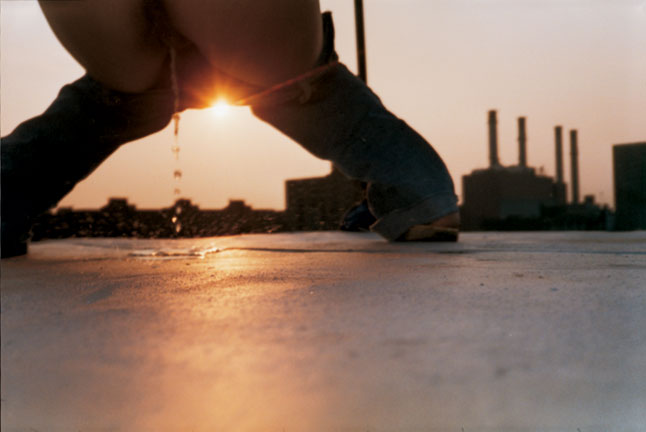
I’ve always had bit of penis envy, but only when it comes to peeing in public. I’ve admired how men could just whip it out and go with no hassle—unlike us ladies who have to find somewhere discreet to pee, and make sure we don’t splash our shoes. So, needless to say, when I met Ellen Jong, who has been taking self-portraits for the past ten years while pissing wherever the damn well hell she wants, I was fully in awe. Jong has shamelessly leveled the playing field, proving women can do anything guys can do—and not ruin their shoes.

 .

Miss Rosen: What is your favorite part of taking photos of yourself peeing in public?

 .

Ellen Jong: What is the most incredible is that these photos bring a smile to everyone’s face because everyone’s got their own story, both men and women.  The smile seems not to be a response to my photos but a smile at themselves while remembering their own stories, which always makes me so happy.  Peeing is harmless.  There are some things that you just can’t take too seriously about yourself.

.

MR: I’ve noticed a range of reactions to the pictures, all of which are very strong. It’s not exactly a subject that goes unnoticed. As the photographer and subject, how do you feel about exposing yourself—to people’s opinions be it positive or negative?

.

EJ: I take many of the responses very personally. While creating the book, I was on the verge of insanity grasping on to the little bit of self I could hold onto. I’ve exposed myself a great deal and pushed even more to reveal what is in the book’s text. It’s difficult to remain distant from criticism when I feel so vulnerable. But, I prefer to hear all the reactions, good and bad. I can’t get the taste of sweet without the bitter.

.

MR: My mother got a little uptight when I told her about the book, and my 91-year-old grandfather was in shock. And I’m just the publisher! How does your family feel about your work?

 .

EJ: My mom and dad are my biggest fans. Though my parents were always really worried about me, when these photos became an expressive body of work and an identifiable thing that I can own, my parents could do nothing but support me. During my first show at Vice, we got shut down by the police because we’d blocked traffic on the street. There were people everywhere. I can even remember a drum circle. It was a crazy party. My parents sat at the window of a nearby restaurant the entire time, watching the mayhem with smiles on their faces. My boyfriend at the time got arrested that night for failure to control the crowd and my mom giggled.

.

Photograph © Ellen Jong

.

MR: Speaking of arrests, I understand you have quite a story.

 .

EJ: While I was living in Miami, I came up to New York for a photo shoot in Times Square. While location scouting, I came across a storefront with red, white, and blue neon verticals in the window. It was 9:00 p.m. on a weekday and there was sidewalk traffic but I figured I’d seen way more crazy things on the street than someone taking a pee, especially in the Times Square area. I propped the camera on the sidewalk and set the self-timer while unbuttoning my pants. I ran to position and peed so fast that by the time I picked up the camera, I was dry and buttoned up. Then a pair of cops came out of nowhere with jaws dropped, asking, “Did you just do what we think you did?”

 .

I couldn’t tell if they were more shocked from witnessing the actual urination or by my blatancy. Or were they shocked to see me, a face of innocence, behaving so provocatively?  I explained my work while talking into the eyes of the female cop, telling her that my photos are not meant to be offensive: “I pee in cityscapes as if in nature, like we were once able to do as children…” I don’t remember exactly what I said, but she was willing to let me go. But then her supervisor rolled by and told her to write me up. Instead of giving me a ticket, she gave me a summons thinking she was giving me a break.

 .

A couple of years later, after I had moved to New York, I was at a summer festival at the East River Park with an open bottle of tequila. The cops came up, took my license, and discovered I had a warrant for arrest because I had ignored the summons. They handcuffed me and escorted me a patrol car.  Mind you, it was summer. I was wearing a mini skirt, a tank top (no bra), and flip-flops. I must have looked 12 if not younger.  And, since the offense doesn’t come up in their system, they were expecting the worst. Did they think I was dangerous?

.

I went thru the system; I sat in the cell at the police station while waiting for my identity verification to get back from Albany. It hit midnight and I was taken to Central Booking for another round of fingerprints, mug shots, and paperwork, with all the other men and women arrested that evening. They finally took off the handcuffs and put me into a cell with four other chicks sleeping on floor mats. I took a bench.

.

The first thing in the morning, I was given a lawyer—she was awesome. When I told her that I was arrested for public urination, she shut her folder and said, “Well no woman should be arrested for that,” then disappeared into the courtroom. When we got in front of the judge, I was surprised to find that no one recognized the offense code. Once revealed there was a chuckle amongst them; even the judge laughed. I had to swear to behave for the next six months. Then my lawyer said I was free to go and directed me to the wooden gate held shut by a small hook latch. I just walked out. I can still hear the giggling in the courtroom. It has been six months and my record should now be cleared.

.

Photograph © Ellen Jong

 .

MR: It’s a little shocking to think this is how our law enforcement system works.

 .

EJ: It’s easy to forget that peeing in public is illegal since it’s something everyone does; when you gotta go, you just gotta go. I might’ve taken it a little far considering some of the places I’ve peed (the phone booth is pretty crass). But I hope the combination of those crass moments and the serenity of the landscapes in nature create a bigger picture. I express my wild and quiet contemplative sides through these pictures. They’re my insides pouring itself onto film.

 .

www.ellenjong.com

Categories: Art, Books, Manhattan, Photography, Women

Nat Finkelstein Shot the Velvet Underground

Posted on October 30, 2009

copyright Nat Finkelstein

copyright Nat Finkelstein

Who Shot Rock & Roll
A Photographic History, 1955–Present

By Gail Buckland

,

BEHIND THE SCENES WITH

ELIZABETH MURRAY FINKELSTEIN

.

Nat Finkelstein, American photographer and photojournalist, was born in Brooklyn in 1933. Starting off as a student of the legendary art director of Harper’s Bazaar, Alexey Brodovitch, Finkelstein worked for agencies like The Black Star and PIX. However Finkelstein is probably best known for his work with Andy Warhol, as his ‘unofficial’ in- house photographer, which is nowadays recognized as some of the best photographic work of the 20th century. Since then, Finkelstein has exhibited his work worldwide; among many other locations, his photographs are in the collection of the Museum of Modern Art, The Metropolitan Museum of Art, The Brooklyn Museum of Art, and The Andy Warhol Foundation, New York; The Victoria and Albert Museum, London; and the Centre Georges Pompidou, Paris. Nat Finkelstein passed away in early October 2009 in his home in Upstate New York. He was 76 years old.

.

Elizabeth Murray Finkelstein discusses her husband’s work, Velvet Underground and Friends, 1966, selected for publication in Who Shot Rock & Roll by Gail Buckland (Knopf, October 2009, $40).

 .

I can imagine you must have mixed emotions, with Nat having recently passed, and the responsibility of running his archive falling to you just as Who Shot Rock & Roll launches. How do you feel about being the spokesperson on behalf of Nat and his work?

 .

Elizabeth Murray Finkelstein: Nat and I had a pact through our marriage: I would protect both his art and his legacy. Because he was significantly older than me—he died at 76, I’m 35—we knew the reality of the situation. I would live to carry on his work, a responsibility I take very seriously.

 .

When I met Nat, he was living in a horrible situation, in a gross apartment under the BQE, depressed and with few prospects for the future. I looked around through this squalid place and there was his artwork. I recognized genius and asked him, “You did all THIS?” And Nat answered, “Yeah, but nobody cares.” He broke my heart. With that, I made it our mission to get his life together and to re-establish him as an ARTIST. I think we did OK.

.

This project really brings my relationship to Nat full circle, as it was through his work at The Factory in the mid 60s that we first connected. Although neither you nor I were there for it, Nat sure as hell was, and though he is gone, his work continues to live on. Can you describe for us how Nat felt about photographing the Factory and its denizens?

 .

Ironically, perhaps, Nat and Andy Warhol had a common background. Both were children of the Depression, of working class families, who found their voice through their vision.  Nat respected Andy – I think Nat knew where Andy was coming from, as an artist and maybe also as a person. Nat was a well-established photojournalist in the 1960s, and Andy knew Nat’s name through photo credits in magazines.    When they met, both probably recognized the mutual benefit. I’ve reminded a few haters that it was Andy who wanted Nat at the Factory. And Nat knew a good story when he saw one.

 .

There were qualities of the Factory that Nat really loved:  brilliant art, beautiful women, and the Velvet Underground. These are the subjects on which he focused his camera. But he believed the Factory ultimately represented the soft underbelly of the American underground. In 1965, Nat was also photographing, and organizing anti-Vietnam War and civil rights activity—ugly scenes of young and old violently oppressed by the powers that were. In contrast, Nat said that political struggle was of no concern at the silver Factory, where celebrity for its own sake was a common goal. He derisively called the arch-scenesters “the Satellites”—those who existed only to revolve around a bigger star.

 .

Nat described the Velvet Underground as “the psychopath’s Rolling Stones.” Please elaborate…

 .

The Psychopath’s Rolling Stones… Ha! In 1966, Nat used that phrase in his book proposal for the Andy Warhol Index. He was a huge fan of the Rolling Stones, so he wasn’t being derogatory or demeaning—he was being pithy. However, Nat told me that Lou Reed was totally offended when he read this. Obviously, the VU were doing their own thing, but Lou thought the comparison to the Stones diminished their uniqueness. And so, as per Nat, Lou Reed responded, “The three worst people in the world are Nat Finkelstein and two speed dealers.” Touché! Nat claimed Lou never forgave him for the “psychopath” quote. That’s sad, because Nat truly cared for the VU as people, as individuals. He was proud of their accomplishments. But he felt he had been iced out—dismissed or betrayed. In the last years of Nat’s life, Eden Cale, daughter of John, became our very close friend. Nat and John reconnected through Eden, which meant a lot to Nat.

 .

Critic Ian Johnston describes Nat’s photo of the Velvet Underground as “…among the best ever portraits of a rock band, exuding sleaze, menace, and decadent glamour.” What are your thoughts on this image, and how well it has stood the test of time?

 .

Nat has maybe 1,000 photographs of the VU—everything from group shots, to performances, to candid portraits of the individuals. As a photographic study of a rock & roll band—a body of work—it may be unparalleled in scope.

 .

The image in Who Shot Rock & Roll was from a group portrait session; we have a few contact sheets from this shoot, which we referred to as “VU with Vox.” As for the far-reaching influence of these photos, I’m reminded of an email we got several years ago. A VU fan from England, I believe, wrote to ask if Nat had any photographs of the Vox speaker by itself. The fan wanted to know if a legend about the alteration of the Vox knobs was true, and if Nat had photographic evidence. Nat’s response was, “Do you want to buy a photograph?” To which the fan responded, “I just want to know if the story is true.”

 .

I was a fan of the Velvet Underground long before I knew Nat Finkelstein. I didn’t know Nat’s name. I certainly didn’t know he would be my husband—but I knew his pictures. Nat’s photographs are the visual component to the VU story. Despite the arguments and estrangements, Nat and the VU are inextricably linked in history. As long as the Velvet Underground is relevant, which I imagine is forever, Nat’s photographs will remain relevant, too. Great art is timeless.

Categories: 1960s, Art, Books, Brooklyn, Exhibitions, Manhattan, Music, Photography

Godlis Shot Debbie Harry and Patti Smith

Posted on September 1, 2009

Godlis - Blondie

Godlis – Blondie

 .

Godlis began photographing at CBGB’s in 1976. As a refugee of the New York City street photography scene, his work reveals an infatuation with Leica cameras, long handheld exposures, and Brassai’s classic night photographs of the 1930s. His work has been exhibited at the Museum of Modern Art, in the landmark 1981 show “New Wave/New York: at P.S.1, New Museum of Contemporary Art, CBGB 313 Gallery, and Pace MacGill Gallery, all in New York; and at Rencontres Internationales de la Photographie, Arles.

 .

Godlis discusses his work, Blondie, CBGB’s, New York City, 1977, and Patti Smith Outside CBGB’s, Bowery and Bleecker Street, New York City, 1976, selected for publication in Who Shot Rock & Roll by Gail Buckland (Knopf, October 2009, $40).

 .

What lead you to study photography at Imageworks and what were your aspirations when you first entered the discipline?

 .

Godlis: Well, seeing Antonioni’s “Blow Up” was probably pretty key to me getting interested in photography. David Hemmings as David Bailey in his darkroom in swinging London, with the club appearance by the Yardbirds—not to mention Vanessa Redgrave and Jane Birkin; that made photography look pretty cool.

.

I got my first camera at the end of the summer of 1970. I was living in Boston and immediately began shooting black & white pictures of all my friends. I became fascinated by the cult of the camera itself.  I started educating myself by picking up old Photography Annuals and hanging out looking at photo books at the library. I was clearly obsessed with what this “photography” thing was, so I took a basic course in 1972 to actually get inside a darkroom.

 .

Right around that time, I took a trip to NYC to the Museum of Modern Art, where I was stunned by the Diane Arbus 1972 exhibition.  For me that was a defining moment, where my fascination with photography crossed paths with the rock aesthetic I had grown up around. Bob Dylan’s “Ballad of a Thin Man” was cut from the same cloth as Diane Arbus’ “Jewish Giant with Parents.” So that exhibition, along with the first time I saw Cartier-Bresson’s “Decisive Moment” was the turning point for me.

.

After that I needed a place to really learn how to learn about the art of photography. Imageworks was where I landed in the fall of 1974. Imageworks was in East Cambridge, Massachusetts. It was the kind of experimental photography school that really flourished in the early 70s—an art school devoted totally to photography—where a group of like-minded kids with cameras showed up to pick up skills and share ideas. Teachers came in from RISD in Providence and SVA in NYC. My first class, my first day—Nan Goldin and Stanley Greene were both beginner photographers in that class—was like jumping into a cold pool. It was all photography all the time, and I couldn’t get enough of it.

 .

Imageworks was where that I began to learn how to really look at photographs—Robert Frank, Walker Evans, Lee Friedlander, Garry Winogrand, Brassai, Kertesz, Atget, Weegee. My greatest teacher was Paul Krot from RISD, who invented the Sprint chemicals I still use. He cut through all the crap and made it very clear what was important to know. And there really was a cult of straight “street photography” at Imageworks.  That’s what really interested me, and that’s how I saw myself, in that pre-Post Modern era: the lonely street photographer with camera conquering the world.

.

I hung around Imageworks until it imploded and shut down during the recession of 1975, and then packed up my gear and headed to NYC to shoot on the streets of New York and look for work as an assistant.

 .

NYC, 1976, Abbie Hoffman’s old St. Marks Place apartment!! It couldn’t be more fitting. Gail quotes you as saying, “I wasn’t a rock photographer. I photographed a scene.” What attracted you to the East Village in 1976, and to its underground HQ, CBGB’s?

.

When I got to NYC in 1976, I was looking for work as a photographer’s assistant to pay the bills.   Eventually I landed a steady job, and looked for a place to hang out and hear music. There weren’t very many clubs that didn’t have cover bands, and I’d seen that picture of Patti Smith and Bob Dylan that kind of tipped me off to CBGB’s, so I went in there to see what was going on. I had also seen copies of Punk magazine and Rock Scene at a newsstand at Penn Station. The first time I went to CBGB’s I saw Television and figured out pretty quickly that there were some like-minded Velvet Underground fans in this place. I had found my new hangout. It didn’t hurt that I got in for free.

 .

But I didn’t really go there to photograph, I went there to hear music and meet people. It was late one night at the bar that I had this epiphany that maybe I should be photographing the place. If I could photograph it at night under natural light exactly the way it looked—I had been looking at Brassai’s night pictures of Paris in the 1930s  at the time—that would be something no one else was doing. And if I didn’t do it who would? I didn’t want to be a rock photographer. I didn’t want to be Annie Liebowitz. I wanted to be Brassai!

.

As far as St. Marks Place goes, I used to go down there in the 60s when I was a teenager and always loved the block so it wasn’t that far fetched to go looking for an apartment there. It was close to the Bowery and CBGB’s where I was spending all my time, and the rent was cheap. Roberta Bayley lived upstairs in the same building, so we could share darkroom chemicals. What I didn’t expect was that I would end up in Abbie Hoffman’s old apartment. I found that out years later, when we went on rent strike and one of my neighbors told me that Abbie had gone underground from there. It’s always felt like a lot of history passed through that place.

 .

Your epiphany, to photograph New York at night, and to explore the issues of film, paper, and exposure, are what set apart your work from so many others. Your work with light at night is exciting, can you speak about the different challenges you faces with the conditions of the street and nightclub environments?

 .

I was committed to shooting by natural light at night—no flash—so I was already painting myself into a corner. But it was my corner and no one else’s. If you use a flash, it’s like turning a light on in a room that’s already lit a certain way and I definitely didn’t want to do that. But I made it work for me. I wanted my pictures to look exactly the way things looked at CBGB’s, at that time and place.

 .

I was already shooting with a Leica camera, which I could hold steady at slow shutter speeds. But the problem was determining the right combination of shutter speeds, f/stop, and film developing. That took weeks of testing. I was like a mad scientist in the darkroom, trying variations of mixing chemicals to push the Tri-x film until I got enough on the negative to make a good print. Then testing out papers to come up with the right look. It really paid off, in that it gave my pictures a unique look. I didn’t even know what they would look like until I figured it all out. But once I figured it out, I was free to shoot at night indoors, onstage and off, and outdoors with people lit up by the Bowery streetlights.

 .

I had to shoot at ¼-second exposure handheld, so I had to remind people—drunk people—to hold still. But that worked to my benefit too. What was great was that the prints glowed. They looked great at night, when I showed them to people in the club. The darkroom light was the same as the club lighting. The magazines in America thought they were blurry grainy shots because they didn’t look like flash photos but in England and France they loved them.

 .

Now for the people who were there in 1976-79, they tell me the pictures look exactly like what they remember of CBGB’s. And for people who weren’t there, the pictures show them what it would have been like to be there. That was what I wanted to do—to show what the present will look like as the past. That’s the essence of my type of photography.

 .

How did the people on the scene connect to the work you were doing?

 .

I used to go down to CBGB’s every night with a box of pictures to show people what I was doing. Inevitably I left with fewer pictures than I showed up with—I gave many away. But over time, everyone in the club knew what I was doing and wanted to be part of it. There were no digital backs on the cameras back then. So you had to develop and print the work yourself every day.

 .

The way the pictures were printed made them look especially good under the club lighting. I remember Bob Gruen telling me one night—I was so impressed that this was the actual Bob Gruen—that he used to do the same thing, bringing pictures down to clubs and showing them to everyone when he started out.  That meant a lot to me, and everyone’s reaction at CBGB’s spurred me on.

.

Handsome Dick Manitoba’s finding my stolen wallet and returning it to me at CBGB’s one night in 1976 led me to do that picture of him and his girlfriend Jody in front of CB’s to return the favor. Television called me to do their photograph for the second album, which led to the pictures of Richard Lloyd at in the hospital. Tapping Patti Smith on the shoulder one night outside CBGB’s and asking to take her photograph lit up by the Bowery streetlamps led to one of my most memorable photographs. I remember talking with Alex Chilton in 1977 and being totally impressed by his stories of photographer William Eggleston, whom he’d known in Memphis—which led to us doing the photograph of him where a drop of rain magically landed on the lens.  We really all worked off of each other every night at CBGB’s—just like the bands worked off of their audiences.

 .

I love your little story about Robert Frank, could you retell it here?

 .

Well I was such a big fan of Robert Frank since my time at Imageworks and so much of what I was doing at CBGB’s was influenced, both consciously and unconsciously, by him. I knew The Americans and Lines of My Hand inside out. His photograph of the kids with the jukebox from The Americans, I wanted to make that photograph inside CBGB’s. I had seen him speak in 1975 at Wellesley College right after Walker Evans had died, when he showed a reel of the banned Rolling Stones film.

 .

But now here I was shooting at CBGB’s in 1977 and in walks Robert Frank, right past the front desk. I was stunned. I was the only one there who recognized him. But to me, one of my biggest influences had just walked into the place, where I was shooting pictures totally influenced by him. At that time I didn’t have any idea that he lived around the corner on Bleecker Street! I remember he asked me what was going on here, and he said in his Swiss accent, “It looks like de way people dress here is very important.”

 .

Then everyone around me wanted to know who is this guy. I said incredulously, “That’s Robert Frank!” Well no one knew who that was. So I said, “Robert Frank, The Americans?” No reaction. “Cocksucker Blues”? Still no reaction. Then “Exile on Main Street?”  Well that was a pretty influential album on the punk scene in 77, so when I said he did the cover for that album, it clicked and people said, “Oh yeah—he’s very cool! What’s his name?”

.

Godlis - Debbie Harry

Godlis – Debbie Harry

Categories: 1970s, Art, Books, Brooklyn, Exhibitions, Manhattan, Music, Photography

Chris Stein Shot Richard Hell and Debbie Harry

Posted on August 31, 2009


Chris Stein - The Legend of Nick Detroit

Chris Stein – The Legend of Nick Detroit

.

Chris Stein, guitarist and songwriter, was born in Brooklyn. In the early 70s, Stein joined the glam-rock group the Stilettos, which featured Deborah Harry as its lead singer. After the Stilettos fell apart, Stein and Harry formed the hugely popular and successful punk/New Wave band Blondie. Stein wrote the hit song “Sunday Girl,” and co-wrote, with his onetime-girlfriend Harry, Blondie hit songs including “Heart of Glass,” “Dreaming,” “Rapture,” “Picture This,” “Rip Her to Shreds,” and “Island of Lost Souls.” He ran the label Animal Records from 1982 to 1984, and also did the album cover for “Exposure,” Robert Fripp’s solo album, the first record cover done will all color Xeroxes. Stein not only composed the scores for the films “Union City” and “Pie in the Sky: The Brigid Berlin Story,” but also was a co-composer on the scores for the movie “Wild Style” and the TV special “When Disco Ruled the World.” In the late 90s Chris and Harry relaunched Blondie; since then the group has recorded two albums and continues to perform in concert all over the world. Stein, also a longtime photographer, has done album artwork for Lydia Lunch and Dramarama.

 .

Stein discusses his works collaborations with John Holmstrom for PUNK magazine, Richard Hell and Debbie Harry, Seventeenth Street, New York City, “The Legend of Nick Detroit,” and Anya Phillips and Debbie Harry,” selected for publication in Who Shot Rock & Roll by Gail Buckland (Knopf, October 2009, $40).

.

 You are a musician as well as a photographer, which gives you a unique insight into the relationship between photography and music. How do you feel the image impacts the listener’s understanding of the music?

 .

Chris Stein: I have never figured out or decided if image was a plus or a minus when it comes to defining one’s musical style. I often say in interviews that when I was a teenager “most of my heroes were 60 year old black men.” This of course is a reference to trends that embrace only youth and fancy fashion as the mark of success. Recently much was made of the dowdy matron who appeared on some TV talent show and was endowed with a terrific singing voice. But there the context was all about her unattractiveness, which then became her selling point thereby negating the whole argument. Very weird! 

 .

Your photographs in Who Shot Rock & Roll feature the distinctive graphics of John Holmstrom. They are unlike any other image in the book, as they show your willingness to collaborate with yet another artist in the creation of the image. How did you come to create these images—clearly they were staged, but did you have the end product in mind when you set out to shoot, or was this something that came about through the process of creation itself?

.

Going into the various PUNK magazine projects with John, I was already familiar with the form: that of the Fumetti, a photo story that was laid out like a comic strip, often with speech balloons for the characters. Fumettis began, I think, in the early 60s and are currently more popular in Latin America and Europe than in the U.S. John Holmstrom was a source of many terrific ideas and working with a large number of our peers from the rock scene in NYC was great fun! In many of the photos I left room for the speech balloons when composing the shot.

.

What advantages do you see in shooting your own band and artistic coterie instead of having someone from the outside doing it?

.

Just the familiarity between us makes it easier to shoot candid moments.

 .

In the days before the Internet and digital photography, when content was seemingly limited to those with access, the creation of images played a massive role in the music. How does your work contribute to this archive?

 .

Because Debbie was so photogenic and appealing in pictures it was easy to disseminate shots of her to the media early on. Many people saw her image before hearing the bands music. During the 70s in the UK the weekly national music press didn’t have an equivalent in the U.S. and because of this many bands were visually available to British music fans prior to those bands music being heard or played on radio. This phenomenon certainly contributed to the popularity of “punk,” which relied heavily on elements of fashion to define itself.

.

Chris Stein - Staten Island Ferry

Chris Stein – Staten Island Ferry

Categories: Art, Books, Brooklyn, Exhibitions, Manhattan, Music, Photography

« Older entries    Newer entries »

Categories

Archives

Top Posts

  • Home
  • About
  • Marketing
  • Blog
  • Azucar! The Life of Celia Cruz Comes to Netflix in an Epic Series
  • Eli Reed: The Formative Years
  • Bill Ray: Watts 1966
  • Jonas Mekas: I Seem to Live: The New York Diaries 1950-1969, Volume 1
  • Mark Rothko: The Color Field Paintings
  • Imprint

Return to top

© Copyright 2004–2025

Duet Theme by The Theme Foundry