Miss Rosen
  • Home
  • About
  • Imprint
  • Writing
    • Books
    • Magazines
    • Websites
    • Interviews
  • Marketing
    • Publicity
    • Exhibitions & Events
    • Branding
  • Blog

Posts from the “Books” Category

Jamel Shabazz: “Everything You Do Today Will Reflect on Your Future.”

Posted on May 1, 2010

The Art of War, 1980, Photograph © Jamel Shabazz

.

On a slow, sunny summer day during 2000, while working at powerHouse Books, there was a knock on the door. I jumped up to open it. A tall and stylish man stood before me, graciously introducing himself as Jamel Shabazz.

.

As Jamel recalled for this interview, “I decided that it was time to move forward and produce my first monograph, so I found the address to powerHouse Books and took a chance. Once I arrived, I remember standing outside the hallway to the office for a few minutes, going over my strategy, one final time. I then took a deep breath and knocked on the door. My world would never be the same. Once in, I introduced myself to the vibrant, Miss Sara Rosen, who greeted me with a million dollar smile, she then referred to Craig Cohen, Associate Publisher, whose disposition was warm and genuine.”

.

Although Jamel did not have an appointment to meet with us, when he showed us a catalogue from an exhibition of his work in Paris, Craig and I nearly fell over from excitement. We had never seen anything like his work before—bold portraits of people on the streets of New York City during the 1980s revealing the original style and fierce pride as hip hop first made its way into the culture. I remembered my childhood in the Bronx; Craig recalled that of his in Brooklyn; and we both decided to publish Jamel Shabazz’s first book, Back in the Days, the following year.

.

Nearly ten years have passed since that fateful day, and powerHouse published additional books by Jamel Shabazz including The Last Sunday in June, a ten-year retrospective of New York’s Gay Pride Parade, Seconds of My Life, a thirty-year career retrospective, and my personal favorite: A Time Before Crack, which revisits Jamel’s archive and reaches new depth and understanding of street culture with a collection of images which span 1975–1985. I am honored to have helped introduce Jamel and his work to the world, and humbled by the outpouring of love and admiration his photographs have inspired. I thank him for giving me the opportunity to speak with him about his work. Enjoy the interview!

.

Best Friends, Photograph © Jamel Shabazz

.

I developed a theory a long time ago about why your work inspires so much love among people who see it. I believe every photographer is “in” their photographs just as much as their subject is. For example, when you see a cold photograph, you also see a cold photographer. I always thought what was amazing about your photographs was that you had first spoken and connected with the people in the photos by engaging them in conversations about pride, self-love, respect, and self-empowerment. And after your conversations, you had taken their photos. So when they looked into your camera, they radiated back to you the positive energy with which you imbued them. And that we, as viewers, look at these people looking at us with so much love, pride, respect—power—that we get a jolt. It is as if what you said to the people in these photographs is now being then transferred to us, the viewers.

.

So that’s a long theory yes, but it is the only way I can understand how people react so strongly to these photographs. Believe you me, I have seen a lot of people look at a lot of photos but never have I seen the reaction your photos get. And I don’t think it’s because of the shoes, or the glasses, or the coats. I think it is because there is something about Jamel that is coming back through these photographs, and we feel it when we look at it. But I wanted to ask you: why do you think people have had the reaction to the work?

.

Jamel Shabazz: Your observation is 100% right on. Before each photograph, I took the time to engage most of my subjects about life and making the right choices, in order to survive. I did this because when I was younger, the older guys, in my community did it to me, so it was ingrained in me as a young child to give back, and I vowed that I would reach out to the youth in my community at all cost. They respected me because I wasn’t afraid of them, and I took an interest in their lives. It was beyond the photograph—I help many make career choices; I spoke to them about diet, education, and  how  to select the right mate.

.

Each image that you see in my book is a visual record, of the countless encounters that I had with young people. I did it out of love and concern. I saw  the crack epidemic making it’s way to my community and I wanted to avert as many as I could away from its destruction. So when you study the faces of those in my book, you are seeing faces of young men, women and children, who I just finished bonding with, young people who I told were special and were our future.

.

Often times I would departed them with the words, “Everything you do today will reflect on your future.”

.

Fly Guy, Photograph © Jamel Shabazz

.

When you began work on A Time Before Crack, you were adamant that this book not through of as Back in the Days Part II. Please elaborate.

.

Jamel Shabazz: The book was originally called Strictly Old School and I decided to change not only the name, but the images. With the success of Back in the Days, I felt at first that a continuation would be a good ideal, however I didn’t want to be pigeon-holed as a fashion photographer, so I came up with a title that reflected a social condition rather than trying to make a fashion statement.

.

To make the book different from my first, I used photographs that I took in the mid-70’s and that alone separated it from Back in the Days. In addition I included more group shots, women, children, and families. Using the collage in the front and back gave it a little more edge and allowed me to have over a thousand faces in this work.

.

I enlisted four writers (Claude Gruntizky, Charlie Ahearn, James “Koe” Rodriguez, and Terrence Jennings) to give commentary of their choice, each one from a different racial back ground, African, White, Latin, and African American.

.

A Time Before Crack is about a people who lived in a time before crack cocaine destroyed communities, and ruined lives. This book books serves as visual medicine for those that were affected by the epidemic.

.

Homeboys, 1980, Photograph © Jamel Shabazz

.

You have been labeled a “Hip-Hop fashion photographer,” but you would prefer to be recognized as a street and documentary photographer. Please explain why.

.

Jamel Shabazz: I have been called a Hip-Hop photographer on countless occasions and those that see me that way really don’t understand my history or work. Yes, I have shot Hip-Hop fashion for magazines but that only represents such a small body of my work. I started taking photographs, when the term “Hip Hop” wasn’t even in the dictionary. To accept this label would limit my creativity.

.

Photo documentarian is the proper term for my work. It’s broader and has greater leverage. For thirty years have traveled travel both far and near and document varies people and cultures. I have shot homelessness, prostitution, military culture, the law enforcement community ,the horror of 911, and so much more. I look forward to the day, when I can share that part of my work. Every chance I get, I make it a point to display images that reflect that side of my craft.

.

The international success of hip hop has allowed me to share it’s platform. I am very grateful for that and I will continue to incorporate it in all I do—but there is so many other things that needs to be recorded as well. For example, I have a desire to go to Vietnam and document the children of American service men that were left behind over thirty years ago. No one really knows that side of me.

.

East Flatbush, Brooklyn, 1980, Photograph © Jamel Shabazz

.

What do you hope the publication of these photographs, taken over 20 years ago, will do for the people and the culture today?

.

Jamel Shabazz: My objective with A Time Before Crack is to create conversation about how  life was before the great crack and AIDS plagues of the 1980s—when women were treated with respect,  when the majority of us had two-parent house holds.

.

Crack cocaine snatched the lives of so many innocent souls. Thousands of young men and women have had their lives ruined by drugs, and many linger in prisons through out America today due to them.

.

I have heard on numerous occasions how people broke down and cried while looking at my photographs, remembering a better time.

.

My goal is to make being positive and caring popular again.

.

Tupac, 1998, Photograph © Jamel Shabazz

www.jamelshabazz.com

Categories: 1970s, 1980s, Art, Books, Photography

DJ Disco Wiz: “A Man Is Made By What He Accomplishes Against All Odds”

Posted on April 22, 2010

 .

It’s Just Begun: The Epic Journey of DJ Disco Wiz, Hip Hop’s First Latino DJ is a gritty and gripping tale of one man’s struggles to not only survive, but to triumph over adversity and abuse.

 .

I have always held Luis Cedeño (or Wiz, as his friends like to call him) with the highest regard and have always felt that he was family. His warm and generous personality belies his horrific personal history, a history of which I had not even a clue before editing of his autobiography. To know someone who has endured and overcome physical, emotional, and psychological pain so intense it could have easily destroyed a lesser man renews my faith in the redemptive power of love and humanity.

 .

For every person who believes Hip Hop is about money, status, and fashion; for everyone who equates violence and destruction with street credibility; for everybody ready to believe that the only way to succeed to ensure others fail, It’s Just Begun offers the antidote. Wiz’s story is more than a glorified, romanticized look at street life—it is a chilling, gripping, and ultimately uplifting saga of one man’s quest for emancipation from the prisons in which he has been living.

.

Even at this late date, so many years after we first met, I still find it difficult to reconcile the charming and cuddly DJ I love with stories I have read. Which is, I believe, a testament, to the transformative possibilities on this earth. As I type these words, chills spill across my back, not wanting to give anything away, but unable to hold back.

 .

Wiz sat down for an interview to talk about what he’s been through, and how he has made it this far.

 .

Your grandfather Norberto Cedeño was a respected artist and you say that this was the one aspect of his life your family felt comfortable talking about.  As a child, what was their reaction to your interest in art and drawing and eventually music and performance?

 .

DJ Disco Wiz: As far as I remember I was always artistic. My family always commented “you got that from your grandfather”.  But the sad thing is that once I got into Hip Hop, they were totally not supportive. To them it was a black thing and they could not associate themselves with what I was doing. They never went to see me DJ, nor did they care about what I was doing. They really didn’t grasp the movement, nor could they see beyond their prejudices.

 .

Apart from Hip Hop, what music did you listen to growing up?  Did you follow what was happening in Latino music at the same time?

 .

Wiz: First of all, as a child there was no such thing as Hip-Hop music. We created the genre and movement that would later be termed Hip Hop. I was a lover of all genres of music, Motown, rock, R&B, Disco, funk and soul. And eventually the sound of the Fania All Stars Salsa music as well.

.

That montage of music, was what later helped me as a DJ become that avid “crate digger” in search of those great break beats which would become synonymous with the early years of Hip Hop. It was all about the DJ back then.

 .

There’s a moment in the book when you talk about watching Kool Herc set up for a jam at the P.A.L.  When did you cross the line from being in the crowd to DJing on the stage, and what was it about hip hop that makes this possible?  Was there a single moment early when you realized that this was something you could really do?

.

Wiz: It was an epiphany at the moment, but seeing Kool Herc the first time was not the deciding factor. Crossing over is all credited to my childhood friend and partner Grandmaster Caz. He was the one who pulled me into the role of becoming a DJ. I really can’t answer specifically what in Hip Hop makes it possible; I can undoubtedly say that for me it was an indescribable feeling that compelled me towards the movement.  At that time we did not know what we were doing. But we knew it was an alternative to the obvious, of street gangs, prison or early death. So to answer your question, no one knew or realized its full impact or significance at that moment. It wasn’t until many years later that we realized what we had created.

 .

You describe the negative feelings other Latinos had about your involvement in Hip Hop.  What problems did you encounter from the African Americans you were performing for and with?  What kind of prejudice did Grandmaster Caz and your black friends encounter for including you?  Did you bring anything from Cuban or Puerto Rican music to DJing that they didn’t like because it was from Latin music?

.

Wiz: Caz and I both got hassled by our respective communities. My street credibility was enough to keep any personal attacks from stopping me by either community from doing what I wanted to do. As matter of fact, in the beginning no one really knew I was Spanish. Everyone presumed that I was black until they got to see us perform live. Then they were shocked to see a light skin Latino rocking the turntables.  But as far as the music was concerned I definitely found my distinctive signature by gravitating towards the break beats that came from ancestral African drums which is the foundation of all Spanish and black music. I also had this aggressive style behind the turntables that would later be termed Battle Style DJ.

Photograph courtesy of DJ Disco Wiz

.

Photograph courtesy of DJ Disco Wiz


Did your presence bring more Latinos to your shows that may have stayed away otherwise? Do you follow Latino Hip Hop now, specifically in Cuba and Puerto Rico?


Wiz: Once they started realizing that DJ Disco Wiz was Spanish, I’d have to say yes. The Latino community started coming out to the events. I definitely support the young up and coming Latino hip hop artist from both Cuba and Puerto Rico like Mellow Man Ace, Immortal Technique, Rebel Diaz, and T-Weaponz etc… I actually support the movement in all Latin countries for example Mexico’s Boca Floja, who I just performed with in Mexico City. I also have a weekly radio show on UrbanLatinoRadio.com called the Hip Hop Chronicles where I feature the new Hip Hop artist as well as the old school fundamentals.

 .

Studying with Peace and the Latino organization in prison, you describe how cycles of violence throughout history have affected our communities.  Did this alter or change your feelings towards your father and grandfather as products of the same cycle?  You had extremely volatile relationships with the men in your life but the women seem to have been a more constant presence.  How has their influence helped you break some of these patterns?

 .

Wiz: Honestly, I never really thought about my father or grandfather or related with them when it came to my life. I never met my grandfather so I really never harbored any negative feelings towards him. As far as my father was concerned, once he passed away I rarely thought about him until I started writing this book.  All the life lessons I acquired during my incarceration I applied towards myself.  Through the constant love I received from the women throughout my life, especially my wife Lizette, I have learned to love myself and those around me in order to break that vicious cycle of violence that I once lived by.

.

Has the experience of writing your memoir changed your relationship to some of the people in your past?  Have you gotten any feedback or reaction from the people you’ve written about?

.

Wiz: I would have to say yes, especially the relationship with my daughter Tammy. I believe the book was an eye opening experience for Tammy. It gave her a new perspective to who her father really was and to what really happened thirty years ago. I believe she now understands me better and she has expressed to me how much the book has changed her own life. I feel it has definitely helped us both heal. As far as feedback, my partner Grandmaster Caz just told me how incredible he thought the book was. He mentioned how the book took him back in time to even some of the memories he had forgotten.  This to me was very significant because he even mentioned how much he didn’t know about me until he just read the book.

 .

You chose not to rejoin Caz when you were released from prison in the early eighties.  How did you follow Hip Hop during the period you weren’t performing?  You’re very critical about the way hip hop has evolved.  What are some of the points or events you feel changed it for the worse and for the better?  How could people reclaim it now?

.

Wiz: Once I went away, my life was pretty much scripted for me. When and if I came out, I would have to be a productive member of society. To me and many that meant getting a real job and staying out of trouble. Unfortunately, Hip Hop did not provide that life style at the time.  Hip Hop has always been a part of my life in one way or another. Although I wasn’t performing, I was on top of what was happening with Caz and the movement.  In the beginning hip hop was about the people and for the community that really had nothing else. After I came home, it was no longer that. When Hip Hop became a business it changed its essence and became something new and very different from what we had created so many years earlier in the streets of the South Bronx. Exactly when that happened, I can’t pinpoint. But in my opinion the change was neither good nor bad. It was a change that helped hip hop become global. And it is a business that has helped many. I truly believe that for anything to survive it must reinvent itself and change with the times, and hip hop is a perfect example of this. People reclaim it everyday. Today, real Hip Hop lives in the grass roots and underground movements. In some places it still is about the people and for the community

.

Your memoir preserves an important part of Hip Hop’s history.  What do you believe is the future of Hip Hop?

.

Wiz: Its future is just like it’s past, the possibilities are endless.

 .

Many of the struggles in the book come from your need to establish a street reputation for survival.  If you could say one thing to the kid you were then, what would it be?  What did you believe made a man then and what do you believe makes a man now?

 .

Wiz:  I would tell that kid to believe in himself no matter what his circumstances are, because no one believed in me as a child. They never told me I would accomplish anything. Needless to say that I would be a part of an incredible global movement like Hip Hop, a top chef at some of the finest eating establishments in the world and an author of a book I believe and hope will change many lives is something no one saw coming. I believe now that a man is made by what he accomplishes against all adversities and all the odds. And what he eventually leaves behind for future generations to learn from and the lives that he touches along the way.

 .

Photograph courtesy of DJ Disco Wiz

 .

Luis “DJ Disco Wiz” Cedeño, the first Latino hip hop DJ, is credited for being the first DJ to make a “mixed plate” in 1977 along with Grandmaster Caz. In the years since, Wiz has been an influential force in educating the world about the early years of hip-hop. Wiz was a major contributor in the opening of the Experience Music Project in Seattle in 2000, and was instrumental in the making of Jim Fricke and Charlie Ahearn’s Yes Yes Y’all (Da Capo Press, 2002). He was also featured in the Emmy-nominated VH1 Rock Doc NY77: The Coolest Year in Hell, and is the creator and founder of the Hip-Hop Meets Spoken Wordz series.

.

Don’t Stop! Get It! Get It!

Check the Reviews

Categories: 1970s, 1980s, Art, Books, Bronx, Music, Photography

Ellen Jong: “Did They Think I Was Dangerous?”

Posted on April 15, 2010

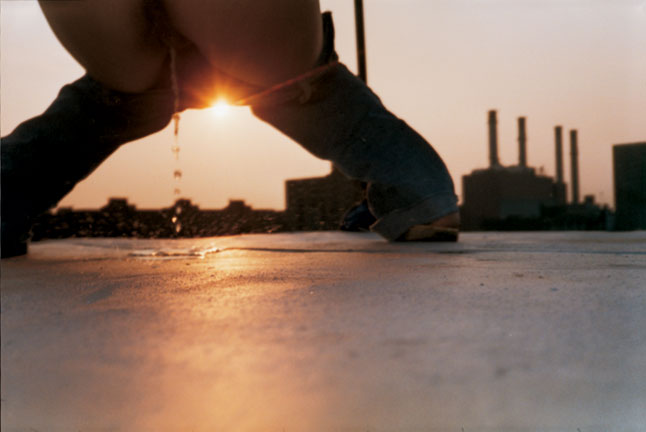
Photograph © Ellen Jong

 .

I’ve always had bit of penis envy, but only when it comes to peeing in public. I’ve admired how men could just whip it out and go with no hassle—unlike us ladies who have to find somewhere discreet to pee, and make sure we don’t splash our shoes. So, needless to say, when I met Ellen Jong, who has been taking self-portraits for the past ten years while pissing wherever the damn well hell she wants, I was fully in awe. Jong has shamelessly leveled the playing field, proving women can do anything guys can do—and not ruin their shoes.

 .

Miss Rosen: What is your favorite part of taking photos of yourself peeing in public?

 .

Ellen Jong: What is the most incredible is that these photos bring a smile to everyone’s face because everyone’s got their own story, both men and women.  The smile seems not to be a response to my photos but a smile at themselves while remembering their own stories, which always makes me so happy.  Peeing is harmless.  There are some things that you just can’t take too seriously about yourself.

.

MR: I’ve noticed a range of reactions to the pictures, all of which are very strong. It’s not exactly a subject that goes unnoticed. As the photographer and subject, how do you feel about exposing yourself—to people’s opinions be it positive or negative?

.

EJ: I take many of the responses very personally. While creating the book, I was on the verge of insanity grasping on to the little bit of self I could hold onto. I’ve exposed myself a great deal and pushed even more to reveal what is in the book’s text. It’s difficult to remain distant from criticism when I feel so vulnerable. But, I prefer to hear all the reactions, good and bad. I can’t get the taste of sweet without the bitter.

.

MR: My mother got a little uptight when I told her about the book, and my 91-year-old grandfather was in shock. And I’m just the publisher! How does your family feel about your work?

 .

EJ: My mom and dad are my biggest fans. Though my parents were always really worried about me, when these photos became an expressive body of work and an identifiable thing that I can own, my parents could do nothing but support me. During my first show at Vice, we got shut down by the police because we’d blocked traffic on the street. There were people everywhere. I can even remember a drum circle. It was a crazy party. My parents sat at the window of a nearby restaurant the entire time, watching the mayhem with smiles on their faces. My boyfriend at the time got arrested that night for failure to control the crowd and my mom giggled.

.

Photograph © Ellen Jong

.

MR: Speaking of arrests, I understand you have quite a story.

 .

EJ: While I was living in Miami, I came up to New York for a photo shoot in Times Square. While location scouting, I came across a storefront with red, white, and blue neon verticals in the window. It was 9:00 p.m. on a weekday and there was sidewalk traffic but I figured I’d seen way more crazy things on the street than someone taking a pee, especially in the Times Square area. I propped the camera on the sidewalk and set the self-timer while unbuttoning my pants. I ran to position and peed so fast that by the time I picked up the camera, I was dry and buttoned up. Then a pair of cops came out of nowhere with jaws dropped, asking, “Did you just do what we think you did?”

 .

I couldn’t tell if they were more shocked from witnessing the actual urination or by my blatancy. Or were they shocked to see me, a face of innocence, behaving so provocatively?  I explained my work while talking into the eyes of the female cop, telling her that my photos are not meant to be offensive: “I pee in cityscapes as if in nature, like we were once able to do as children…” I don’t remember exactly what I said, but she was willing to let me go. But then her supervisor rolled by and told her to write me up. Instead of giving me a ticket, she gave me a summons thinking she was giving me a break.

 .

A couple of years later, after I had moved to New York, I was at a summer festival at the East River Park with an open bottle of tequila. The cops came up, took my license, and discovered I had a warrant for arrest because I had ignored the summons. They handcuffed me and escorted me a patrol car.  Mind you, it was summer. I was wearing a mini skirt, a tank top (no bra), and flip-flops. I must have looked 12 if not younger.  And, since the offense doesn’t come up in their system, they were expecting the worst. Did they think I was dangerous?

.

I went thru the system; I sat in the cell at the police station while waiting for my identity verification to get back from Albany. It hit midnight and I was taken to Central Booking for another round of fingerprints, mug shots, and paperwork, with all the other men and women arrested that evening. They finally took off the handcuffs and put me into a cell with four other chicks sleeping on floor mats. I took a bench.

.

The first thing in the morning, I was given a lawyer—she was awesome. When I told her that I was arrested for public urination, she shut her folder and said, “Well no woman should be arrested for that,” then disappeared into the courtroom. When we got in front of the judge, I was surprised to find that no one recognized the offense code. Once revealed there was a chuckle amongst them; even the judge laughed. I had to swear to behave for the next six months. Then my lawyer said I was free to go and directed me to the wooden gate held shut by a small hook latch. I just walked out. I can still hear the giggling in the courtroom. It has been six months and my record should now be cleared.

.

Photograph © Ellen Jong

 .

MR: It’s a little shocking to think this is how our law enforcement system works.

 .

EJ: It’s easy to forget that peeing in public is illegal since it’s something everyone does; when you gotta go, you just gotta go. I might’ve taken it a little far considering some of the places I’ve peed (the phone booth is pretty crass). But I hope the combination of those crass moments and the serenity of the landscapes in nature create a bigger picture. I express my wild and quiet contemplative sides through these pictures. They’re my insides pouring itself onto film.

 .

www.ellenjong.com

Categories: Art, Books, Manhattan, Photography, Women

Boogie: Art Coup

Posted on April 13, 2010

In the summer of 2004, I was out in San Francisco and stumbled upon a little black-and-white photography magazine called Hamburger Eyes. I flipped through the mag and came to a full stop at a photo essay called Mean Streets. Ice-cold images of life in the projects of New York City popped off the page as I stood, slack-jawed, in awe. I looked for the name of the photographer: Boogie. “Who is this lil Puerto Rican hardrock with a camera?” I wondered to myself.

.

A year later I would find out. Boogie sent me an email asking me if I would be interested in publishing his first monograph, It’s All Good. He sent me photos, photos, and more photos. I fell off my chair a couple of times. When I got back up, I got up on it. Over the next three years, I published both It’s All Good and Belgrade Belongs to Me under my imprint, Miss Rosen Editions.

.

Funny thing is, no matter how much I learned, I always had more questions. I discovered this interview we did a couple of years back. It still gives me pleasure to read his words and contemplate his work. Boogie’s transformation in the time I have known him is tremendous, and I am grateful for the opportunity we shared to create these two monographs.

.

Photograph © Boogie

.

Miss Rosen: I’d like to begin with family background, about your grandfather and your father’s work, and how your exposure to their work may have influenced you, not necessarily as an artist but as a young man.

.

Boogie: My dad was an icon painter and amateur photographer and my grandfather was too. My grandfather always had the best cameras—Leicas, Contax. He got arrested after the second World War for taking photos of some military facility and then the Communists put him in jail. He thought they were going to kill him so he wrote his last will and testament from prison. My aunt still has it.

.

I had some photos of when the Americans bombed Belgrade in 1945, when the Germans were withdrawing. Then the Communists came and it was worse than the Nazi occupation. Yugoslavia was a totally artificial state. You can’t put together people who don’t want to be together in the same state. The second World War pretty much never ended over there; we’re just waiting for the opportunity to kill each other again. We, Serbs, feel like a great deal of injustice has been done to us. We lost more than 50% of our male population in the first World War, then we lost 2.5 million in the second World War (and we were on the side of the Allies), then the Americans bombed us in the 90s.

.

Photograph © Boogie

.

Living under Milosevic was like living in a mental institution. It was apocalyptic, especially during the biggest crisis in 1993. Pensions and salaries were like three to five United States dollars. People, especially the old and retired, were literally dying of hunger, or committing suicide rather than starve to death. The streets were empty. There was a shortage of gasoline, so there were very few cars on the street. And then, in the middle of the night, you would see a police truck cruising slowly. There were protests against Milosevic every day. In the beginning they were peaceful, so I didn’t go. I don’t believe in peaceful, passive resistance. It’s either grab the gun and go to the woods or sit at home. But then they turned violent. The police were very brutal, beating protesters mercilessly. And that’s when I started to go out and shoot [photographs]. Milosevic wasn’t sure cops from Belgrade would be tough enough—they might not want to beat on their neighbors. So cops were brought from other parts of Serbia, huge cops with mustaches, in riot gear. Shit, I ran from them a few times. Scary.

.

Photograph © Boogie

.

Miss Rosen: Tell me about your work as a young photographer picking up the camera, training yourself—and then going after Nazis as a subject!

.

Boogie: I did a lot of photography back in Serbia. I used to freelance for magazines and newspapers, and I always shoot when I go there to visit. I did a series on Nazi skinheads recently. Belgrade is very cinematic, in a depressing way. A friend of mine is a supporter of a football club; one group of supporters is Nazi skinheads and he knew them so he introduced me to them. The whole movement is on the rise in Europe, especially in Eastern Europe; it came with economic crisis. It’s pretty normal when things go down, you blame someone else.

.

It was like a dream come true, when you shoot stuff no one else can. For awhile that was the point of me being a photographer. It’s not anymore, but when you first start out and you carry a big camera around it’s cool, chicks like me now. You go through phases, and you want people to know you’re a photographer. Then you go over it and the only thing that matters is the final result, the photo, your equipment looks like shit and you’re totally low-key.

.

In the beginning I would find inspiration in shooting rough stuff in things no one could get access to, but now I don’t really care about that. I don’t think that’s what makes a good shot.

.

.

Miss Rosen: Moving in that vein I’d like to discuss the war, how it affected the people you knew, and the world you lived in?

.

Boogie: I am what Belgrade used to be 20 years ago, in spirit. Belgrade had a really unique cosmopolitan spirit 20 years ago and it all got fucked up during the war. Young people left the country, we got a million refugees and that sprit of 86-89 is gone. A new one will somehow evolve and come to existence, but right now it’s just a mix of what’s left from the original spirit and what refugees brought with them.

.

We had really great creative energy, bands that didn’t copy anything from anyone. We had something original, it was ours. The underground clubs in Belgrade were the second best in Europe in NME. I was 17, 18, 19.

.

I went into the army when I was 19. You have to go. Of course, it was a waste of time being in the stupid army. The best part is actually shooting and you don’t do that often; and even if you do you have to clean your gun after so it sucks. I was in Air Defense; you don’t fly, you try to shoot them down. It’s antiaircraft guns. I got out in 1990.

.

The conflict started in 1991 and it went through 1998.

.

I started taking photos of the protests in 1993. It was weird—miserable poverty, no money, no gas, nothing. I wasn’t a photographer then. I was a kid with a camera and my photos from then pretty much suck. I think I got my first good shot in 1996. The first good shots I got were during 1996.

.

Photograph © Boogie

.

Miss Rosen: How did you come to live in the U.S.?

.

Boogie: I was just drinking one night with friends at my place and we all applied for the green card lottery and I was the one who won. I never intended to come, and then I won, and of course I had to go because I won. 1998.

.

I thought I spoke English. It was a huge shock. It was like your general opinion about the US is that money is all around, money is all around, land created by immigrants, they’ll love us—can’t be further from the truth. You start from below zero. I started working for some Serbian guy duplicating and delivering videotapes for $300 a week. I was living in a studio in Queens—it was nice, it wasn’t a hellhole, but everything else was grim. My life sucked.

.

The first time I went back was after two and a half years. That was like, it was very hard to come back to the US after spending a few weeks home. At that time Belgrade was home. It took me five years to decide if I am here or if I am still there, but you can’t do anything until you really decide this is your home or back there is your home. Somehow, you put things into place and then you can move on.

.

I wanted to be a photographer. I thought I was very good but I wasn’t.

.

I got a job in a hospital, Beth Israel, fixing medical equipment walking around with a white coat and screwdriver and pliers. $17.50 per hour, overtime 50% more. I always had my camera with me. I would leave home early, shoot before work, shoot after work, rush home and develop. I had a darkroom in my bathroom. The whole hospital thing started driving me crazy and I decided I would learn web design and become a web designer. So I gave myself two months and I learned web design, Flash, and became a web designer; and that was okay because I was making twice as much money.

.

.

Miss Rosen: I remember, after we published It’s All Good, I found a submission you sent to someone years ago at powerHouse. It never got passed along to me—which, in the end, seems to have worked out any way, but it must have been tough to have tried to get down in New York.

.

Boogie: It’s just impossible to get into the photo world. You send your shit around and no one wants you and there is no feedback. You don’t know if you are talented, you doubt yourself. I got depressed and I stopped taking photographs in the year 2000 for two years. Not a single shot, not even September 11.

.

I was doing some web design and I was bored one afternoon and made a website with 20 of my photos. I was searching for some lists of expired domain names and searching by “art,” and I found artcoup.com, and I bought it. It’s very random. I made this little website with just 20 photos and I sent the link around and I got like 20,000 visitors in a few weeks and feedback was amazing and I was like, oh, maybe I should start taking pictures again. So I did.

.

I started shooting again and sending my stuff around and of course same story. No one wants you no one cares, so I was like, I won’t send anything to anyone anymore and it was like that for a few years. I wasn’t really pushing. I met Tim Barber through Vice.

.

Miss Rosen: Yea! It was thanks to Tim that you came directly to me—I had seen your work and was interested, but with everything going on in this office I never seem to have the time to track photographers down. One of the things I remember our discussing in the beginning was your intention with this project—why were you doing it? You weren’t entirely sure, so I asked the obvious question: Are you a moralist?

.

Photograph © Boogie

.

Boogie: Am I a moralist? Hmm, I don’t know. The whole story about photographers doing what they do because they want to change the world, expose harsh reality of wars, starvation, violence—is aaaaaagh, crap. They (me too, I guess) do what they do because it gives them thrills. They become addicted to the adrenalin rush, to the world not everyone is allowed to see. You go to the crackhouse, and there is a chance that something bad will happen to you—then everything turns out to be OK. You get out of there, take a deep breath, and trust me, it’s your best breath of air, ever. I don’t judge people I am photographing. They made some wrong choices in life, and they were too weak to keep fighting, they just gave up. So I guess we’re not gonna change the world, but rather show it as is, fucked up to the bone.

.

As for the gangsters and drug addicts—I guess I’m always after extremes; and, of course, the whole experience of dealing with people like that is like being in the movie. It all started one day when I went to Bed-Stuy. I was walking around when I saw a homeless group in an abandoned parking lot. I approached them (they either thought I was a cop or that I’m crazy or something) and asked to take pictures. They were all like, No, no, no. But one girl allowed me to take pictures of her. I bought her a beer, we started talking, I went there again the next day, and so on and so on. We became friends. Then one day she asked me if I wanted to take pictures of her and her friend smoking crack.

.

I think photography is in a way similar to acting. You need to get into your character’s head, you have to become him in order to fully understand him. I’m a white guy, but white guy with an accent. I don’t sound like anyone gang guys hate, and I don’t really look like WASPy American guy. Also, I feel OK when guns are around (I don’t want them pointed at me, but what the fuck). Hey, I’m Serb after all!

.

Photograph © Boogie

http://boogiephoto.blogspot.com/

www.artcoup.com

Categories: Art, Books, Brooklyn, Photography

Delphine Fawundu-Buford: Nina Simone/Four Women

Posted on April 6, 2010

I first met Delphine Fawundu-Buford a few years ago; damn I don’t even remember how we met, she’s just one of those sparkling magical people who seems to be in your life for the longest, kinda like family. We had been talking about publishing some of her 90s Hip Hop work: Lauryn Hill on the stoop, so innocent you might not even spot her in a crew of round the way girls hangin’ out; Smif N Wessun acting out, kinda crazy bringin me back to Bucktown; and then all these amazing shots taken of storefronts, of a place and a time that’s that old New Yawk that natives reminisce about when they remember how this city used to be…  Let’s just say, Delphine’s got the photo album for a period in Hip Hop history that few people are checking for, but all of us need to be.

.

Miss Fawundu-Buford just reached out to me, to let me know about her exhibition of new work at a group show curated by the amazing Deborah Willis called Girl Talk, which is up at Renaissance Fine Art in Harlem through Sunday April 11. The show closes on April 11 with an artist talk at 2pm. In advance of then, I’m going to let Delphine speak about her pieces, an interpretation of Nina Simone’s Four Women.

.

© Delphine Fawundu-Buford

.

Nina Simone’s Four Women, An Interpretation
Four Self-Portraits by Delphine Fawundu-Buford

.

With this series I created a 2010 interpretation of Nina Simone’s Four Women.

.

Nina Simone’s Four Women speaks to the legacy of slavery and it’s transformation into four archetypes of black women.

.

Nina sings… My skin is black./My arms are long./My hair is wooly./My back is strong./Strong enough to take the pain./Inflicted again and again./What do they call me? My name is Aunt Sara.

.

In my depiction, Aunt Sara is the “strong” black woman.  This strength is reflected mainly in her character and level of endurance.  Sometimes her strength is great as she is a vibrant, creative, hard-working woman who gets the job done.  However at times, she finds this strength to endure the societal pain that has been “inflicted again and again.”  The words on Aunt Sara’s back reflect these conflicting strengths.

.

© Delphine Fawundu-Buford

.

Nina sings…My skin is yellow./ My hair is long/ Between two worlds./ I do belong./ My father was rich and white./ He forced my mother late one night./What do they call me? My name is Safronia.

.

In this series Safronia is often faced with the question: What are you?  This is due to her light skin, light eyes and hair texture.  In a race and image driven society we are often comfortable when we can quickly place a person within some racial or ethnic category.  Safronia is an innocent spirit conceived into a world that refuses to holistically deal with the horrors of her ancestral past.  Safronia’s ambiguous image, and conflicting ancestry leaves her wondering: Who am I?

.

© Delphine Fawundu-Buford

.

Nina sings… My skin is tan./My hair is fine/my hips invite you../My mouth like wine./Whose little girl am I?/Anyone who has money to buy/What do they call me? My name is Sweet Thing.

.

In this series, Sweet Thing represents a hybrid between the racially and sexually exploited, Sara Baartman a.k.a “Venus Hottentot” of South Africa, and the scantly dressed hyper sexualized black woman or “Vixen” that has become iconic in urban culture.   Here Sweet Thing is tired, “pimped out” and confused.  Her mannequin with an attitude posture symbolize the little power that Sara Baartman must have had to not totally mentally give in to the harsh experience of being forced to tour Europe as onlookers leisurely examined her “abnormally” huge derrière.   Sweet Thing like the “Vixen” is faceless.   In our society, her image represents the manufacturing of beauty:  breast and buttock implants, hair weaves, dieting products, and a host of other capitalistically driven cosmetic adjustments.

.

© Delphine Fawundu-Buford

.

Nina sings… My skin is brown./My manner is tough./I’ll kill the first mother I see./My life has to been rough./ I’m awfully bitter these days./Because my parents were slaves./What do they call me? My name is PEACHES!

.

Although Ms. Simone’s Peaches may have been a revolutionary, someone ready to fight for what they believe in regardless of their past, I chose to depict Peaches as a young gang member.  Peaches was born to parents who are both slaves to a system which perpetuates poverty, lack of self-education, consumerism, racism, and sexism.  Deep down she knows that she comes from a significantly rich ancestry, but some how something went wrong.  She rebels against a society that does not accept her, educational institutions that belittle her, corporations that control her, and a prison industrial complex that welcomes her.   Misguided in her form of retaliation, she fights hardest against and even kills the ones closest to her.  “My name is PEACHES!” She cries for help everyday.  At what time do we listen?

.

www.delphinefawundu.com
www.theRFAgallery.com

Categories: 1990s, Art, Books, Music, Photography, Women

Nat Finkelstein Shot the Velvet Underground

Posted on October 30, 2009

copyright Nat Finkelstein

copyright Nat Finkelstein

Who Shot Rock & Roll
A Photographic History, 1955–Present

By Gail Buckland

,

BEHIND THE SCENES WITH

ELIZABETH MURRAY FINKELSTEIN

.

Nat Finkelstein, American photographer and photojournalist, was born in Brooklyn in 1933. Starting off as a student of the legendary art director of Harper’s Bazaar, Alexey Brodovitch, Finkelstein worked for agencies like The Black Star and PIX. However Finkelstein is probably best known for his work with Andy Warhol, as his ‘unofficial’ in- house photographer, which is nowadays recognized as some of the best photographic work of the 20th century. Since then, Finkelstein has exhibited his work worldwide; among many other locations, his photographs are in the collection of the Museum of Modern Art, The Metropolitan Museum of Art, The Brooklyn Museum of Art, and The Andy Warhol Foundation, New York; The Victoria and Albert Museum, London; and the Centre Georges Pompidou, Paris. Nat Finkelstein passed away in early October 2009 in his home in Upstate New York. He was 76 years old.

.

Elizabeth Murray Finkelstein discusses her husband’s work, Velvet Underground and Friends, 1966, selected for publication in Who Shot Rock & Roll by Gail Buckland (Knopf, October 2009, $40).

 .

I can imagine you must have mixed emotions, with Nat having recently passed, and the responsibility of running his archive falling to you just as Who Shot Rock & Roll launches. How do you feel about being the spokesperson on behalf of Nat and his work?

 .

Elizabeth Murray Finkelstein: Nat and I had a pact through our marriage: I would protect both his art and his legacy. Because he was significantly older than me—he died at 76, I’m 35—we knew the reality of the situation. I would live to carry on his work, a responsibility I take very seriously.

 .

When I met Nat, he was living in a horrible situation, in a gross apartment under the BQE, depressed and with few prospects for the future. I looked around through this squalid place and there was his artwork. I recognized genius and asked him, “You did all THIS?” And Nat answered, “Yeah, but nobody cares.” He broke my heart. With that, I made it our mission to get his life together and to re-establish him as an ARTIST. I think we did OK.

.

This project really brings my relationship to Nat full circle, as it was through his work at The Factory in the mid 60s that we first connected. Although neither you nor I were there for it, Nat sure as hell was, and though he is gone, his work continues to live on. Can you describe for us how Nat felt about photographing the Factory and its denizens?

 .

Ironically, perhaps, Nat and Andy Warhol had a common background. Both were children of the Depression, of working class families, who found their voice through their vision.  Nat respected Andy – I think Nat knew where Andy was coming from, as an artist and maybe also as a person. Nat was a well-established photojournalist in the 1960s, and Andy knew Nat’s name through photo credits in magazines.    When they met, both probably recognized the mutual benefit. I’ve reminded a few haters that it was Andy who wanted Nat at the Factory. And Nat knew a good story when he saw one.

 .

There were qualities of the Factory that Nat really loved:  brilliant art, beautiful women, and the Velvet Underground. These are the subjects on which he focused his camera. But he believed the Factory ultimately represented the soft underbelly of the American underground. In 1965, Nat was also photographing, and organizing anti-Vietnam War and civil rights activity—ugly scenes of young and old violently oppressed by the powers that were. In contrast, Nat said that political struggle was of no concern at the silver Factory, where celebrity for its own sake was a common goal. He derisively called the arch-scenesters “the Satellites”—those who existed only to revolve around a bigger star.

 .

Nat described the Velvet Underground as “the psychopath’s Rolling Stones.” Please elaborate…

 .

The Psychopath’s Rolling Stones… Ha! In 1966, Nat used that phrase in his book proposal for the Andy Warhol Index. He was a huge fan of the Rolling Stones, so he wasn’t being derogatory or demeaning—he was being pithy. However, Nat told me that Lou Reed was totally offended when he read this. Obviously, the VU were doing their own thing, but Lou thought the comparison to the Stones diminished their uniqueness. And so, as per Nat, Lou Reed responded, “The three worst people in the world are Nat Finkelstein and two speed dealers.” Touché! Nat claimed Lou never forgave him for the “psychopath” quote. That’s sad, because Nat truly cared for the VU as people, as individuals. He was proud of their accomplishments. But he felt he had been iced out—dismissed or betrayed. In the last years of Nat’s life, Eden Cale, daughter of John, became our very close friend. Nat and John reconnected through Eden, which meant a lot to Nat.

 .

Critic Ian Johnston describes Nat’s photo of the Velvet Underground as “…among the best ever portraits of a rock band, exuding sleaze, menace, and decadent glamour.” What are your thoughts on this image, and how well it has stood the test of time?

 .

Nat has maybe 1,000 photographs of the VU—everything from group shots, to performances, to candid portraits of the individuals. As a photographic study of a rock & roll band—a body of work—it may be unparalleled in scope.

 .

The image in Who Shot Rock & Roll was from a group portrait session; we have a few contact sheets from this shoot, which we referred to as “VU with Vox.” As for the far-reaching influence of these photos, I’m reminded of an email we got several years ago. A VU fan from England, I believe, wrote to ask if Nat had any photographs of the Vox speaker by itself. The fan wanted to know if a legend about the alteration of the Vox knobs was true, and if Nat had photographic evidence. Nat’s response was, “Do you want to buy a photograph?” To which the fan responded, “I just want to know if the story is true.”

 .

I was a fan of the Velvet Underground long before I knew Nat Finkelstein. I didn’t know Nat’s name. I certainly didn’t know he would be my husband—but I knew his pictures. Nat’s photographs are the visual component to the VU story. Despite the arguments and estrangements, Nat and the VU are inextricably linked in history. As long as the Velvet Underground is relevant, which I imagine is forever, Nat’s photographs will remain relevant, too. Great art is timeless.

Categories: 1960s, Art, Books, Brooklyn, Exhibitions, Manhattan, Music, Photography

Godlis Shot Debbie Harry and Patti Smith

Posted on September 1, 2009

Godlis - Blondie

Godlis – Blondie

 .

Godlis began photographing at CBGB’s in 1976. As a refugee of the New York City street photography scene, his work reveals an infatuation with Leica cameras, long handheld exposures, and Brassai’s classic night photographs of the 1930s. His work has been exhibited at the Museum of Modern Art, in the landmark 1981 show “New Wave/New York: at P.S.1, New Museum of Contemporary Art, CBGB 313 Gallery, and Pace MacGill Gallery, all in New York; and at Rencontres Internationales de la Photographie, Arles.

 .

Godlis discusses his work, Blondie, CBGB’s, New York City, 1977, and Patti Smith Outside CBGB’s, Bowery and Bleecker Street, New York City, 1976, selected for publication in Who Shot Rock & Roll by Gail Buckland (Knopf, October 2009, $40).

 .

What lead you to study photography at Imageworks and what were your aspirations when you first entered the discipline?

 .

Godlis: Well, seeing Antonioni’s “Blow Up” was probably pretty key to me getting interested in photography. David Hemmings as David Bailey in his darkroom in swinging London, with the club appearance by the Yardbirds—not to mention Vanessa Redgrave and Jane Birkin; that made photography look pretty cool.

.

I got my first camera at the end of the summer of 1970. I was living in Boston and immediately began shooting black & white pictures of all my friends. I became fascinated by the cult of the camera itself.  I started educating myself by picking up old Photography Annuals and hanging out looking at photo books at the library. I was clearly obsessed with what this “photography” thing was, so I took a basic course in 1972 to actually get inside a darkroom.

 .

Right around that time, I took a trip to NYC to the Museum of Modern Art, where I was stunned by the Diane Arbus 1972 exhibition.  For me that was a defining moment, where my fascination with photography crossed paths with the rock aesthetic I had grown up around. Bob Dylan’s “Ballad of a Thin Man” was cut from the same cloth as Diane Arbus’ “Jewish Giant with Parents.” So that exhibition, along with the first time I saw Cartier-Bresson’s “Decisive Moment” was the turning point for me.

.

After that I needed a place to really learn how to learn about the art of photography. Imageworks was where I landed in the fall of 1974. Imageworks was in East Cambridge, Massachusetts. It was the kind of experimental photography school that really flourished in the early 70s—an art school devoted totally to photography—where a group of like-minded kids with cameras showed up to pick up skills and share ideas. Teachers came in from RISD in Providence and SVA in NYC. My first class, my first day—Nan Goldin and Stanley Greene were both beginner photographers in that class—was like jumping into a cold pool. It was all photography all the time, and I couldn’t get enough of it.

 .

Imageworks was where that I began to learn how to really look at photographs—Robert Frank, Walker Evans, Lee Friedlander, Garry Winogrand, Brassai, Kertesz, Atget, Weegee. My greatest teacher was Paul Krot from RISD, who invented the Sprint chemicals I still use. He cut through all the crap and made it very clear what was important to know. And there really was a cult of straight “street photography” at Imageworks.  That’s what really interested me, and that’s how I saw myself, in that pre-Post Modern era: the lonely street photographer with camera conquering the world.

.

I hung around Imageworks until it imploded and shut down during the recession of 1975, and then packed up my gear and headed to NYC to shoot on the streets of New York and look for work as an assistant.

 .

NYC, 1976, Abbie Hoffman’s old St. Marks Place apartment!! It couldn’t be more fitting. Gail quotes you as saying, “I wasn’t a rock photographer. I photographed a scene.” What attracted you to the East Village in 1976, and to its underground HQ, CBGB’s?

.

When I got to NYC in 1976, I was looking for work as a photographer’s assistant to pay the bills.   Eventually I landed a steady job, and looked for a place to hang out and hear music. There weren’t very many clubs that didn’t have cover bands, and I’d seen that picture of Patti Smith and Bob Dylan that kind of tipped me off to CBGB’s, so I went in there to see what was going on. I had also seen copies of Punk magazine and Rock Scene at a newsstand at Penn Station. The first time I went to CBGB’s I saw Television and figured out pretty quickly that there were some like-minded Velvet Underground fans in this place. I had found my new hangout. It didn’t hurt that I got in for free.

 .

But I didn’t really go there to photograph, I went there to hear music and meet people. It was late one night at the bar that I had this epiphany that maybe I should be photographing the place. If I could photograph it at night under natural light exactly the way it looked—I had been looking at Brassai’s night pictures of Paris in the 1930s  at the time—that would be something no one else was doing. And if I didn’t do it who would? I didn’t want to be a rock photographer. I didn’t want to be Annie Liebowitz. I wanted to be Brassai!

.

As far as St. Marks Place goes, I used to go down there in the 60s when I was a teenager and always loved the block so it wasn’t that far fetched to go looking for an apartment there. It was close to the Bowery and CBGB’s where I was spending all my time, and the rent was cheap. Roberta Bayley lived upstairs in the same building, so we could share darkroom chemicals. What I didn’t expect was that I would end up in Abbie Hoffman’s old apartment. I found that out years later, when we went on rent strike and one of my neighbors told me that Abbie had gone underground from there. It’s always felt like a lot of history passed through that place.

 .

Your epiphany, to photograph New York at night, and to explore the issues of film, paper, and exposure, are what set apart your work from so many others. Your work with light at night is exciting, can you speak about the different challenges you faces with the conditions of the street and nightclub environments?

 .

I was committed to shooting by natural light at night—no flash—so I was already painting myself into a corner. But it was my corner and no one else’s. If you use a flash, it’s like turning a light on in a room that’s already lit a certain way and I definitely didn’t want to do that. But I made it work for me. I wanted my pictures to look exactly the way things looked at CBGB’s, at that time and place.

 .

I was already shooting with a Leica camera, which I could hold steady at slow shutter speeds. But the problem was determining the right combination of shutter speeds, f/stop, and film developing. That took weeks of testing. I was like a mad scientist in the darkroom, trying variations of mixing chemicals to push the Tri-x film until I got enough on the negative to make a good print. Then testing out papers to come up with the right look. It really paid off, in that it gave my pictures a unique look. I didn’t even know what they would look like until I figured it all out. But once I figured it out, I was free to shoot at night indoors, onstage and off, and outdoors with people lit up by the Bowery streetlights.

 .

I had to shoot at ¼-second exposure handheld, so I had to remind people—drunk people—to hold still. But that worked to my benefit too. What was great was that the prints glowed. They looked great at night, when I showed them to people in the club. The darkroom light was the same as the club lighting. The magazines in America thought they were blurry grainy shots because they didn’t look like flash photos but in England and France they loved them.

 .

Now for the people who were there in 1976-79, they tell me the pictures look exactly like what they remember of CBGB’s. And for people who weren’t there, the pictures show them what it would have been like to be there. That was what I wanted to do—to show what the present will look like as the past. That’s the essence of my type of photography.

 .

How did the people on the scene connect to the work you were doing?

 .

I used to go down to CBGB’s every night with a box of pictures to show people what I was doing. Inevitably I left with fewer pictures than I showed up with—I gave many away. But over time, everyone in the club knew what I was doing and wanted to be part of it. There were no digital backs on the cameras back then. So you had to develop and print the work yourself every day.

 .

The way the pictures were printed made them look especially good under the club lighting. I remember Bob Gruen telling me one night—I was so impressed that this was the actual Bob Gruen—that he used to do the same thing, bringing pictures down to clubs and showing them to everyone when he started out.  That meant a lot to me, and everyone’s reaction at CBGB’s spurred me on.

.

Handsome Dick Manitoba’s finding my stolen wallet and returning it to me at CBGB’s one night in 1976 led me to do that picture of him and his girlfriend Jody in front of CB’s to return the favor. Television called me to do their photograph for the second album, which led to the pictures of Richard Lloyd at in the hospital. Tapping Patti Smith on the shoulder one night outside CBGB’s and asking to take her photograph lit up by the Bowery streetlamps led to one of my most memorable photographs. I remember talking with Alex Chilton in 1977 and being totally impressed by his stories of photographer William Eggleston, whom he’d known in Memphis—which led to us doing the photograph of him where a drop of rain magically landed on the lens.  We really all worked off of each other every night at CBGB’s—just like the bands worked off of their audiences.

 .

I love your little story about Robert Frank, could you retell it here?

 .

Well I was such a big fan of Robert Frank since my time at Imageworks and so much of what I was doing at CBGB’s was influenced, both consciously and unconsciously, by him. I knew The Americans and Lines of My Hand inside out. His photograph of the kids with the jukebox from The Americans, I wanted to make that photograph inside CBGB’s. I had seen him speak in 1975 at Wellesley College right after Walker Evans had died, when he showed a reel of the banned Rolling Stones film.

 .

But now here I was shooting at CBGB’s in 1977 and in walks Robert Frank, right past the front desk. I was stunned. I was the only one there who recognized him. But to me, one of my biggest influences had just walked into the place, where I was shooting pictures totally influenced by him. At that time I didn’t have any idea that he lived around the corner on Bleecker Street! I remember he asked me what was going on here, and he said in his Swiss accent, “It looks like de way people dress here is very important.”

 .

Then everyone around me wanted to know who is this guy. I said incredulously, “That’s Robert Frank!” Well no one knew who that was. So I said, “Robert Frank, The Americans?” No reaction. “Cocksucker Blues”? Still no reaction. Then “Exile on Main Street?”  Well that was a pretty influential album on the punk scene in 77, so when I said he did the cover for that album, it clicked and people said, “Oh yeah—he’s very cool! What’s his name?”

.

Godlis - Debbie Harry

Godlis – Debbie Harry

Categories: 1970s, Art, Books, Brooklyn, Exhibitions, Manhattan, Music, Photography

Chris Stein Shot Richard Hell and Debbie Harry

Posted on August 31, 2009


Chris Stein - The Legend of Nick Detroit

Chris Stein – The Legend of Nick Detroit

.

Chris Stein, guitarist and songwriter, was born in Brooklyn. In the early 70s, Stein joined the glam-rock group the Stilettos, which featured Deborah Harry as its lead singer. After the Stilettos fell apart, Stein and Harry formed the hugely popular and successful punk/New Wave band Blondie. Stein wrote the hit song “Sunday Girl,” and co-wrote, with his onetime-girlfriend Harry, Blondie hit songs including “Heart of Glass,” “Dreaming,” “Rapture,” “Picture This,” “Rip Her to Shreds,” and “Island of Lost Souls.” He ran the label Animal Records from 1982 to 1984, and also did the album cover for “Exposure,” Robert Fripp’s solo album, the first record cover done will all color Xeroxes. Stein not only composed the scores for the films “Union City” and “Pie in the Sky: The Brigid Berlin Story,” but also was a co-composer on the scores for the movie “Wild Style” and the TV special “When Disco Ruled the World.” In the late 90s Chris and Harry relaunched Blondie; since then the group has recorded two albums and continues to perform in concert all over the world. Stein, also a longtime photographer, has done album artwork for Lydia Lunch and Dramarama.

 .

Stein discusses his works collaborations with John Holmstrom for PUNK magazine, Richard Hell and Debbie Harry, Seventeenth Street, New York City, “The Legend of Nick Detroit,” and Anya Phillips and Debbie Harry,” selected for publication in Who Shot Rock & Roll by Gail Buckland (Knopf, October 2009, $40).

.

 You are a musician as well as a photographer, which gives you a unique insight into the relationship between photography and music. How do you feel the image impacts the listener’s understanding of the music?

 .

Chris Stein: I have never figured out or decided if image was a plus or a minus when it comes to defining one’s musical style. I often say in interviews that when I was a teenager “most of my heroes were 60 year old black men.” This of course is a reference to trends that embrace only youth and fancy fashion as the mark of success. Recently much was made of the dowdy matron who appeared on some TV talent show and was endowed with a terrific singing voice. But there the context was all about her unattractiveness, which then became her selling point thereby negating the whole argument. Very weird! 

 .

Your photographs in Who Shot Rock & Roll feature the distinctive graphics of John Holmstrom. They are unlike any other image in the book, as they show your willingness to collaborate with yet another artist in the creation of the image. How did you come to create these images—clearly they were staged, but did you have the end product in mind when you set out to shoot, or was this something that came about through the process of creation itself?

.

Going into the various PUNK magazine projects with John, I was already familiar with the form: that of the Fumetti, a photo story that was laid out like a comic strip, often with speech balloons for the characters. Fumettis began, I think, in the early 60s and are currently more popular in Latin America and Europe than in the U.S. John Holmstrom was a source of many terrific ideas and working with a large number of our peers from the rock scene in NYC was great fun! In many of the photos I left room for the speech balloons when composing the shot.

.

What advantages do you see in shooting your own band and artistic coterie instead of having someone from the outside doing it?

.

Just the familiarity between us makes it easier to shoot candid moments.

 .

In the days before the Internet and digital photography, when content was seemingly limited to those with access, the creation of images played a massive role in the music. How does your work contribute to this archive?

 .

Because Debbie was so photogenic and appealing in pictures it was easy to disseminate shots of her to the media early on. Many people saw her image before hearing the bands music. During the 70s in the UK the weekly national music press didn’t have an equivalent in the U.S. and because of this many bands were visually available to British music fans prior to those bands music being heard or played on radio. This phenomenon certainly contributed to the popularity of “punk,” which relied heavily on elements of fashion to define itself.

.

Chris Stein - Staten Island Ferry

Chris Stein – Staten Island Ferry

Categories: Art, Books, Brooklyn, Exhibitions, Manhattan, Music, Photography

Kate Simon Shot Bunny Wailer

Posted on August 25, 2009

kate simon - Bunny Wailer

kate simon – Bunny Wailer

 .

Kate Simon was born and raised in upstate New York. Her father, medical doctor and amateur photographer, introduced her early on to photography. In the late 1970s Simon photographed the pioneers in Reggae Music including Bob Marley, Lee “Scratch” Perry , Bunny Wailer, Peter Tosh, Burning Spear, and many more. She took some of the most amazing documentary photographs of Bob Marley and the Wailers during various tours and day-to-day life. Simon’s shots are occasionally candid, catching her subjects in intensely personal moments. She has captured photographs of almost every occasion in Bob Marley’s life including celebrations, shock, football games, his funeral and more. She can name claim to the most famous portrait of Bob Marley ever taken, the front cover of the “Kaya” album. Her photos of the 1977 Exodus tour are perhaps the most astonishing of all and are a tour de force in documentary photography.

.

Simon discusses her work, Bunny Wailer, Kingston, Jamaica, 1976, selected for publication in Who Shot Rock & Roll by Gail Buckland (Knopf, October 2009, $40).

 .

In the book, Gail quotes you as saying, “You can’t make a picture happen. [the person has to] give it to you and you have to be ready for it.” I would love if you could talk about that shoot with Bunny Wailer, about your experience, about who you are and who he is, and how your collaboration made that image possible.

.

Kate Simon: Well that is a damn good question. Certainly a picture of its time, it was shot in 1976. First of all it is certainly that Bunny Wailer had just put out one the absolute hallmark corner stone record of Roots Rock Reggae called “Blackheart Man.” Bunny Wailer was one of the original Wailers with Peter Tosh and Bob Marley. His singing and his falsetto and his heart, it was just an unbelievable voice. It’s nothing like what his face in that photograph would suggest because it is really soft and just angelic. You can really hear it in “Reincarnated Souls,” “Hallelujah Time,” and “Pass It On” and in the other really well known Wailer songs.

 .

I was living in England at the time as a photographer for one of the weeklies in the music business. Chris Blackwell, the founder of Island Records, sent me down to Jamaica. I got there as the sole photographer and there were two journalists and all three of us were waiting for Bunny to come down from the hills, because he lived in Bull Bay, about nine miles outside Kingston and we waited at Tommy Cowan’s yard. Tommy Cowan was literally the Bill Graham of Jamaican Roots Rock Reggae circuit 1976. He had this office where Jacob Miller, Gregory Isaacs, Peter Tosh, Robbie Shakespeare—everyone that created this genre of music hung out.

 .

I had to wait for Bunny for a week. I waited and when he got there I was ready and I would say so was he. This whole week that  we were waiting he was thinking about what he wanted to project to us journalists who were waiting for him. Bunny finally did come with the intention to give me photographs. He was really pitching these really intense images my way. What a face, what intelligence, what fire beneath. He was really clear in regard to who he was and who he was going to give to me. It was not a game face though; it felt very authentic. The only thing that I would say that was to my credit is that I was not intimidated. I will never forget it. It was to this day one of my favorite sessions.

 .

Most of the people that lived then are dead now: Peter Tosh, Dennis Brown, Jacob Miller, Augustus Pablo, Bob Marley, the fathers of this genre of music. Bunny Wailer is extremely alive right now, and he was alive then. I am so grateful to him. It was a really effective exchange. He could tell I was getting it and that is why he gave me some more. Every shot was good and every picture was good. One shot builds to the next shot, and with the energy you know when it is working. The subject knows when it is working and you know when it is working. It is hard work for both, but it is great. You are in the zone.

 .

I want to talk to you about what Gail is doing with the book. Her idea is to move past the genre of rock photography. One of the things that I got really into when talking with her about it, was the idea that with music and photography that there is actually a place where the two meet. The image is so essential to our understanding of music. You as a photographer become a contributor, a collaborator in the experience of the music.

.

Arguably, a lot of us photographers who are drawn to shoot these musicians have their own kind of rhythmic sense. Don’t you think there is a rhythm to communication, don’t you think a stranger picks up. As a photographer it is your job to make a stranger trust you, respect you and like you, I mean instantaneously. You are throwing your own rhythm to the subject and then they are responding to it, it is utterly rhythmic and it is energetic and it is an exchange of energy. Being sensitive and appreciative of the music makes you be able to approach them.

 .

You shot Bob Marley’s album cover. This is before the Internet and before CDs. One part of a record before the 80s was not just the packaging of it but the communication of their message.

 .

I can remember the person who showed me the “Are You Experienced” album cover, delivering it like it was the tablets of Moses. The famous cover that you are referring to is “Kaya” after which they started to use my pictures on other albums. As an artist it feels great to me, Bob Marley was the unbelievable photo subject because he was completely respectful of photography as a vocation, he understood that it was real work. He really let me know that I was welcome whenever he was around. That was just so freeing and so helpful. It was significant to me in regard to my growth as a photographer because I tried all these new ways of shooting and new kinds of film because this subject Bob Marley so inspired me and I knew that he would not stop me, I knew that he would be with me and encourage me. He was a sent-from-heaven subject. He was just like you would imagine: a very conscious, empathetic, spiritual, really positive person. I think it is a gift from God to be identified with a person that I think so highly of, so many years later.

Categories: 1970s, Art, Books, Exhibitions, Music, Photography

Robert Bayley Shot The Ramones & The Heartbreakers

Posted on August 20, 2009

Roberta Bayley – Heartbreakers

Roberta Bayley – Heartbreakers

 .

Roberta Bayley reigns supreme as one of the principal photographers who served as a significant visual chronicler of the punk rock music movement that lasted from the mid-70s up until the early-80s. Bayley worked as a door person at the legendary CBGB’s where she befriended the scene’s most significant figures. Among the punk music artists she has photographed are Iggy Pop, Blondie, Richard Hell, Elvis Costello, The Sex Pistols, Johnny Thunders and The Heartbreakers, Joe Strummer, The Ramones, Nick Lowe, The Damned, The Clash, The Dead Boys, and The New York Dolls. The chief photographer for Punk magazine, Bayley’s photographs have appeared in countless publications including Blank Generation Revisited: The Early Days of Punk, Please Kill Me: The Uncensored Oral History of Punk, and CBGB and OMFUG: Thirty Years from the Home of Underground Punk, among others. Bayley co-wrote the book Patti Smith: An Unauthorized Biography with Victor Bockris, and is author of Blondie: Unseen 1976–1980. Her photographs have been exhibited in such major cities as New York, Los Angeles, Sydney, Austin, Paris, Portland, Amsterdam, Tokyo, Hong Kong, London, Mexico City, and Pittsburgh.

 .

Bayley discusses her work, The Heartbreakers, 1975, and The Ramones, New York City, 1976, selected for publication in Who Shot Rock & Roll by Gail Buckland (Knopf, October 2009, $40).

 .

The images Gail selected for the book, The Heartbreakers and The Ramones, are among the most iconic images of punk. Your personal history, working at CBGB’s and photographing the artists (your friends) at the dawn of their careers, put you at the eye of the hurricane (a position I, and many others I am quite sure, look at with envy and awe). Your work is as essential to the scene as the music itself. What did these pictures mean to you when you made them, and has that meaning changed over time, as the photographs have grown into icons?

 .

Roberta Bayley: I made the Ramones image for a shoot for Punk magazine. It was never meant to be the album cover, so there was no pressure on me. John Holmstrom and Legs McNeil were there and we knew the Ramones so it wasn’t a high stress session.  The Ramones record company, SIRE, had already hired a “professional” photographer to shoot the album cover but the band hated the photos and were desperate enough to call me! I was paid $125 for that image and one other to be used for publicity—take it or leave it. I took it. As soon as it was released I knew somehow that it was iconic. Over the years many people, especially in England, told me they were “gobsmacked” seeing the cover, and bought the record just because of that image. There has never been another image of the Ramones that captures that particular perfect moment.

 .

The Heartbreakers “blood” photo is completely different in it’s origin than the Ramones image.  This image was taken from a session that was (literally) the fourth roll of film through my camera! It was taken in my then-unfurnished, brand new apartment on St. Marks Place (where I still live). The blood concept was Richard Hell’s, taken from the product used to simulate blood in 50s B-movies (it was actually Hershey’s syrup).  The photo was used for a New Year’s Eve poster with the phrase “Catch Them While They’re Still Alive”—playing on the band’s reputation as heavy drug users.

 .

The Heartbreakers image did not become “iconic” until it was used for the cover of Please Kill Me in 1996. That book was issued in England, France, Germany, Japan, and Finland, and is still in print. So the image has become associated with that classic book about punk.

.

I have always loved the dirty glamour, casual formality, and inescapable individuality your subjects exude. As much as these two images were photo shoots for the bands, there’s nothing contrived about these images. Whether it’s Joey Ramone’s smirk or Johnny Thunder’s bravado, the images feel like they are playing to you, connecting to you, rather than to the camera. What was the energy on these shoots, and how did your personal relationships affect your connection to them?

 .

The people I photographed back then were people I knew, and had known, for a few years. Most of them (all of them?) were not experienced in front of the camera, nor was I experienced behind the camera. We were all winging it. I had a natural talent for relaxing my subjects. Also I worked quickly. Most of my subjects didn’t really love the photo experience. They were musicians and not models. So I tried to relax people, take the photo and end it.  I’m sure there was also an element of flirtation involved, which is part of relaxing your subject, along with humor.

 .

Punk came out of NYC at its grimiest. How did your work reflect the times you were living in (and by that I mean, how did you make a living being a photographer in NYC back in the 70s)?

.

I had no idea that New York was at its nadir when I arrived in 1974. I had just arrived from London and New York seemed vibrant and fabulous to me!


I did NOT make a living as a photographer in the 70s!  I always had another “day job.” Until 1978 it was CBGB’s and then I worked for Blondie for a year (for $150 a week!). It was only in 2004 that I quit my various day jobs and have made a living solely from my “art”!

 .

You describe working at Punk as a form of “creative insanity.” Can you add to this, I am curious as to how the insanity nurtured and impacted your work?

 .

John and Legs were both a few years younger than me, and they brought a lot of originality and enthusiasm to what they were trying to do with Punk. They didn’t break the rules so much as they had no idea there WERE any rules! Plus there was zero money, which always fuels creativity. Hey, the magazine’s original headquarters was called “the dump” and it was. Three of them lived there and there was no shower. They used to go over to Nancy Spungen’s to bathe. The most fun came out of the “fumettis” which were like movies or comic books in still-photo form. We tried to shoot “on location” as much as possible but if something didn’t work out John could always draw in the special effects later. It was damn good fun and everybody on the scene wanted to be involved. We got people to do crazy things in the name of “art.”

.

Roberta Bailey - The Ramones

Roberta Bailey – The Ramones

Categories: 1970s, Art, Books, Exhibitions, Music, Photography

Maripol Shot Madonna

Posted on August 13, 2009

Madonna

Maripol – Madonna

 .

Maripol’s work as an art director and designer has influenced popular movements in music, fashion, and art since the early 1980s. She was the founder of Maripolitan Popular Objects Ltd., a fashion accessories company that also designed merchandising for Madonna’s “Like a Virgin” tour. Maripol has art directed films by Marcus Nispel and Abel Ferrara; and music videos for Cher, D’Angelo, Elton John, and Luther Vandross. Her clients also include Kodak, L’Oreal, Panasonic, and Peugeot. Maripol’s work has been exhibited at P.S.1 Contemporary Art Center, Deitch Projects, the Robert Miller Gallery, New York; Musée Maillol, Paris. Maripol has produced films including Downtown 81, which she also art directed, Just an American Boy by Amos Poe, and Face addicts by Edo Bertoglio. She has been published in The New York Times Magazine, WWD, ELLE, i-D, V Magazine, Anthem, Black Book, Nylon, Trace, InStyle, Time Out New York, and The Village Voice, Kurv among countless others. Maripol’s books include Maripolarama (powerHouse Books, 2008) New York Beat: The Making of Downtown 81 (Petit Grand, 2001) and Mes Polas: 1977–90s (Art Random,1990). Maripol lives between Paris and New York with her teenage son Lino.

 .

 Maripol discusses her work, Madonna, Danceteria, NYC, 1982, selected for publication in Who Shot Rock & Roll by Gail Buckland (Knopf, October 2009, $40).

 .

Tell me about how you came to be carrying around your Polaroid camera at parties? I ask as the Polaroid is (and was) something so special; before digital technology it was the instant photo; and even now it is so much more—it preserves the photograph as an object (and not just an image/scan). What was it about the Polaroid that had you spending crazy $$ on film in order to get these photos, and how did people react when you asked to shoot them?

 .

Maripol: I carried my camera everywhere indeed and I still have it; its the brown leather clad SX70s. I took it to Studio 54, to Mudd Club, at Fiorucci , on weekends to Montauk, in bed (ha-ha). It’s true it was kind of expensive (like a dollar, a shot) but there was no waste; I used paint, scratch, or cut up the bad results. I knew all of my subjects and the intimacy of the Polaroid did not threaten them. One time I asked David Bowie If I could snap and he said, “No, no darling,” so I respected it!

.

Downtown NYC in the early 80s is my dream era; post-punk style meeting old-school glamour—and you (in my opinion) were the catalyst for so much of the look. You are a designer, stylist, photographer, artist, model, the IT GIRL of the time. How were you able to fuse your vision with the personalities of the period?

.

Thanks, I am honored. I think I worked with my instincts getting to dig up materials for objects, and worked when a live model with an idea could have the most impact. It was sort of a sixth sense!

 .

How did you connect to Madonna? What was it about her personality that connected with your own, and what was the inspiration for her revolutionary look—the rubber bracelets, lace hair ties, lingerie and leggings, etc.?

.

Madonna came to me with Martin B. to help with her style for her first album. In a few words, I would say she was fresh, smart, sexy, active, and just perfect. I thought, “What about a girl named Madonna wearing my crosses on her ears, blasphemous enough and punk.” The rest was like having a Marilyn Monroe in my hands; the 80s were like the 50s; it was all about symbols. She signed the album cover, “For the most perverted mother that I ever had.”


I remember when Madonna came out big on her second album, and all of a sudden everyone was rocking her look. I remember the “Like a Virgin” video when she was dancing on the gondola and the “Borderline” video where she kicked the lamppost with her lime green pumps—hah! I wasn’t even in love with the music, but the outfits—divine! How did it feel to see a legion of women—from little girls to grandmas, suddenly rocking variations on your designs?


There was a Madonna look-alike contest at Macy’s and 100 girls came. Andy Warhol and I were judges and we had a lot of fun. It was surreal but kind of sad at the same time that they could not have their own personalities. That was the power of MTV! But think of it: it happened before with the Beatles, Michael Jackson, Sonny and Cher… It even happened to me. My biggest influence when I was young was David Bowie, his Ziggy Stardust looks, his music, so I went to London when I was 16th and bought green platform boots above the knees which I wore with hot pants, when I returned to my Catholic boarding school they asked me to change—just like Madonna!

Categories: 1980s, Art, Books, Brooklyn, Exhibitions, Fashion, Manhattan, Music, Photography

   Newer entries »

Categories

Archives

Top Posts

  • Home
  • About
  • Marketing
  • Blog
  • Azucar! The Life of Celia Cruz Comes to Netflix in an Epic Series
  • Eli Reed: The Formative Years
  • Bill Ray: Watts 1966
  • Jonas Mekas: I Seem to Live: The New York Diaries 1950-1969, Volume 1
  • Mark Rothko: The Color Field Paintings
  • Imprint

Return to top

© Copyright 2004–2025

Duet Theme by The Theme Foundry