
Miss Rosen
  • Home
  • About
  • Imprint
  • Writing
    • Books
    • Magazines
    • Websites
    • Interviews
  • Marketing
    • Publicity
    • Exhibitions & Events
    • Branding
  • Blog

Posts from the “1980s” Category

Koe Rodriguez: Return of the Foto King

Posted on August 17, 2010

Courtesy of Koe Rodriguez

.

I have known Koe Rodriguez for the longest, but only recently discovered his treasure trove of graff history. I’ll let Koe get into it…

.

How did you first get into graff? Did you write, or have you always been more of an aficionado?

.

I got into Graff during the early 80s because Hip-Hop was in full effect and everybody was goin’ for theirs.  My older cousin and his friends where into it, the media was giving it some exposure and I was personally blown away by it.  I was into drawing at the time, so I gravitated towards the element of Hip-Hop that resonated with me the most.  I started off like everyone else, a young toy, getting’ up with El Marko markers and Wet Look spray paint.

.

By the mid-80s, I began trying my hand at painting.  My name was originally “Coe,” but I later changed it to “Koe” after discovering there was a Coe in the Bronx.  When it came to piecing, I enjoyed rockin’ the letter “K” much better than the letter “C” as well.  As I was actively writing, I began documenting the art as well – this was in 1985 at the age of 15.

.

Being a true Gemini and having that insatiable appetite to absorb knowledge, I was also consuming as much information as I could about Hip-Hop and Graffiti in general.  This went on for many years and by the time I was in my 20 and 30s, cats were calling me a Hip-Hop encyclopedia and later a scholar.  When I was filmed for the movie “Just For Kicks,” they actually gave me that “Hip-Hop Scholar” credit, I never requested it.  I’m a pretty humble cat and rarely ride my own jock.

.
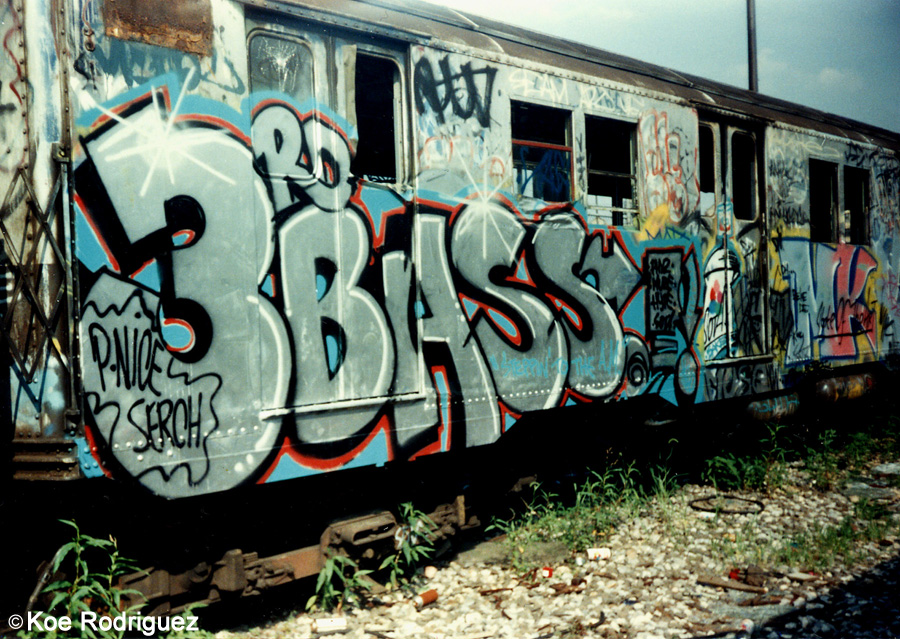
Courtesy of Koe Rodriguez

.

When did you begin collecting materials on graff culture? Where has this path taken you?

.

I began collecting graff related items dating back to the early 80s.  Newspaper clippings came first and then books like Subway Art and Steven Hager’s Hip-Hop came next.  My family was fortunate enough to cop a VCR around 1984 and I began recording anything I could on Hip-Hop culture, especially Graffiti.  ABC (Channel 7) ran a few good specials on Hip-Hop early on like 20/20’s “Rappin’ To The Beat,” “The Big Break Contest,” “New York Hot Tracks” and a made for TV movie called “Dreams Don’t Die” featuring Graff by the late, great Dondi White.  In the late 80s, I would cut my high school classes, jump on a Path Train and head to the original Soho Zat to boost IGT Magazines and Vaughn Bode comics.

.

The 80s were a really special time for consuming all things Hip-Hop.  I remember heading over to comic book hot spot Forbidden Planet to rack comics with my lil’ homie and Vulcan (who was working there) had the drop on us and told us to forget about boosting anything.  It was actually pretty cool (and funny) being busted by a popular graff writer of the time.  Vulcan was cool about the situation and after asking him what would be a good spot to photograph subway burners he put us on to a good spot uptown to bench and catch flicks.  As for the path that collecting and being down with Hip-Hop in general has taken me, its allowed me to have a pretty nice career in Hip-Hop.  Truthfully, I feel blessed to be doing what I’ve always loved doing, and getting paid for it.  Life is a trip.

.

Courtesy of Koe Rodriguez

.

Which piece is the pride of your collection and why?

.

A: Wow – there’s just so many. lol I have vintage Krylon cans for colors that have been discontinued for quite some time.  I have my collection of original graff magazines and books.  I have thousands of graff related photos dating back to the 80s and more importantly, I have all the great memories.  My collection of archives and paraphernalia isn’t exclusive to graff related items.  I’ve collected pretty much anything that deals with Hip-Hop culture in general.  My home office is a serious omage to the culture.  My file cabinet is covered in Hip-Hop related stickers alone – anything from an original “OPP” sticker or Yo MTV trading cards to Hip-Hop apparel hang tags that I customized into magnets.  I have some real conversation pieces.

.

Having observed graff for three decades, what would you say is the most impressive thing about how the culture has developed during this time? What has been the most surprising?

.

Graff culture never ceases to amaze me.  Its essentially gone from a secret society of outlaw artists to an internationally recognized artform with a global contingency.  It went from being eradicated below ground to blowing up something crazy above ground.  I’m always impressed at how Graff’s evolution, be its style or its lifestyle has maintained immense resiliency, cleverness, inventiveness and steady progression.  Graff writers are pop culture’s new rock stars.  Guys like Lee and Cope 2 who were considered outlaws and their works considered urban blight, are global celebrity’s and bankable talent.

.

Graff culture is unstoppable and it’s gonna continue to grow and radiate for many years to come.  With corporations still eager to get in between the sheets with graff artists to promote or sell their products and/or services, more and more writers are seeing a reason to stick to their guns and take their craft to much higher levels.  Hip-Hop is big business and rappers shouldn’t be the only ones prospering from it anymore; not when art is one of the most provocative, respected and lucrative mediums on the planet.

.

Courtesy of Koe Rodriguez

 .

You mention you have pen pal letters! What’s that all about?

.

A: Back in the late 80s, myself and some of my graff friends like: Ket, Cole, Nic 1, Cavs, and John The Greek were communicating with other writers around the globe and engaging in photo trading, which was essentially swapping your graff photos for other writer’s photos – kinda like trading baseball cards.  My foray into photo trading started off around 1987 after reaching out to West Coast graff magazine “Ghetto Art” (which later became “Spray Can Art”) and starting a friendship with the rag’s publishers, Charlie DTK and Tim “Power.”  Charlie, who is now considered a West Coast graff legend, would send me dope graff flicks by him and hot LA writers and I would send him hot graff flicks from New York.  We would always include a letter with all of our flicks to exchange information, gossip or to simply shoot the shit.

.

Sometimes we would even send each other packages containing VHS and audio tapes of graff related stuff like “Style Wars” and Hip-Hop mix shows by Red Alert, Chuck Chillout and Mr. Magic.  This is all pre-Internet and if you wanted to holler at anyone out of town or abroad, you sat down and wrote a letter or you hollered at them on the phone.  Eventually, more cats started getting down with photo trading and the next thing you knew, I was writing cats from New York to Holland…it was crazy! I have a huge folder of all the original letters I ever received from the cats I wrote to dating back to the late 80s.  Looking back, it’s bugged-out how committed we were to our craft.

.

Courtesy of Koe Rodriguez

.

What are your plans for the collection?

.

I recently took a bunch of my Hip-Hop collectibles to the Las Vegas apparel show “Magic.” I consult for the heritage Hip-Hop brand Sedgwick & Cedar and laced our booth with some of my vintage Hip-Hop pieces.  I was instrumental in laying out the booth’s overall flavor and had some of  my prize pieces like an old name buckle, vintage Krylon cans and markers and Cazal glasses in these hot trophy cases.  The booth looked like a Hip-Hop museum and mad heads were drawn to it on the strength of its funky true school flavor.  It worked well with baggin’ sales and it definitely let cats know that there were some real vets in the house.  Some of my graff related collectibles are featured in a book that I began working on with my old shooting partner from Brooklyn, John The Greek.

.

This book features some of our greatest NY Graff flicks from the late 80s to 1993.  The book has a lot of shots of dope subway graff during its twilight on the New York subway system, which is significant in itself.  It also features the “Foto Kingz,” the crew of graff writers who also documented graffiti culture for crazy years.  That crew consisted of Cavs, Ket, Cole, John The Greek, Nic 1, Charlie DTK and later me.  I’m hoping we really get a chance to publish the book as its content is not just culturally and historically significant, but just a hot slice of true Hip-Hop culture.

.

Courtesy of Koe Rodriguez

Categories: 1980s, Art, Graffiti, Photography

Chris Pape aka FREEDOM: Down by Law

Posted on August 12, 2010

.

CHRIS PAPE AKA FREEDOM: DOWN BY LAW

.

Eric Firestone Gallery, East Hampton
August 14–September 26, 2010

.

Chris Pape (aka Freedom) is an American painter and graffiti artist. Pape started tagging subway tunnels and subway cars in 1974 as “Gen II” before adopting the tag “Freedom”. He was a witness and a participant to the 20-year run of the New York subway graffiti movement.

.

He began writing as Gen II in 1974 and finished his career on the trains in 1983 with the tag Freedom.

.

Pape is best known for his numerous paintings in the eponymous Freedom Tunnel, an Amtrak tunnel running underneath Manhattan’s Riverside Park. Prominent paintings in the Freedom Tunnel attributed to Pape include his “self-portrait” featuring a male torso with a spray-can head and “There’s No Way Like the American Way” (aka “The Coca-Cola Mural”), a parody of Coca-Cola advertising and tribute to the evicted homeless of the tunnel. Another theme of Freedom’s work is black and silver recreations of classical art, including a reinterpretation of the Venus de Milo and a full train car recreation of the iconic hands from Michelangelo’s Sistine Chapel.

.

Pape will be exhibiting a self portrait from the Freedom Tunnel in “Down by Law” at the Eric Firestone Gallery, East Hampton, opening on August 14, 2010. He has graciously agreed to speak about his work here.

.

New York in the 1970s and 1980s was a city bursting with originality, innovation, and experimentation. Please talk about how you see the relationship between your early work as an artist and the environment in which it took hold.

.

The great cities of the 20th century are Paris in the 20s, Berlin in the 30s, and New York in the 70s; and I guarantee you, there will never be another city like New York in the 70s. The gay rights movement, the feminist movement, punk rock, hip hop, graffiti, the blackout, Son of Sam, tabloid journalism, street gangs (in 1977 it became fashionable for gang members to walk through the streets with golf clubs), the blackout, Saturday Night Fever — Saturday Night Live — it all came out of New York!

.

If there were one particular moment that defined my later work it would have to be in the 1960s. In 1965, at the age of five, my parents wouldn’t let me leave the block alone. I was allowed to go “subway fishing”, this meant laying atop a subway grating and swinging a string with gum affixed to it until it hovered over a lost coin or some other treasure and hoisting them up. These were long summer days that seemed to go on endlessly. I pulled up Indian head pennies, buffalo nickels, matchbooks, a baseball card, and other bits of junk that somehow stayed in the back of my brain until the early 80s.

.

In 1980 I was already a graffiti writer doing letters on the sides of trains, I quickly found out that I could paint realistic images with spraypaint and looked for a place to do it. There was a freight train tunnel in Riverside Park where trains still ran, the gratings formed 15-foot high canvasses of light against the walls, and in those beams of light I repainted the images of my youth including a baseball card. In 1986 the homeless moved in and became known as the “Mole People”, I stopped painting and documented their lives for three years. I finished my mural work in 1995. I tell the story because I can’t think of any other city in America where something like that could’ve happened. That was New York back in the day.

.

It has recently been suggested to me that the term “graffiti” is marginalizing, and loaded with negative connotations. How do you feel about the use of the word in general, as well as application to your work as an artist?

.


The graffiti word is offensive, but it was the only word to describe the early stages of the movement. In 1974 the word “graffiti artist” was coined in the New York Times—that seems like a happy marriage. I don’t lose any sleep over this stuff.

.

As a working artist over the past three decades, you have seen first hand how the art world—from galleries and dealers to museums and collectors—responds and reacts to contemporary American art. What are your thoughts on the differences (and similarities, if applicable) between the US, European, and Asian markets?

.


I think the art world as a whole views the works of artists as commodities. Let’s not forget the lessons of the 1980s when graffiti canvases were sold for huge amounts right up until the stock market crash. Things do seem a lot more liberal in Europe where graffiti artists from New York are celebrated and have been for years.

.

Who are your artistic inspirations, and how have they influenced your ideas, aesthetics, and actions through the course of your career?

.


Hopper is my favorite painter, I think he tapped into the American psyche more then any other painter of the last century, but I don’t think he inspires me. I’ve bitten generously from Warhol, Oldenburg and Rosenquist, you can see the Rosenquist influence in the “Buy American” painting. Warhol and Oldenburg are there on a more spiritual level.

.

Self Portrait in The Freedom Tunnel, Artwork © Chris Pape

Self Portrait inspired by The Freedom Tunnel, Artwork © Chris Pape

For “Down by Law” you will be exhibiting your self portrait from the Freedom Tunnel. Please talk about the importance of this piece, and the context in which it was created.

.


The self portrait for the show was originally painted in the tunnel in 1984. At the time it wasn’t THE FREEDOM TUNNEL, it was just me doing my thing, which allowed me to fail a lot. This painting didn’t really fit in with the themes I had established, but it seemed to work and was published in a number of books. It’s a self portrait. The jacket was given to me by my parents in 1976, I left home in ’77 and lived in the jacket, quite literally. The spraycan head is an old graffiti device that seemed to describe my life at the time.

.

There has been a wide array of artists to emerge from the early graffiti movement. How have your earlier experiences influenced you ideas about art, and in what direction would you like to go?

.


When I left the tunnel in 1995 I was a little bit dazed. I was stuck as a painter, although I continued my visual journalism work. I did my new paintings large, and then small, in color, with a sable brush – it seemed as though nothing worked. Of course the answer was that it couldn’t work. The paintings in the tunnel are just that, there in a tunnel. In the same way that if you buy a subway graffiti artist’s work it’s best to buy an entire subway car or it loses context. I think that’s a battle that all graffiti writers that started on trains have had. I’m not saying I’ve fully overcome it but I’ve come close.

.

www.ericfirestonegallery.com

Categories: 1970s, 1980s, Art, Exhibitions, Graffiti, Manhattan, Painting

Jane Dickson: The Architecture of Distraction

Posted on August 11, 2010

At the end of May, Jane Dickson and I took a bus from Baltimore to New York, which is the perfect highway journey for a tete-a-tete on topics about everything from art and ideas to happiness and success. It was on this ride that she told me about her new work, “The Architecture of Distraction”, inspired by a trip to Las Vegas. Being fascinated with forms of distraction, I wanted to take this opportunity to chat with Jane about her new paintings and where they are taking her.

.

Artwork © Jane Dickson

I love the title, “The Architecture of Distraction” as it implies an intention that goes beyond the more congenial term, “entertainment.” Please talk about what has attracted you to the idea of distraction and the forms in which it manifests in American life.

.


I’m struggling daily to focus, to think my own thoughts clearly without interruptions and  to follow through on those ideas. Yet I reject being a recluse because I’m as seduced  as anyone by the overwhelming energy of the city, my brilliant friends, the internet… I’m driven to distraction by my desire to keep up with more than is humanly possible.

.

I’ve been thinking about how this attraction/seduction/distraction paradox is structural to our hyper-commercialized culture. Our attention is hijacked every few seconds by systems designed by the best minds money can buy.  Like everyone else, I’m struggling with the internet’s huge new layers of virtual info/distractions.

.

You know, every time I sit down to write an email I find an hour has gone by, I’ve signed petitions to save whales, seen strange videos, read about art projects in Greenland  and I’ve forgotten to do that one email I went online for in the first place. This is not news but it’s an ever-increasing challenge to find strategies to cope with. I understand the world by painting my dillemas so my current question is how to visualize distraction.

.


Artwork © Jane Dickson
Your new project focuses on Las Vegas, which is distraction on the largest possible scale. What is it about Las Vegas that you find in turns compelling and challenging in the desire to represent it visually ?

.


I was at loose ends last year and a friend invited me to Vegas.  Entering that seemingly endless maze of disorienting patterns and shapes, flashing lights and crazy music, what Rem Koolhaas called the Synthetic Reality of Fantastic Technology, I realized I had entered the 3-D precursor to the internet’s labyrinth of temptations. I took hundreds of pictures, many of people at slot machines. When I got home and looked at them I realized what interested me was the architecture and the way it swallows everyone. Slot machines look like computer terminals. We get away from work and then are riveted by these screens, losing money, thinking we’re having fun.

.

You mentioned that you are also working on paintings of an amusement park ride in Vienna, and that this work recalls a project you did 25 years ago. What is it like to work on a similar subject through the lens of “distraction” ?

.

Most of my work has focused on  prefab entertainment zones since my first paintings of Times Square. One of my first jobs was working there as a computer billboard animator on weekend nights.  I wandered around wondering why everyone, including me, wanted to be in a place that was so raw. I began to paint it from every angle I could, trying to capture the edges of it’s attractive/repulsiveness,  when I was pregnant and couldn’t stand the smell of Times Square I moved on to Demolition Derbies, street fairs, …..asking, why this? Why does this signify fun? What does this have to tell me about myself, my culture, the world ?

.

When I embrace a new subject it feels electric, like new love, totally fascinating. Eventually I get to know it too well and I’m done. With carnivals I’m revisiting an old subject from a fresh perspective. I’m a different person than I was when I first painted it. I see things I didn’t register before. Early on, besides glorying in the artificiality of the lights, I focused mostly on alienated individuals. Now I’m entranced by the geometric meta-structures that determine the scope of the “freedom” each ride offers. I’m observing about the architectural structures as framework for, creation of, limitation to, and distraction from desires and choices, reflecting the larger invisible structures, natural, political and economic that are reshaping my world every day.

.

Artwork © Jane Dickson

I love how you had said about the Vienna work that the paintings were like potato chips, and that you couldn’t do just one. Please talk about the difference between this vibe and the more challenging aspects of the Las Vegas project.

.

A lot of art making is a long hard slog into the unknown. “How the hell do I treat this? What do I put it on? What paint do I use? How thick, how big, how many…?” This is a process of trial and error requiring enormous faith to engage the biggest question; “Is this project really worth doing at all?”

.

But sometimes there are moments of grace when I feel fluent with the subject and the materials and the work just flies. It feels like the push-ups are over and now I can dance.  When the work is really flowing I feel like I’m gorging myself on colors and marks. “just one more…just one more…” I don’t want to stop.

.

( I always imagine I’m eating colors.)

.

With Las Vegas I’m still exploring, everything is in question. With amusement park rides I’m at home even if these paintings are on smooth square panels which I’ve never used before. That’s an important point. As an artist I can’t stay long in the familiar zone or I begin to fall asleep creatively. The architecture of these rides is exciting right now because I beat my head against the wall all last year exploring them with the wrong materials and it just felt dead. Now I know the subject well,  I’ve finally found a congruent approach technically and it’s beginning to sing.

.

Lastly I have to confess that whatever subject I am focusing on can begin to feel like a job. I start to push myself, make mental demands and commitments, get hyper-critical of the work in progress…..So the distraction of a side project feels like play. I haven’t promised it to anyone. I don’t have expectations for it. It can surprise me. Sometimes I switch which project is my main one in my head to trick myself into lightening the burden of expectations I’ve put on it. The one I don’t care about is always easiest.

.

Artwork © Jane Dickson

Do you have your own favorite distractions, and in what form do they take?

.

Right now reading, swimming, hip hop and indie music events, crossword puzzles, facebook and “Mad Men.”

.

www.janedickson.com

Categories: 1980s, Art, Painting

Martha Cooper: Down by Law

Posted on August 2, 2010

Martha Cooper

MARTHA COOPER: DOWN BY LAW

.

Eric Firestone Gallery, East Hampton
August 14–September 26, 2010

.

Martha Cooper is a documentary photographer born in the 1940s in Baltimore, Maryland. She began photographing in nursery school after her father gave her a camera. She graduated from high school at the age of 16, and from Grinnell College with a degree in art at age 19. From 1963-65, she taught English as a Peace Corps volunteer in Thailand and then journeyed by motorcycle from Bangkok to England where she received an ethnology diploma from Oxford. She was a photography intern at National Geographic Magazine in the 1960s, and worked as a staff photographer for the Narragansett Times in Rhode Island and at the New York Post in the 1940s.

.

Martha is perhaps best known for documenting the New York graffiti scene of the late 1970s and early 80s. While working for the New York Post she began taking photos of creative play on the Lower Eastside in order to use up the remaining film in her camera each day before developing it. One day she met a young boy named Edwin who showed her his drawings and explained that he was practicing to write his nickname on walls.  Edwin offered to introduce her to a graffiti king. This is how she met the great stylemaster, Dondi, who eventually allowed her to photograph him in the yards at night while he was painting. In 1984, with Henry Chalfant, she published Subway Art, a landmark photo book that subsequently spread graffiti art around the world.

.

In addition to publishing more than a dozen books, Martha’s photographs have appeared in innumerable magazines including National Geographic, Smithsonian and Vibe. She is the Director of Photography at City Lore, the New York Center for Urban Folk Culture. She still lives in Manhattan but is currently working on a photo project in Sowebo, a Southwest Baltimore neighborhood.

.

Cooper will be exhibiting four silver gelatin prints from her early b-boy documentary work in “Down by Law” at the Eric Firestone Gallery, East Hampton, opening on August 14, 2010. She has graciously agreed to speak about her work here.

Doze Green, Rock Steady Park, Photograph © Martha Cooper

New York in the 1970s and 1980s was a city bursting with originality, innovation, and experimentation. Please talk about how you see the relationship between your early work as a photographer and the environment in which it took hold.

.

 I’ve long been drawn to anything made by hand perhaps because my parents always encouraged creative play. In 1977 I began working as a staff photographer for the New York Post and the job required that we cruise around the city all day in our cars with two-way radio contact to the news desk in case there was a breaking assignment. When not on assignment we were supposed to look for feature “weather” photos. My favorite neighborhood for photos was Alphabet City on the Lower Eastside where I could almost always find kids making something from nothing.

.

It has recently been suggested to me that the term “graffiti” is marginalizing, and loaded with negative connotations. How do you feel about the use of the word in general, as well as application to your work?

.

 Writers probably enjoy being associated with “negative connotations”. Being bad can be cool. Of course the term graffiti has been around much longer than markers and spray paint. In NYC, it’s most fitting for tags but less appropriate for sophisticated spray painted walls. Words and their connotations change over time. Just let me know what you want me to call it and I’ll be happy to oblige. If you prefer the term aerosol art, I’ll go with that stilted though it may be.

.

As a working photographer over the past three decades, you have seen first hand how the art world—from galleries and dealers to museums and collectors—responds and reacts to contemporary American art. What are your thoughts on the differences (and similarities, if applicable) between the US, European, and Asian markets?

.

As a documentary photographer I’ve always been more interested in publishing my photos in books and magazines than showing them in galleries. I never paid much attention to the art market until very recently. Collectors in Europe and Japan seem more eager to collect “graffiti” (should I say aerosol?) related work. I’m just happy that people anywhere enjoy looking at my pictures.

.

Who are your artistic inspirations, and how have they influenced your ideas, aesthetics, and actions through the course of your career?

.

My dad was an amateur photographer and he used to take me on “camera runs” with the Baltimore Camera Club so my first experience with photography was just going out looking for pictures and that’s still my approach today…

.

I’m from a generation of street photographers who never studied photography. I grew up seeing photojournalism magazines like Look and Life and National Geographic and wanted to become a professional photographer so that I could travel the world. I was always more interested in thinking about what I wanted to photograph than how I was going to shoot it. It was never my intention to make art.

.

For “Down by Law” you will be exhibiting your silver gelatin prints of Rock Steady Crew members Frosty Freeze, Ken Swift, Crazy Legs, and Doze Green . Please talk about your work documenting the b-boy movement, and the way in which these photographs—in particular that of Frosty—have become historic markers of the culture.

.

I first encountered b-boys by chance in 1980 in Washington Heights and was so impressed that I contacted Sally Banes, a dance writer, to help me document them. It took us a year before we had enough material to publish a story. We asked Henry Chalfant to help us find dancers. He was organizing an event with graffiti, rapping and DJing and thought dance would be a great addition. Through his graffiti contacts, we met Crazy Legs.

.

The resulting story in the Village Voice in April 1981 with Frosty Freeze on the cover introduced breaking and Rock Steady to the world. Because NYC is a media town, magazines and film crews quickly covered the “new” dance. Henry filmed them for his movie Style Wars as did Charlie Ahearn for Wild Style. The words “Hip Hop” were not in general use at the time but as people became more aware of the culture, breaking was included as an integral part and the Rock Steady Crew became worldwide celebrities. As far as I know my photos are the earliest documentation of b-boying.

.

There has been a wide array of artists to emerge from the early graffiti and Hip-Hop movement. How have your earlier experiences documenting b-boys, young writers in the yards, and trains running along the lines influenced you ideas about art, and in what direction would you like to go?

.

I don’t think a lot about art. Still photography is a wonderful way to document. In a fraction of a second the camera can capture and preserve a million details. I’m interested in using photography for historic preservation. I want people to look at my photos and get a sense of what life was like at a specific time and place.

.

I’ve seen New York City change radically over the past 30 years and my photos are appreciated because they are a record of a different time. For the past 4 1/2 years I’ve been documenting a difficult neighborhood in Baltimore with a vibrant street life. My hope is that in thirty years these photos will similarly be enjoyed.

Ken Swift, Photograph © Martha Cooper

Frosty Freeze, Photograph © Martha Cooper

www.12ozprophet.com/index.php/martha_cooper

www.ericfirestonegallery.com

Categories: 1980s, Art, Bronx, Exhibitions, Graffiti, Manhattan, Music, Photography

Ruby Ray: Punk Passage

Posted on June 30, 2010

Darby backstage, cut up, 1978, Photograph © Ruby Ray

.

A couple of years ago, Carlo McCormick introduced me to Ruby Ray, understanding that she and I were destined to connect as her photographs of punk as it first exploded on the West Coast are unlike anything else out there. A regular contributor to Search & Destroy, Ruby Ray’s work defined a look and a vibe that has long since gone by. What remains are her photographs, which continue to evoke and inspire a do-it-yourself ethos that is more relevant than ever. I thank Ruby Ray for chatting about her work.

.

Please talk about the punk scene when it was coming up on the West coast in the 70s.

.


There was just an explosion of energy and so many great bands and shows up and down the whole coast. And a good number of NYC and UK bands came out here. We were playing a postindustrial game and had already decided that we were the winners! It was an awakening to all the lies – we weren’t caught in the matrix! SF was so cool because it was a small city with plenty of spaces and cheap rent. Anyone with guts could put on a show or start a band.

.

.

Please talk about your work for Search & Destroy magazine. What was it like to be a part of underground publishing?

.

We published S&D on newsprint and laid out all the pages by hand using miniscule typewritten pages and rubber cement.  The text was usually Xeroxed several times in case the glue rubbed the type off!  We had these giant flats that we had to carefully place and glue all the text and photos on, like a giant collage. Cartoonists came in and volunteered hand draw logos or headlines.  What should it look like, what would punk visuals consist of?  These were things influencing us subconsciously; we made it up as we went along. We had books all over for ideas –situationists, punk from other places, Russian constructivists, surrealists. The hippie paper the Oracle was an inspiration, too. Layout sessions happened on tables and the floor of our apartment with everyone helping out.  It was a lot of work, but invigorating!  We all felt very alive and part of something important. I learned so much and met so many great people! We tried to push the limits…

.


.

Do you see any connection between the DIY ethos of that era and today’s move trends digital self-publishing and promotions?

.

Totally, and it’s funny you ask me that because I have only just become involved with a cartoonist/games creator in developing a worldwide, online artist gallery and self-publishing website that hasn’t launched yet. I’m planning to publish my book Punk Passage there this fall in a print-on-demand edition and other formats. This method gives me so much freedom to publish the book just as I want it. It’s the future of new media and power to the people publishing. With billions of people in the digital landscape, there is always an audience for talent. Zeitgeist of the times impels us to find new forms. We have got to find different ways for artists to survive and thrive by their works.

.

How did it feel to be documenting a brand new scene and subculture? What was it like seeing your work in print as things were happening?

.

It was fabulous and exciting! I am a person who learns by doing and punk was my art school! It challenged me to become a better photographer and allowed me free use of my creativity to come up with whatever I wanted. It was a wonderful time of experimentation. And it gave me a forum which is what any artist wants. It’s fun to collaborate.  We didn’t have to be worried about sales or whether the advertisers liked what we produced, we just put it out there.


.

How did your photographs influence and connect to a broader audience?

.

Well, for a while, I thought I was doomed to obscurity! But my big punk exhibit at the SF library in 2009 showed me differently. Almost 10,000 people came to the exhibit and granted, punk is a big draw. But I found a growing number of people had who claimed inspiration from my work, and that was very gratifying. My recent punk exhibit in LA took my work to yet another level. Sometimes, you have just got to hang in there… It may be awhile before those fans accept my new images.

.

Who were your favorite subjects to photograph?

.

Penelope of the Avengers was so photogenic and very easy to work with. Everyone was in love with her back then. The Mutants were so much fun, everything they did and said was instant art! I adored meeting and photographing John Cooper Clarke in London.  It was always a different experience – at the clubs you had to be surreptitious because “punks” were not into posing per se. I always tried to think of everyone as my peer so I wouldn’t become intimidated.  I had to make it interesting for them too.

.

.

What is the story behind the William Burroughs photograph?

.

When Search & Destroy stopped publishing, we started RE/Search and were putting out a magabook on Burroughs and his work.  He was glad to oblige the photographer because he knew we would do a great book on him.  I was a nervous wreck and only had about 10 minutes to shoot him and I had to make do with the location where he was attending a party.  We brought the guns that were the props and I choose the garden to contrast the guns with.  I kept praying the whole time that the film was exposed properly, and prayed again when I had to develop it.  It wasn’t like with digital cameras where every photo comes out perfectly exposed; you really have to think when using film and natural light.  Bill was at ease with me and I love the way the pictures came out.  I am still shooting film, by the way!

Categories: 1970s, 1980s, Music, Photography

DJ Disco Wiz: The $99,000 Question

Posted on June 14, 2010

Flyer courtesy of DJ Disco Wiz

DJ Disco Wiz has been collecting original Hip Hop party flyers dating back to the earliest days in the game. Back in the days, these flyers were made by hand, and their painstaking precision is just one part of their charm. Both an art form unto themselves as well as a part of our culture’s history, these party flyers take us back to a time and a place that is unlike any other.

.

Many of these flyers are now in the collection of the Experience Music Project in Seattle. But don’t worry, if you can’t get across the country that quickly, you can still check them out in the incomparable oral history of Hip Hop’s early years, Yes Yes Y’all by  Jim Fricke and Charlie Ahearn.

.

In conjunction with his June 24 book signing event at Fat Beats, Wiz agreed to chat about his mind blowing collection.

.

Flyer courtesy of DJ Disco Wiz


Please talk about the inspiration to donate your collection of original Hip-Hop flyers to the Experience Music Project.

.

DJ Disco Wiz: I had just started recovering from my first of two bouts with thyroid cancer in 1999, when Grandmaster Caz strongly suggested that I attend an interview session taking place in Harlem moderated by Jim Fricke the senior curator of The Experience Music Project in Seattle.

.

That was the beginning of a series of events that followed, our oral interviews were used as part of the museums opening Hip-Hop Oral History series and later transcribed onto text in Jim Fricke and Charlie Ahearn’s book Yes Yes Y’all. The Experience Music Project Oral History of Hip-Hop’s First Decade.

.

70% of my flyer collection was also used in the book. I made a donation of flyers to the museum on behalf of myself and Caz. The caption reads: “Donated solely for the preservation of Hip-Hop Culture, may no man take away what we created. —DJ Disco Wiz/Luis Cedeño and Grandmaster Caz/Curtis Brown.”

.

How do you feel about having your collection part of a major museum?

.

Honestly it goes beyond words for me, the preservation aspect happened for me because of personal health reasons and the sheer notion of not knowing how many tomorrows were left..

.

The feeling of wanting to leave something behind for future generations is overwhelming and transcending. I am thankful and fortunate to have my archives in a respected institution.

.

Back in the days—before InDesign and Photoshop and Kinkos—flyers were a handmade artform. Please talk about what it took to make these pieces, and what it was like to receive them?

.

This was the beginning of an unforeseen unstoppable movement/culture and it was not televised. It was “each one teach one, each one reach one” it was definitely a process for sure…

.

In the early days most flyers were simply hand written with a marker then it evolved with the use of stencils and elaborate tags/throw ups by legendary graffiti artist, along with common phases of the times. One of my favorites were Afrika Bambaataa’s flyers which used the phase “Come in Peace.”

.

How did you and Grandmaster Caz come together to design the flyers for your events?

.

Creation of our event flyers was Caz’s thing 100%. I pretty much just co-signed them as we went along…

.

Why did you decide to collect the flyers for the parties that were happening back in the days?

.

That’s the $99,000.00 question! I really don’t know why? and honestly don’t care to know I’m just so glad and thank God everyday that I did…

.

I do remember coming home in February of 1982 after being away for more than four years. Hip-Hop was then hitting the radio airwaves and making its maiden voyage around the globe. I opened a box containing 100s of my flyers from the 70’s… It was absolutely magical  to say the least…

.

Are there any flyers you collect today?

.

Yes! of course, am not a hoarder.. but I do love to collect—flyers, banners, event ticket stubs, etc, because as history has clearly taught us… you’ll never know.

.


.

Don’t Miss This!
Thursday, June 24 at 7pm
DJ Disco Wiz at Fat Beats, New York
Signing Copies of His Autobiography
IT’S JUST BEGUN

Categories: 1970s, 1980s, Art, Books, Bronx, Music, Photography

Janette Beckman: “When I First Arrived in NYC in 1982, Hip Hop was New and Fresh”

Posted on May 19, 2010

Grandmixer DST, Photograph © Janette Beckman

Janette Beckman and I were invited to appear on WFMU’s “Coffee Break for Heroes and Villains with Noah” on Tuesday, June 1 from 9am–noon, to discuss the art of Hip Hop photography. I first met Janette back when we were working on Made in the UK: The Music of Attitude, 1977–1983, a retrospective of her career documenting the Punk, Mod, Skinhead, 2 Tone, and Rockabilly culture in the UK.

.

It was during that time that Janette showed me a copy of her first book, Rap, with Bill Adler, showcasing her work from the burgeoning Hip Hop scene during the 1980s. Needless to say, I fell off my chair when I caught a glimpse of her photographs, many of which have become icons unto themselves. From this, inspiration was born, and Janette published her third book, The Breaks: Stylin’ and Profilin’ 1982–1990, which she kindly allowed me to subtitle after her original subtitle, Kickin It Old School, appeared as the name of a corny Jamie Kennedy movie coming out at the same time.

.

Janette has photographed the likes of… EVERYONE. Check out this list, it is legendary: Afrika Bambaataa, GrandMaster Flash and the Furious Five, the Fearless Four, the World Famous Supreme Team, Lovebug Starski, Salt’n’Pepa, Run-DMC, Stetsasonic, UTFO, Roxanne Shante, Sweet T, Jazzy Joyce, Slick Rick, Boogie Down Productions, Eric B. and Rakim, EPMD, NWA, Ice-T, 2 Live Crew, Tone Loc, Gang Starr, Ultramagnetic MCs, Rob Base and DJ EZ Rock, Special Ed, Leaders of the New School, Jungle Brothers, Beastie Boys, Rick Rubin—and more! Hell, honey, even shot Jomanda! That’s for real. Got a love for you. You know, I just had to do this interview…

.


How did you get into shooting Hip Hop?

.

Janette Beckman: I was working for a British music magazine called Melody Maker when I saw my first Hip Hop show back in 1982 in London. The show featured Afrika Bambaata, Grandmixer DST, Futura 2000, Dondi White, breakdancers, and double dutch girls.  It was absolutely mind blowing—we had never seen anything like it—and it seemed to me to be the new Renaissance in music, art, fashion and dance.

.

FUTURA and DONDI, Photograph © Janette Beckman

Being from the UK punk scene what did you make of it?

.

JB: The punk scene in London had reached it’s peak and I think everyone was looking for the next new thing. Hip Hop was much like the UK punk scene when it first started: so creative, groundbreaking, and in many ways both movements came from the streets—art and music created by “working class” kids who were inventing new things never seen before.

.

What was Hip Hop like back in the days, when artists were first getting record deals, but still didn’t have the marketing machine behind them?

.

JB: When I first arrived in NYC in 1982, Hip Hop was new and fresh. It seemed to me as an outsider coming from UK that the artists were free to do what they wanted, the music came from the streets and really told stories of what was happening in peoples lives, from the political like “The Message” and Public Enemy, to the raps about love, girls, sex, sneakers.

.

Anything seemed possible and the small record companies were much more interested allowing the artists to have creative freedom from the way they dressed to the beats and the raps. There was an amazing creative energy—riding on the train hearing some kid rhyming, seeing girls wearing the first giant hoop earrings, the fake LV outfits, the new way to lace your sneakers, the graffiti. Of course this was before MTV, stylists, the Internet started to dictate the way you were supposed to look.

.


Looking through The Breaks, I am totally blown away. You shot some of the photos that have long been burned into my brain. What was your favorite shoot, and why?

.

JB: My favorite shoot was for the British magazine The Face. They asked me to photograph the emerging Hip Hop scene and sent me out to Queens on a warm summer day in 1984 to photograph a group called Run-DMC. I took the subway to Hollis where Jam Master Jay met me at the station and walked me to the leafy block where they were hanging out with some friends. I just took out my camera and started shooting. The photo of Run DMC and posse is one of my favorites because it is such a moment in time. Totally unposed.

.

Photograph © Janette Beckman

Please talk about your Ladies of Hip Hop shoot for Paper, as that photo is a classic!

.

JB: I had been working for Paper magazine since their first issue. They told me they were gong to get the Ladies of Hip Hop together for a shoot. I think it was in a Mexican restaurant on West Broadway. The ladies started to arrive and the boys were told they had to leave. Ladies only this time. What an amazing group—all getting along so well and having fun—and Millie Jackson was there, the “Godmother” of it all.

.

Eazy-E, Photograph © Janette Beckman

Please talk about shooting Eazy E, as I find this photo so touching. No profiling, no posing, no gangsterism in Eric. I love it…

.

JB: I was working on the final shots for my first book and had traveled to LA to shoot the important West Coast scene. NWA were recording their new album in a studio in Torrance and had agreed to have me shoot them. There was an alley at the side of the studio and I asked the group to pose for me. I only took a couple of shots of each of them.

.

We were talking about the recording. They liked my British accent and asked if I would be up for reading some lyrics on their album (it turned out to be lyrics about how to give the perfect blow job, which I thought maybe would not be right for my debut in the recording industry).

.

What do you think about the way Hip Hop has changed—as an economic force, a global culture, an art form, and a way of life for so many people of all ages?

.

JB: Hip Hop has really changed the world. I love the idea that people are rhyming in Africa, India, France in every language. What some people thought was a fad is a now, thirty years later, a worldwide phenomena used for advertising, soundtracks, TV, billboards. Artists like M.I.A, Ben Watt, and Santogold are mixing Hip Hop with their own beats and making some thing completey new—much like Hip Hop artists took disco and R&B beats and made them their own. And still kids on the street
around the world are keeping Hip Hop real.

.

.

www.janettebeckman.com
Don’t Stop! Get It! Get It!

Categories: 1980s, Art, Books, Bronx, Brooklyn, Fashion, Manhattan, Music, Photography

Dustin Pittman: Cast of Characters

Posted on May 12, 2010

Halston, 1979, Photograph © Dustin Pittman

.

I first met Dustin Pittman when curing an exhibition about New York City in the 1970s. The depth of his archive was so profound, I felt like I traveled back in time. Since then, Dustin has been shooting New York’s never-ending parade of characters unlike anyone else in the world today. Dustin graciously agreed to do an interview showcasing his old and new school CAST OF CHARACTERS.

 .

.

WoW! Your perspective on New York nightlife is truly your own and makes me think  “The more things change, the more they remain the same.” Does this ring true or false to you?

.

Dustin Pittman: I think that it definitely rings true. As a photographer I am always looking to fill my frame and capture new and fresh thoughts and concepts from my subjects. It doesn’t matter if I stood in the middle of the dance floor at Studio 54, or Paradise Garage in 1978 or backstage shooting fashion in 1976 or working with International designers in their atelier or the Boom Boom Room at the Standard in 2010.  I’m always searching, looking, always ready, on guard to capture the moment. I have been photographing people for over 40 years. In the studio. On the streets. Way Uptown. Way Downtown. New York, Paris, London, Milan, Tokyo, Europe, Africa, India, Middle East, the entire World. Day for Night. Night for Day.

.

I love the way people look. It is their individual “look” and they “own it”. They are influenced by their history, their customs, their beliefs. You can’t take that away from them. They are who they are. The way they “carry” themselves. Their body language. The way they stand. Their heads, necks, arms, backs, shoulders, torsos, legs, feet and, of course, their FACES AND EXPRESSIONS.  I love people for that. That’s the difference between the 70’s and now. There were no cell phones, no laptops, facebook or twitter. People connected with other people in “real people time”. They didn’t  need to have their guard up all the time. They never anticipated the “snap of the shutter”. They just went about their business. People being People. Individuals being Individuals

 .

.

Now with all the blogs, vlogs and instant street photography people are ready for you. They are waiting for you. They are strategically dressed and screaming “take my picture”.  But, having said. That is the way it is. I accept it. It is not the 1960’s, 1970’s, 1980’s, 1990’s, etc, the time is now. I honor that. We may glamorize the past, but we honor our present. I honor that in people. New technology has ushered in new ideas and tools. People are more willing to explore themselves. They know who they are. They know their culture. I AM A HUGE FAN OF THAT.

.

Now I have the opportunity to shoot with traditional cameras as well as the latest digital cameras with HD Video output. More technology, more opportunities. Old School and New School as one.

 .

.

Looking through your work, I was overwhelmed by the abundance of style. Everyone you photograph uses their face and body as a canvas. What are your thoughts on such personal expression?

.

DP: My style of photographing has always been the “Polaroid School of Photography”  SPONTANEITY. I have always been in the “cinema-verite mode. What does that mean. I leave people alone. I let them “be”. I let them interact . I want them to show me their beautiful hearts and souls. I love their life. Past and Present.  I don’t want to destroy that precious “moment”. I let them perform. I got that from Andy Warhol.

.

In the early days we used to go out to dinners, events and parties together with our cameras always “cocked”. I got it from shooting videos of the Warhol Superstars back in the 70’s. I got it from the countless thousands of Fashion Designers, Actors, musicians, and street people that I have photographed throughout my career. I got it from John Fairchild, the head of W. We traveled the around the world photographing inside the fashion ateliers together.  I got it from Anna Wintour. I got it from Gloria Swanson. I got it from Andre Leon Talley. I got it from Carrie Donovan. We would travel Paris, Milan, London and New York together. I got it from Toni Goodman, Vogue’s Creative Director and I got it from the Masters of Street and Portrait Photography way back in the 60’s and 70’s.  Photographers like William Eggelston, Robert Frank, William Klein, Eugene Smith, Larry Clark, Nan Goldin,  Diane Arbus, Helen Levitt, Elliott Erwitt, Danny Lyons, Garry Winogrand, Bill Cunningham, Robert Mapplethorpe Todd Popageorge,  and many more.

.

We would work the streets and rooms together all night long and into the next day, and then into the night. There was no sleep for me during those years. Sleep. Who needed it. As long as my cameras were loaded and there was enough film in my pockets, that was my “fix”. My light is always on. When I photograph my subjects I look, think and compose before I snap my shutter. I never “ponce”.. I love to respect the moment, always letting it unfold. I let it happen. Never do I go into the frame and ask my subjects to pose or to “look this way” or stand this way. That is a different photograph. That is a photograph for the “studio”. Or, dare I say the word, the “poparazzi” photographers, who I am not a fan of.

.

Mudd Club, 1978, Photograph © Dustin Pittman

.

Who is your ideal subject?

.

DP: My ideal subjects are the “untouched people on the streets of the world”. People are People and I love them for just being Who They Are.  People are my “Celebration of Life”. Young or Old, To photograph youth, from birth to death at any age. ROCKS.

 .

.

When did you move to New York and what was the city like back then? How was it being a photographer, getting access to celebrities of all kinds?

.

DP: I moved to New York in 1968 and I was considered “street cool”. What a time it was. Right on the cusp of exploring “free expression” in the arts. Liberation and Hedonism were my themes. Film, photography, dance, performance art, theatre, music, fashion, poetry, etc was flourishing. It was a renaissance again. My renaissance. I spent 3 weeks photographing the happenings and lifesyle at the Woodstock festival before it even started. The  70’s and 80’s was a great time for photographing. Max’s Kansas City, Mudd Club, CBGB’s. I photographed the first Gay Pride parade in Greenwich Village  in 1970 and the 1st Woman’s Rights parade in the early 70’s.

.

I was the very first fashion photographer photographing backstage fashion in the 70’s. It was just myself, the designers, hair and makeup and the models. Now there are thousands backstage and thousands trying to get into the tents. In the 70’s and 80’s,  I used to gather bunches of people and we used to spent the rest of the entire night and into the day shooting short films, movies and photographs. It was that easy.  Access to people was easier. You could do what you wanted. You didn’t have to give up your photographic rights in order to capture a person, scene or event.

.

Betsy Johnson, 1979, Photograph © Dustin Pittman

.

Having been on the scene for three decades, how would you best define the essence of New York’s nightlife?

.

DP: I feel that New York nightlife is and always will be the driving force behind discovering and creating new ideas and trends. What propels that is the driving creative energy nightlife sucks in and out of you. Say what you want about “hanging out” at night, but one can always find something special to document happening somewhere. In the 70’s and 80’s, it was unthinkable to leave Manhattan for a party, show or event.  Now the big advantage is that New York nightlife has expanded to the boroughs. Williamsburg, the Bronx, Greenpoint, Bushwick, Gowanas, Richmond Hill, Long Island City. Artists are always looking for cheap workable space for their studios, galleries and performance events and these areas fit the bill. Having said that, because of this change, it has given us more opportunities. Anything and Everything is possible.

.

Iris, Photograph © Dustin Pittman

.
www.dustinpittman.com
www.poparchives.com

Categories: 1970s, 1980s, Art, Fashion, Manhattan, Photography

Guy Gonzalez: Peep Man/Deuce 42

Posted on May 4, 2010

Photograph courtesy of Guy Gonzalez

.

On Thursday, May 6, Guy Gonzales will be reading excerpts from his upcoming book, Peep Man/Deuce 42 at Happy Ending, New York, as part of the Sex Worker Literati project, Embarrassing Things I’ve Done for Money. The event starts at 7pm—but since I cannot be there, I asked Guy for an interview about his book, cause I have been hearing stories for a minute now, and I am curious as fuck! Yup Yup.

.

Your autobiography, Peep Man/Deuce 42, is nearing completion and I cannot wait to hear more about this project! What has the process of writing your memoirs been like?

.

Guy Gonzales: The journey itself is cathartic; the recapitulation process quite revealing. As I scour my brain, the missing pieces fall succinctly into place, allowing me to finally come clean; the ultimate redemption.

.

What have you discovered about revisiting your past in this manner?

.

GG: Such an undertaking is one thousand percent necessary, for facing consequences that still remain unresolved, especially on an emotional level. However, I am thrilled and blessed to have been an integral component of what was once a glorious transgression, that will inspire countless artists and writers to come!

 .

Photograph courtesy of Guy Gonzalez


What brought you to Times Square in 1982?

GG: Like a forlorn moth I gravitated toward the neon, which burned incessantly with meaning. Although I am from a decent family, we were soured by dysfunction; the emotional evisceration I endured somehow qualified me for membership amongst the underbelly caste society of Times Square.

What was it like to work in one of history’s most infamous red-light districts?

GG: Times Square and “the Deuce”, 42nd Street, instilled meaning beyond mortal comprehension; an unparalleled sense of belonging. I shall always deeply treasure the indisputable fact that I actually worked in legendary peep palaces like Show World, Les Gals, 711, and The Pussycat. We were just too cool; there will never be anything like it ever again.


Photograph courtesy of Guy Gonzalez

.

How did you transform your career from cashier/mop man to Love-Team, performing live sex acts on stage with your girlfriend?

.

GG: While swabbing sperm I began to notice that many of the “Love Teams” were actually young couples, although a little strung out. The Fantasy Booths were occupied by showgirls who often did sex shows as well. The “booth babies” often selected someone who worked on the premises, like a cashier, because that was someone you could usually trust, used to handling money. Initially, doing continuous sex shows was invigorating, until we became burnt to a crisp. Then the shows became somewhat sad.

.

The May 6th event is titled, “Embarrassing Things I’ve Done for Money.” Was being a performer embarrassing in any way, or are there other stories that fit this subject!?

.

GG: Having sex in front of strangers is not embarrassing in the least, if you’re really into it. Especially in that sexually uninhibited period that was the early 80’s. The only incidents I can construe as slightly embarrassing are when the male member of a boy-girl Love Team can’t summon his fabled erector set to perform the show. But that happened a lot, because we were stoned out of our fucking minds…

.

You were working in the sex industry at the time AIDS first became a public health crisis. How did this change the spirit of the world you were in?

.

GG: We rarely, if ever, used condoms. Regardless of the consequences, we were irresponsible, period. We flaunted a lifestyle of complete abandon. But disease doesn’t discriminate; the fatal wake-up call came too late for many of us. Even more devastating than the health crisis is the hypocrisy were subjected to now!

.

Photograph courtesy of Guy Gonzalez

Check It Out: May 6 at 7pm

Categories: 1980s, Art, Bronx, Manhattan

Jamel Shabazz: “Everything You Do Today Will Reflect on Your Future.”

Posted on May 1, 2010

The Art of War, 1980, Photograph © Jamel Shabazz

.

On a slow, sunny summer day during 2000, while working at powerHouse Books, there was a knock on the door. I jumped up to open it. A tall and stylish man stood before me, graciously introducing himself as Jamel Shabazz.

.

As Jamel recalled for this interview, “I decided that it was time to move forward and produce my first monograph, so I found the address to powerHouse Books and took a chance. Once I arrived, I remember standing outside the hallway to the office for a few minutes, going over my strategy, one final time. I then took a deep breath and knocked on the door. My world would never be the same. Once in, I introduced myself to the vibrant, Miss Sara Rosen, who greeted me with a million dollar smile, she then referred to Craig Cohen, Associate Publisher, whose disposition was warm and genuine.”

.

Although Jamel did not have an appointment to meet with us, when he showed us a catalogue from an exhibition of his work in Paris, Craig and I nearly fell over from excitement. We had never seen anything like his work before—bold portraits of people on the streets of New York City during the 1980s revealing the original style and fierce pride as hip hop first made its way into the culture. I remembered my childhood in the Bronx; Craig recalled that of his in Brooklyn; and we both decided to publish Jamel Shabazz’s first book, Back in the Days, the following year.

.

Nearly ten years have passed since that fateful day, and powerHouse published additional books by Jamel Shabazz including The Last Sunday in June, a ten-year retrospective of New York’s Gay Pride Parade, Seconds of My Life, a thirty-year career retrospective, and my personal favorite: A Time Before Crack, which revisits Jamel’s archive and reaches new depth and understanding of street culture with a collection of images which span 1975–1985. I am honored to have helped introduce Jamel and his work to the world, and humbled by the outpouring of love and admiration his photographs have inspired. I thank him for giving me the opportunity to speak with him about his work. Enjoy the interview!

.

Best Friends, Photograph © Jamel Shabazz

.

I developed a theory a long time ago about why your work inspires so much love among people who see it. I believe every photographer is “in” their photographs just as much as their subject is. For example, when you see a cold photograph, you also see a cold photographer. I always thought what was amazing about your photographs was that you had first spoken and connected with the people in the photos by engaging them in conversations about pride, self-love, respect, and self-empowerment. And after your conversations, you had taken their photos. So when they looked into your camera, they radiated back to you the positive energy with which you imbued them. And that we, as viewers, look at these people looking at us with so much love, pride, respect—power—that we get a jolt. It is as if what you said to the people in these photographs is now being then transferred to us, the viewers.

.

So that’s a long theory yes, but it is the only way I can understand how people react so strongly to these photographs. Believe you me, I have seen a lot of people look at a lot of photos but never have I seen the reaction your photos get. And I don’t think it’s because of the shoes, or the glasses, or the coats. I think it is because there is something about Jamel that is coming back through these photographs, and we feel it when we look at it. But I wanted to ask you: why do you think people have had the reaction to the work?

.

Jamel Shabazz: Your observation is 100% right on. Before each photograph, I took the time to engage most of my subjects about life and making the right choices, in order to survive. I did this because when I was younger, the older guys, in my community did it to me, so it was ingrained in me as a young child to give back, and I vowed that I would reach out to the youth in my community at all cost. They respected me because I wasn’t afraid of them, and I took an interest in their lives. It was beyond the photograph—I help many make career choices; I spoke to them about diet, education, and  how  to select the right mate.

.

Each image that you see in my book is a visual record, of the countless encounters that I had with young people. I did it out of love and concern. I saw  the crack epidemic making it’s way to my community and I wanted to avert as many as I could away from its destruction. So when you study the faces of those in my book, you are seeing faces of young men, women and children, who I just finished bonding with, young people who I told were special and were our future.

.

Often times I would departed them with the words, “Everything you do today will reflect on your future.”

.

Fly Guy, Photograph © Jamel Shabazz

.

When you began work on A Time Before Crack, you were adamant that this book not through of as Back in the Days Part II. Please elaborate.

.

Jamel Shabazz: The book was originally called Strictly Old School and I decided to change not only the name, but the images. With the success of Back in the Days, I felt at first that a continuation would be a good ideal, however I didn’t want to be pigeon-holed as a fashion photographer, so I came up with a title that reflected a social condition rather than trying to make a fashion statement.

.

To make the book different from my first, I used photographs that I took in the mid-70’s and that alone separated it from Back in the Days. In addition I included more group shots, women, children, and families. Using the collage in the front and back gave it a little more edge and allowed me to have over a thousand faces in this work.

.

I enlisted four writers (Claude Gruntizky, Charlie Ahearn, James “Koe” Rodriguez, and Terrence Jennings) to give commentary of their choice, each one from a different racial back ground, African, White, Latin, and African American.

.

A Time Before Crack is about a people who lived in a time before crack cocaine destroyed communities, and ruined lives. This book books serves as visual medicine for those that were affected by the epidemic.

.

Homeboys, 1980, Photograph © Jamel Shabazz

.

You have been labeled a “Hip-Hop fashion photographer,” but you would prefer to be recognized as a street and documentary photographer. Please explain why.

.

Jamel Shabazz: I have been called a Hip-Hop photographer on countless occasions and those that see me that way really don’t understand my history or work. Yes, I have shot Hip-Hop fashion for magazines but that only represents such a small body of my work. I started taking photographs, when the term “Hip Hop” wasn’t even in the dictionary. To accept this label would limit my creativity.

.

Photo documentarian is the proper term for my work. It’s broader and has greater leverage. For thirty years have traveled travel both far and near and document varies people and cultures. I have shot homelessness, prostitution, military culture, the law enforcement community ,the horror of 911, and so much more. I look forward to the day, when I can share that part of my work. Every chance I get, I make it a point to display images that reflect that side of my craft.

.

The international success of hip hop has allowed me to share it’s platform. I am very grateful for that and I will continue to incorporate it in all I do—but there is so many other things that needs to be recorded as well. For example, I have a desire to go to Vietnam and document the children of American service men that were left behind over thirty years ago. No one really knows that side of me.

.

East Flatbush, Brooklyn, 1980, Photograph © Jamel Shabazz

.

What do you hope the publication of these photographs, taken over 20 years ago, will do for the people and the culture today?

.

Jamel Shabazz: My objective with A Time Before Crack is to create conversation about how  life was before the great crack and AIDS plagues of the 1980s—when women were treated with respect,  when the majority of us had two-parent house holds.

.

Crack cocaine snatched the lives of so many innocent souls. Thousands of young men and women have had their lives ruined by drugs, and many linger in prisons through out America today due to them.

.

I have heard on numerous occasions how people broke down and cried while looking at my photographs, remembering a better time.

.

My goal is to make being positive and caring popular again.

.

Tupac, 1998, Photograph © Jamel Shabazz

www.jamelshabazz.com

Categories: 1970s, 1980s, Art, Books, Photography

DJ Disco Wiz: “A Man Is Made By What He Accomplishes Against All Odds”

Posted on April 22, 2010

 .

It’s Just Begun: The Epic Journey of DJ Disco Wiz, Hip Hop’s First Latino DJ is a gritty and gripping tale of one man’s struggles to not only survive, but to triumph over adversity and abuse.

 .

I have always held Luis Cedeño (or Wiz, as his friends like to call him) with the highest regard and have always felt that he was family. His warm and generous personality belies his horrific personal history, a history of which I had not even a clue before editing of his autobiography. To know someone who has endured and overcome physical, emotional, and psychological pain so intense it could have easily destroyed a lesser man renews my faith in the redemptive power of love and humanity.

 .

For every person who believes Hip Hop is about money, status, and fashion; for everyone who equates violence and destruction with street credibility; for everybody ready to believe that the only way to succeed to ensure others fail, It’s Just Begun offers the antidote. Wiz’s story is more than a glorified, romanticized look at street life—it is a chilling, gripping, and ultimately uplifting saga of one man’s quest for emancipation from the prisons in which he has been living.

.

Even at this late date, so many years after we first met, I still find it difficult to reconcile the charming and cuddly DJ I love with stories I have read. Which is, I believe, a testament, to the transformative possibilities on this earth. As I type these words, chills spill across my back, not wanting to give anything away, but unable to hold back.

 .

Wiz sat down for an interview to talk about what he’s been through, and how he has made it this far.

 .

Your grandfather Norberto Cedeño was a respected artist and you say that this was the one aspect of his life your family felt comfortable talking about.  As a child, what was their reaction to your interest in art and drawing and eventually music and performance?

 .

DJ Disco Wiz: As far as I remember I was always artistic. My family always commented “you got that from your grandfather”.  But the sad thing is that once I got into Hip Hop, they were totally not supportive. To them it was a black thing and they could not associate themselves with what I was doing. They never went to see me DJ, nor did they care about what I was doing. They really didn’t grasp the movement, nor could they see beyond their prejudices.

 .

Apart from Hip Hop, what music did you listen to growing up?  Did you follow what was happening in Latino music at the same time?

 .

Wiz: First of all, as a child there was no such thing as Hip-Hop music. We created the genre and movement that would later be termed Hip Hop. I was a lover of all genres of music, Motown, rock, R&B, Disco, funk and soul. And eventually the sound of the Fania All Stars Salsa music as well.

.

That montage of music, was what later helped me as a DJ become that avid “crate digger” in search of those great break beats which would become synonymous with the early years of Hip Hop. It was all about the DJ back then.

 .

There’s a moment in the book when you talk about watching Kool Herc set up for a jam at the P.A.L.  When did you cross the line from being in the crowd to DJing on the stage, and what was it about hip hop that makes this possible?  Was there a single moment early when you realized that this was something you could really do?

.

Wiz: It was an epiphany at the moment, but seeing Kool Herc the first time was not the deciding factor. Crossing over is all credited to my childhood friend and partner Grandmaster Caz. He was the one who pulled me into the role of becoming a DJ. I really can’t answer specifically what in Hip Hop makes it possible; I can undoubtedly say that for me it was an indescribable feeling that compelled me towards the movement.  At that time we did not know what we were doing. But we knew it was an alternative to the obvious, of street gangs, prison or early death. So to answer your question, no one knew or realized its full impact or significance at that moment. It wasn’t until many years later that we realized what we had created.

 .

You describe the negative feelings other Latinos had about your involvement in Hip Hop.  What problems did you encounter from the African Americans you were performing for and with?  What kind of prejudice did Grandmaster Caz and your black friends encounter for including you?  Did you bring anything from Cuban or Puerto Rican music to DJing that they didn’t like because it was from Latin music?

.

Wiz: Caz and I both got hassled by our respective communities. My street credibility was enough to keep any personal attacks from stopping me by either community from doing what I wanted to do. As matter of fact, in the beginning no one really knew I was Spanish. Everyone presumed that I was black until they got to see us perform live. Then they were shocked to see a light skin Latino rocking the turntables.  But as far as the music was concerned I definitely found my distinctive signature by gravitating towards the break beats that came from ancestral African drums which is the foundation of all Spanish and black music. I also had this aggressive style behind the turntables that would later be termed Battle Style DJ.

Photograph courtesy of DJ Disco Wiz

.

Photograph courtesy of DJ Disco Wiz


Did your presence bring more Latinos to your shows that may have stayed away otherwise? Do you follow Latino Hip Hop now, specifically in Cuba and Puerto Rico?


Wiz: Once they started realizing that DJ Disco Wiz was Spanish, I’d have to say yes. The Latino community started coming out to the events. I definitely support the young up and coming Latino hip hop artist from both Cuba and Puerto Rico like Mellow Man Ace, Immortal Technique, Rebel Diaz, and T-Weaponz etc… I actually support the movement in all Latin countries for example Mexico’s Boca Floja, who I just performed with in Mexico City. I also have a weekly radio show on UrbanLatinoRadio.com called the Hip Hop Chronicles where I feature the new Hip Hop artist as well as the old school fundamentals.

 .

Studying with Peace and the Latino organization in prison, you describe how cycles of violence throughout history have affected our communities.  Did this alter or change your feelings towards your father and grandfather as products of the same cycle?  You had extremely volatile relationships with the men in your life but the women seem to have been a more constant presence.  How has their influence helped you break some of these patterns?

 .

Wiz: Honestly, I never really thought about my father or grandfather or related with them when it came to my life. I never met my grandfather so I really never harbored any negative feelings towards him. As far as my father was concerned, once he passed away I rarely thought about him until I started writing this book.  All the life lessons I acquired during my incarceration I applied towards myself.  Through the constant love I received from the women throughout my life, especially my wife Lizette, I have learned to love myself and those around me in order to break that vicious cycle of violence that I once lived by.

.

Has the experience of writing your memoir changed your relationship to some of the people in your past?  Have you gotten any feedback or reaction from the people you’ve written about?

.

Wiz: I would have to say yes, especially the relationship with my daughter Tammy. I believe the book was an eye opening experience for Tammy. It gave her a new perspective to who her father really was and to what really happened thirty years ago. I believe she now understands me better and she has expressed to me how much the book has changed her own life. I feel it has definitely helped us both heal. As far as feedback, my partner Grandmaster Caz just told me how incredible he thought the book was. He mentioned how the book took him back in time to even some of the memories he had forgotten.  This to me was very significant because he even mentioned how much he didn’t know about me until he just read the book.

 .

You chose not to rejoin Caz when you were released from prison in the early eighties.  How did you follow Hip Hop during the period you weren’t performing?  You’re very critical about the way hip hop has evolved.  What are some of the points or events you feel changed it for the worse and for the better?  How could people reclaim it now?

.

Wiz: Once I went away, my life was pretty much scripted for me. When and if I came out, I would have to be a productive member of society. To me and many that meant getting a real job and staying out of trouble. Unfortunately, Hip Hop did not provide that life style at the time.  Hip Hop has always been a part of my life in one way or another. Although I wasn’t performing, I was on top of what was happening with Caz and the movement.  In the beginning hip hop was about the people and for the community that really had nothing else. After I came home, it was no longer that. When Hip Hop became a business it changed its essence and became something new and very different from what we had created so many years earlier in the streets of the South Bronx. Exactly when that happened, I can’t pinpoint. But in my opinion the change was neither good nor bad. It was a change that helped hip hop become global. And it is a business that has helped many. I truly believe that for anything to survive it must reinvent itself and change with the times, and hip hop is a perfect example of this. People reclaim it everyday. Today, real Hip Hop lives in the grass roots and underground movements. In some places it still is about the people and for the community

.

Your memoir preserves an important part of Hip Hop’s history.  What do you believe is the future of Hip Hop?

.

Wiz: Its future is just like it’s past, the possibilities are endless.

 .

Many of the struggles in the book come from your need to establish a street reputation for survival.  If you could say one thing to the kid you were then, what would it be?  What did you believe made a man then and what do you believe makes a man now?

 .

Wiz:  I would tell that kid to believe in himself no matter what his circumstances are, because no one believed in me as a child. They never told me I would accomplish anything. Needless to say that I would be a part of an incredible global movement like Hip Hop, a top chef at some of the finest eating establishments in the world and an author of a book I believe and hope will change many lives is something no one saw coming. I believe now that a man is made by what he accomplishes against all adversities and all the odds. And what he eventually leaves behind for future generations to learn from and the lives that he touches along the way.

 .

Photograph courtesy of DJ Disco Wiz

 .

Luis “DJ Disco Wiz” Cedeño, the first Latino hip hop DJ, is credited for being the first DJ to make a “mixed plate” in 1977 along with Grandmaster Caz. In the years since, Wiz has been an influential force in educating the world about the early years of hip-hop. Wiz was a major contributor in the opening of the Experience Music Project in Seattle in 2000, and was instrumental in the making of Jim Fricke and Charlie Ahearn’s Yes Yes Y’all (Da Capo Press, 2002). He was also featured in the Emmy-nominated VH1 Rock Doc NY77: The Coolest Year in Hell, and is the creator and founder of the Hip-Hop Meets Spoken Wordz series.

.

Don’t Stop! Get It! Get It!

Check the Reviews

Categories: 1970s, 1980s, Art, Books, Bronx, Music, Photography

« Older entries    Newer entries »

Categories

Archives

Top Posts

  • Home
  • About
  • Marketing
  • Blog
  • Azucar! The Life of Celia Cruz Comes to Netflix in an Epic Series
  • Eli Reed: The Formative Years
  • Bill Ray: Watts 1966
  • Jonas Mekas: I Seem to Live: The New York Diaries 1950-1969, Volume 1
  • Mark Rothko: The Color Field Paintings
  • Imprint

Return to top

© Copyright 2004–2025

Duet Theme by The Theme Foundry