Miss Rosen
  • Home
  • About
  • Imprint
  • Writing
    • Books
    • Magazines
    • Websites
    • Interviews
  • Marketing
    • Publicity
    • Exhibitions & Events
    • Branding
  • Blog

Posts from the “1970s” Category

DJ Disco Wiz: The $99,000 Question

Posted on June 14, 2010

Flyer courtesy of DJ Disco Wiz

DJ Disco Wiz has been collecting original Hip Hop party flyers dating back to the earliest days in the game. Back in the days, these flyers were made by hand, and their painstaking precision is just one part of their charm. Both an art form unto themselves as well as a part of our culture’s history, these party flyers take us back to a time and a place that is unlike any other.

.

Many of these flyers are now in the collection of the Experience Music Project in Seattle. But don’t worry, if you can’t get across the country that quickly, you can still check them out in the incomparable oral history of Hip Hop’s early years, Yes Yes Y’all by  Jim Fricke and Charlie Ahearn.

.

In conjunction with his June 24 book signing event at Fat Beats, Wiz agreed to chat about his mind blowing collection.

.

Flyer courtesy of DJ Disco Wiz


Please talk about the inspiration to donate your collection of original Hip-Hop flyers to the Experience Music Project.

.

DJ Disco Wiz: I had just started recovering from my first of two bouts with thyroid cancer in 1999, when Grandmaster Caz strongly suggested that I attend an interview session taking place in Harlem moderated by Jim Fricke the senior curator of The Experience Music Project in Seattle.

.

That was the beginning of a series of events that followed, our oral interviews were used as part of the museums opening Hip-Hop Oral History series and later transcribed onto text in Jim Fricke and Charlie Ahearn’s book Yes Yes Y’all. The Experience Music Project Oral History of Hip-Hop’s First Decade.

.

70% of my flyer collection was also used in the book. I made a donation of flyers to the museum on behalf of myself and Caz. The caption reads: “Donated solely for the preservation of Hip-Hop Culture, may no man take away what we created. —DJ Disco Wiz/Luis Cedeño and Grandmaster Caz/Curtis Brown.”

.

How do you feel about having your collection part of a major museum?

.

Honestly it goes beyond words for me, the preservation aspect happened for me because of personal health reasons and the sheer notion of not knowing how many tomorrows were left..

.

The feeling of wanting to leave something behind for future generations is overwhelming and transcending. I am thankful and fortunate to have my archives in a respected institution.

.

Back in the days—before InDesign and Photoshop and Kinkos—flyers were a handmade artform. Please talk about what it took to make these pieces, and what it was like to receive them?

.

This was the beginning of an unforeseen unstoppable movement/culture and it was not televised. It was “each one teach one, each one reach one” it was definitely a process for sure…

.

In the early days most flyers were simply hand written with a marker then it evolved with the use of stencils and elaborate tags/throw ups by legendary graffiti artist, along with common phases of the times. One of my favorites were Afrika Bambaataa’s flyers which used the phase “Come in Peace.”

.

How did you and Grandmaster Caz come together to design the flyers for your events?

.

Creation of our event flyers was Caz’s thing 100%. I pretty much just co-signed them as we went along…

.

Why did you decide to collect the flyers for the parties that were happening back in the days?

.

That’s the $99,000.00 question! I really don’t know why? and honestly don’t care to know I’m just so glad and thank God everyday that I did…

.

I do remember coming home in February of 1982 after being away for more than four years. Hip-Hop was then hitting the radio airwaves and making its maiden voyage around the globe. I opened a box containing 100s of my flyers from the 70’s… It was absolutely magical  to say the least…

.

Are there any flyers you collect today?

.

Yes! of course, am not a hoarder.. but I do love to collect—flyers, banners, event ticket stubs, etc, because as history has clearly taught us… you’ll never know.

.


.

Don’t Miss This!
Thursday, June 24 at 7pm
DJ Disco Wiz at Fat Beats, New York
Signing Copies of His Autobiography
IT’S JUST BEGUN

Categories: 1970s, 1980s, Art, Books, Bronx, Music, Photography

Dustin Pittman: Cast of Characters

Posted on May 12, 2010

Halston, 1979, Photograph © Dustin Pittman

.

I first met Dustin Pittman when curing an exhibition about New York City in the 1970s. The depth of his archive was so profound, I felt like I traveled back in time. Since then, Dustin has been shooting New York’s never-ending parade of characters unlike anyone else in the world today. Dustin graciously agreed to do an interview showcasing his old and new school CAST OF CHARACTERS.

 .

.

WoW! Your perspective on New York nightlife is truly your own and makes me think  “The more things change, the more they remain the same.” Does this ring true or false to you?

.

Dustin Pittman: I think that it definitely rings true. As a photographer I am always looking to fill my frame and capture new and fresh thoughts and concepts from my subjects. It doesn’t matter if I stood in the middle of the dance floor at Studio 54, or Paradise Garage in 1978 or backstage shooting fashion in 1976 or working with International designers in their atelier or the Boom Boom Room at the Standard in 2010.  I’m always searching, looking, always ready, on guard to capture the moment. I have been photographing people for over 40 years. In the studio. On the streets. Way Uptown. Way Downtown. New York, Paris, London, Milan, Tokyo, Europe, Africa, India, Middle East, the entire World. Day for Night. Night for Day.

.

I love the way people look. It is their individual “look” and they “own it”. They are influenced by their history, their customs, their beliefs. You can’t take that away from them. They are who they are. The way they “carry” themselves. Their body language. The way they stand. Their heads, necks, arms, backs, shoulders, torsos, legs, feet and, of course, their FACES AND EXPRESSIONS.  I love people for that. That’s the difference between the 70’s and now. There were no cell phones, no laptops, facebook or twitter. People connected with other people in “real people time”. They didn’t  need to have their guard up all the time. They never anticipated the “snap of the shutter”. They just went about their business. People being People. Individuals being Individuals

 .

.

Now with all the blogs, vlogs and instant street photography people are ready for you. They are waiting for you. They are strategically dressed and screaming “take my picture”.  But, having said. That is the way it is. I accept it. It is not the 1960’s, 1970’s, 1980’s, 1990’s, etc, the time is now. I honor that. We may glamorize the past, but we honor our present. I honor that in people. New technology has ushered in new ideas and tools. People are more willing to explore themselves. They know who they are. They know their culture. I AM A HUGE FAN OF THAT.

.

Now I have the opportunity to shoot with traditional cameras as well as the latest digital cameras with HD Video output. More technology, more opportunities. Old School and New School as one.

 .

.

Looking through your work, I was overwhelmed by the abundance of style. Everyone you photograph uses their face and body as a canvas. What are your thoughts on such personal expression?

.

DP: My style of photographing has always been the “Polaroid School of Photography”  SPONTANEITY. I have always been in the “cinema-verite mode. What does that mean. I leave people alone. I let them “be”. I let them interact . I want them to show me their beautiful hearts and souls. I love their life. Past and Present.  I don’t want to destroy that precious “moment”. I let them perform. I got that from Andy Warhol.

.

In the early days we used to go out to dinners, events and parties together with our cameras always “cocked”. I got it from shooting videos of the Warhol Superstars back in the 70’s. I got it from the countless thousands of Fashion Designers, Actors, musicians, and street people that I have photographed throughout my career. I got it from John Fairchild, the head of W. We traveled the around the world photographing inside the fashion ateliers together.  I got it from Anna Wintour. I got it from Gloria Swanson. I got it from Andre Leon Talley. I got it from Carrie Donovan. We would travel Paris, Milan, London and New York together. I got it from Toni Goodman, Vogue’s Creative Director and I got it from the Masters of Street and Portrait Photography way back in the 60’s and 70’s.  Photographers like William Eggelston, Robert Frank, William Klein, Eugene Smith, Larry Clark, Nan Goldin,  Diane Arbus, Helen Levitt, Elliott Erwitt, Danny Lyons, Garry Winogrand, Bill Cunningham, Robert Mapplethorpe Todd Popageorge,  and many more.

.

We would work the streets and rooms together all night long and into the next day, and then into the night. There was no sleep for me during those years. Sleep. Who needed it. As long as my cameras were loaded and there was enough film in my pockets, that was my “fix”. My light is always on. When I photograph my subjects I look, think and compose before I snap my shutter. I never “ponce”.. I love to respect the moment, always letting it unfold. I let it happen. Never do I go into the frame and ask my subjects to pose or to “look this way” or stand this way. That is a different photograph. That is a photograph for the “studio”. Or, dare I say the word, the “poparazzi” photographers, who I am not a fan of.

.

Mudd Club, 1978, Photograph © Dustin Pittman

.

Who is your ideal subject?

.

DP: My ideal subjects are the “untouched people on the streets of the world”. People are People and I love them for just being Who They Are.  People are my “Celebration of Life”. Young or Old, To photograph youth, from birth to death at any age. ROCKS.

 .

.

When did you move to New York and what was the city like back then? How was it being a photographer, getting access to celebrities of all kinds?

.

DP: I moved to New York in 1968 and I was considered “street cool”. What a time it was. Right on the cusp of exploring “free expression” in the arts. Liberation and Hedonism were my themes. Film, photography, dance, performance art, theatre, music, fashion, poetry, etc was flourishing. It was a renaissance again. My renaissance. I spent 3 weeks photographing the happenings and lifesyle at the Woodstock festival before it even started. The  70’s and 80’s was a great time for photographing. Max’s Kansas City, Mudd Club, CBGB’s. I photographed the first Gay Pride parade in Greenwich Village  in 1970 and the 1st Woman’s Rights parade in the early 70’s.

.

I was the very first fashion photographer photographing backstage fashion in the 70’s. It was just myself, the designers, hair and makeup and the models. Now there are thousands backstage and thousands trying to get into the tents. In the 70’s and 80’s,  I used to gather bunches of people and we used to spent the rest of the entire night and into the day shooting short films, movies and photographs. It was that easy.  Access to people was easier. You could do what you wanted. You didn’t have to give up your photographic rights in order to capture a person, scene or event.

.

Betsy Johnson, 1979, Photograph © Dustin Pittman

.

Having been on the scene for three decades, how would you best define the essence of New York’s nightlife?

.

DP: I feel that New York nightlife is and always will be the driving force behind discovering and creating new ideas and trends. What propels that is the driving creative energy nightlife sucks in and out of you. Say what you want about “hanging out” at night, but one can always find something special to document happening somewhere. In the 70’s and 80’s, it was unthinkable to leave Manhattan for a party, show or event.  Now the big advantage is that New York nightlife has expanded to the boroughs. Williamsburg, the Bronx, Greenpoint, Bushwick, Gowanas, Richmond Hill, Long Island City. Artists are always looking for cheap workable space for their studios, galleries and performance events and these areas fit the bill. Having said that, because of this change, it has given us more opportunities. Anything and Everything is possible.

.

Iris, Photograph © Dustin Pittman

.
www.dustinpittman.com
www.poparchives.com

Categories: 1970s, 1980s, Art, Fashion, Manhattan, Photography

Marcia Resnick: Re-Visions

Posted on May 5, 2010

EMPIRE STATE OF MIND, a group show curated by Jacob Fuglsang Mikkelsen featuring works by Victor Bockris, Bess Greenberg, Ellen Jong, Anton Perich, Marcia Resnick opens at the Copenhagen Photo Festival, Denmark, from May 13 – 20, 2010. Marcia Resnick has graciously granted me an interview to discuss her work, “Re-visions”, which will be featured in the show.

 .

Photograph © Marcia Resnick

.

I love the way your work explores the precocious aspects of childhood. All to often, we forget that kids have their own secret desires. What was your inspiration to revisit the private life of your childhood?

.

Marcia Resnick: In 1975, while driving my car in Manhattan, I became embroiled in a car accident which left me unconscious and internally bleeding. When I awoke in the hospital, my entire life flashed before me.  I began to think about all of the events which led to my being there, daily dissecting my life with a linear historical perspective.  After I returned home, I began to write ideas and draw pictures in preparation for doing a book which considered my life thus far, with both a sense of poignancy and irony.

.

Photograph © Marcia Resnick

.

I like how you subvert the seeming purity of 1950s America, particularly with the cowgirl and Howdy Doody images. What was it like growing up at that time, and how did it inform your work as an artist?

.

MR: I was raised in a middle class home in suburban Brooklyn by Jewish American parents who were very strict and authoritarian.  Television was a large component of life in the 1950’s…Hopalong Cassidy, Howdy Doody and the more artistically stimulating Winky Dinks and Jon Gnagy were fixtures in my childhood, in addition to the popular playthings advertised on television such as slinky toys and hula hoops. I had a special fondness for Jon Gnagy and religiously learned how to draw by watching him on television.

.

Photograph © Marcia Resnick


Photograph © Marcia Resnick

.

The piece that explores the fear of being wallflower within the company of children at the school dance is the perfect foil to the image that has your subject being told not to look at her feet in the company of adults. I find it interesting that in one context the girl is an extrovert; in another she is an introvert. Please speak more about this dynamic.

.

MR: Peer pressure has always been a motivating factor influencing the behavior of children.  The desire to be liked by other children is quite different though than the desire for the approval of adults. This dynamic speaks to this difference.

.

Photograph © Marcia Resnick

.

For your piece captioned “She was often gripped with the desire to be elsewhere”, how did that desire take you to New York City?

.

MR: That desire took me “all the way” from Brooklyn to Manhattan when I moved there at sixteen years old to study art at NYU and then, Cooper Union after which I went to graduate school in California at California Institute of the Arts.  That desire also took me to Europe, Mexico, Central America, Morocco, Egypt and the South Seas and Japan and China in years to come.

.

This work was made in 1978, a very edgy period in New York City’s history. Did your environment in any way play into the themes you are exploring here?

.

MR: I moved to Tribeca in 1975. I was teaching photography at Queens College and NYU. I did the bulk of the work on “Re-visions” in 1976.  It took two years to get it published, during which time I frequented artist’s bars and music clubs at night and Soho art galleries on weekends. There was a palpable electricity in the cultural milieu of NYC at that time. The downtown artists scene was a hotbed of aesthetic creativity. I drew inspiration from the contemporary art and music scenes.

.

More Visuals!
www.copenhagenphotofestival.com

Categories: 1970s, Art, Books, Exhibitions, Photography

Jamel Shabazz: “Everything You Do Today Will Reflect on Your Future.”

Posted on May 1, 2010

The Art of War, 1980, Photograph © Jamel Shabazz

.

On a slow, sunny summer day during 2000, while working at powerHouse Books, there was a knock on the door. I jumped up to open it. A tall and stylish man stood before me, graciously introducing himself as Jamel Shabazz.

.

As Jamel recalled for this interview, “I decided that it was time to move forward and produce my first monograph, so I found the address to powerHouse Books and took a chance. Once I arrived, I remember standing outside the hallway to the office for a few minutes, going over my strategy, one final time. I then took a deep breath and knocked on the door. My world would never be the same. Once in, I introduced myself to the vibrant, Miss Sara Rosen, who greeted me with a million dollar smile, she then referred to Craig Cohen, Associate Publisher, whose disposition was warm and genuine.”

.

Although Jamel did not have an appointment to meet with us, when he showed us a catalogue from an exhibition of his work in Paris, Craig and I nearly fell over from excitement. We had never seen anything like his work before—bold portraits of people on the streets of New York City during the 1980s revealing the original style and fierce pride as hip hop first made its way into the culture. I remembered my childhood in the Bronx; Craig recalled that of his in Brooklyn; and we both decided to publish Jamel Shabazz’s first book, Back in the Days, the following year.

.

Nearly ten years have passed since that fateful day, and powerHouse published additional books by Jamel Shabazz including The Last Sunday in June, a ten-year retrospective of New York’s Gay Pride Parade, Seconds of My Life, a thirty-year career retrospective, and my personal favorite: A Time Before Crack, which revisits Jamel’s archive and reaches new depth and understanding of street culture with a collection of images which span 1975–1985. I am honored to have helped introduce Jamel and his work to the world, and humbled by the outpouring of love and admiration his photographs have inspired. I thank him for giving me the opportunity to speak with him about his work. Enjoy the interview!

.

Best Friends, Photograph © Jamel Shabazz

.

I developed a theory a long time ago about why your work inspires so much love among people who see it. I believe every photographer is “in” their photographs just as much as their subject is. For example, when you see a cold photograph, you also see a cold photographer. I always thought what was amazing about your photographs was that you had first spoken and connected with the people in the photos by engaging them in conversations about pride, self-love, respect, and self-empowerment. And after your conversations, you had taken their photos. So when they looked into your camera, they radiated back to you the positive energy with which you imbued them. And that we, as viewers, look at these people looking at us with so much love, pride, respect—power—that we get a jolt. It is as if what you said to the people in these photographs is now being then transferred to us, the viewers.

.

So that’s a long theory yes, but it is the only way I can understand how people react so strongly to these photographs. Believe you me, I have seen a lot of people look at a lot of photos but never have I seen the reaction your photos get. And I don’t think it’s because of the shoes, or the glasses, or the coats. I think it is because there is something about Jamel that is coming back through these photographs, and we feel it when we look at it. But I wanted to ask you: why do you think people have had the reaction to the work?

.

Jamel Shabazz: Your observation is 100% right on. Before each photograph, I took the time to engage most of my subjects about life and making the right choices, in order to survive. I did this because when I was younger, the older guys, in my community did it to me, so it was ingrained in me as a young child to give back, and I vowed that I would reach out to the youth in my community at all cost. They respected me because I wasn’t afraid of them, and I took an interest in their lives. It was beyond the photograph—I help many make career choices; I spoke to them about diet, education, and  how  to select the right mate.

.

Each image that you see in my book is a visual record, of the countless encounters that I had with young people. I did it out of love and concern. I saw  the crack epidemic making it’s way to my community and I wanted to avert as many as I could away from its destruction. So when you study the faces of those in my book, you are seeing faces of young men, women and children, who I just finished bonding with, young people who I told were special and were our future.

.

Often times I would departed them with the words, “Everything you do today will reflect on your future.”

.

Fly Guy, Photograph © Jamel Shabazz

.

When you began work on A Time Before Crack, you were adamant that this book not through of as Back in the Days Part II. Please elaborate.

.

Jamel Shabazz: The book was originally called Strictly Old School and I decided to change not only the name, but the images. With the success of Back in the Days, I felt at first that a continuation would be a good ideal, however I didn’t want to be pigeon-holed as a fashion photographer, so I came up with a title that reflected a social condition rather than trying to make a fashion statement.

.

To make the book different from my first, I used photographs that I took in the mid-70’s and that alone separated it from Back in the Days. In addition I included more group shots, women, children, and families. Using the collage in the front and back gave it a little more edge and allowed me to have over a thousand faces in this work.

.

I enlisted four writers (Claude Gruntizky, Charlie Ahearn, James “Koe” Rodriguez, and Terrence Jennings) to give commentary of their choice, each one from a different racial back ground, African, White, Latin, and African American.

.

A Time Before Crack is about a people who lived in a time before crack cocaine destroyed communities, and ruined lives. This book books serves as visual medicine for those that were affected by the epidemic.

.

Homeboys, 1980, Photograph © Jamel Shabazz

.

You have been labeled a “Hip-Hop fashion photographer,” but you would prefer to be recognized as a street and documentary photographer. Please explain why.

.

Jamel Shabazz: I have been called a Hip-Hop photographer on countless occasions and those that see me that way really don’t understand my history or work. Yes, I have shot Hip-Hop fashion for magazines but that only represents such a small body of my work. I started taking photographs, when the term “Hip Hop” wasn’t even in the dictionary. To accept this label would limit my creativity.

.

Photo documentarian is the proper term for my work. It’s broader and has greater leverage. For thirty years have traveled travel both far and near and document varies people and cultures. I have shot homelessness, prostitution, military culture, the law enforcement community ,the horror of 911, and so much more. I look forward to the day, when I can share that part of my work. Every chance I get, I make it a point to display images that reflect that side of my craft.

.

The international success of hip hop has allowed me to share it’s platform. I am very grateful for that and I will continue to incorporate it in all I do—but there is so many other things that needs to be recorded as well. For example, I have a desire to go to Vietnam and document the children of American service men that were left behind over thirty years ago. No one really knows that side of me.

.

East Flatbush, Brooklyn, 1980, Photograph © Jamel Shabazz

.

What do you hope the publication of these photographs, taken over 20 years ago, will do for the people and the culture today?

.

Jamel Shabazz: My objective with A Time Before Crack is to create conversation about how  life was before the great crack and AIDS plagues of the 1980s—when women were treated with respect,  when the majority of us had two-parent house holds.

.

Crack cocaine snatched the lives of so many innocent souls. Thousands of young men and women have had their lives ruined by drugs, and many linger in prisons through out America today due to them.

.

I have heard on numerous occasions how people broke down and cried while looking at my photographs, remembering a better time.

.

My goal is to make being positive and caring popular again.

.

Tupac, 1998, Photograph © Jamel Shabazz

www.jamelshabazz.com

Categories: 1970s, 1980s, Art, Books, Photography

DJ Disco Wiz: “A Man Is Made By What He Accomplishes Against All Odds”

Posted on April 22, 2010

 .

It’s Just Begun: The Epic Journey of DJ Disco Wiz, Hip Hop’s First Latino DJ is a gritty and gripping tale of one man’s struggles to not only survive, but to triumph over adversity and abuse.

 .

I have always held Luis Cedeño (or Wiz, as his friends like to call him) with the highest regard and have always felt that he was family. His warm and generous personality belies his horrific personal history, a history of which I had not even a clue before editing of his autobiography. To know someone who has endured and overcome physical, emotional, and psychological pain so intense it could have easily destroyed a lesser man renews my faith in the redemptive power of love and humanity.

 .

For every person who believes Hip Hop is about money, status, and fashion; for everyone who equates violence and destruction with street credibility; for everybody ready to believe that the only way to succeed to ensure others fail, It’s Just Begun offers the antidote. Wiz’s story is more than a glorified, romanticized look at street life—it is a chilling, gripping, and ultimately uplifting saga of one man’s quest for emancipation from the prisons in which he has been living.

.

Even at this late date, so many years after we first met, I still find it difficult to reconcile the charming and cuddly DJ I love with stories I have read. Which is, I believe, a testament, to the transformative possibilities on this earth. As I type these words, chills spill across my back, not wanting to give anything away, but unable to hold back.

 .

Wiz sat down for an interview to talk about what he’s been through, and how he has made it this far.

 .

Your grandfather Norberto Cedeño was a respected artist and you say that this was the one aspect of his life your family felt comfortable talking about.  As a child, what was their reaction to your interest in art and drawing and eventually music and performance?

 .

DJ Disco Wiz: As far as I remember I was always artistic. My family always commented “you got that from your grandfather”.  But the sad thing is that once I got into Hip Hop, they were totally not supportive. To them it was a black thing and they could not associate themselves with what I was doing. They never went to see me DJ, nor did they care about what I was doing. They really didn’t grasp the movement, nor could they see beyond their prejudices.

 .

Apart from Hip Hop, what music did you listen to growing up?  Did you follow what was happening in Latino music at the same time?

 .

Wiz: First of all, as a child there was no such thing as Hip-Hop music. We created the genre and movement that would later be termed Hip Hop. I was a lover of all genres of music, Motown, rock, R&B, Disco, funk and soul. And eventually the sound of the Fania All Stars Salsa music as well.

.

That montage of music, was what later helped me as a DJ become that avid “crate digger” in search of those great break beats which would become synonymous with the early years of Hip Hop. It was all about the DJ back then.

 .

There’s a moment in the book when you talk about watching Kool Herc set up for a jam at the P.A.L.  When did you cross the line from being in the crowd to DJing on the stage, and what was it about hip hop that makes this possible?  Was there a single moment early when you realized that this was something you could really do?

.

Wiz: It was an epiphany at the moment, but seeing Kool Herc the first time was not the deciding factor. Crossing over is all credited to my childhood friend and partner Grandmaster Caz. He was the one who pulled me into the role of becoming a DJ. I really can’t answer specifically what in Hip Hop makes it possible; I can undoubtedly say that for me it was an indescribable feeling that compelled me towards the movement.  At that time we did not know what we were doing. But we knew it was an alternative to the obvious, of street gangs, prison or early death. So to answer your question, no one knew or realized its full impact or significance at that moment. It wasn’t until many years later that we realized what we had created.

 .

You describe the negative feelings other Latinos had about your involvement in Hip Hop.  What problems did you encounter from the African Americans you were performing for and with?  What kind of prejudice did Grandmaster Caz and your black friends encounter for including you?  Did you bring anything from Cuban or Puerto Rican music to DJing that they didn’t like because it was from Latin music?

.

Wiz: Caz and I both got hassled by our respective communities. My street credibility was enough to keep any personal attacks from stopping me by either community from doing what I wanted to do. As matter of fact, in the beginning no one really knew I was Spanish. Everyone presumed that I was black until they got to see us perform live. Then they were shocked to see a light skin Latino rocking the turntables.  But as far as the music was concerned I definitely found my distinctive signature by gravitating towards the break beats that came from ancestral African drums which is the foundation of all Spanish and black music. I also had this aggressive style behind the turntables that would later be termed Battle Style DJ.

Photograph courtesy of DJ Disco Wiz

.

Photograph courtesy of DJ Disco Wiz


Did your presence bring more Latinos to your shows that may have stayed away otherwise? Do you follow Latino Hip Hop now, specifically in Cuba and Puerto Rico?


Wiz: Once they started realizing that DJ Disco Wiz was Spanish, I’d have to say yes. The Latino community started coming out to the events. I definitely support the young up and coming Latino hip hop artist from both Cuba and Puerto Rico like Mellow Man Ace, Immortal Technique, Rebel Diaz, and T-Weaponz etc… I actually support the movement in all Latin countries for example Mexico’s Boca Floja, who I just performed with in Mexico City. I also have a weekly radio show on UrbanLatinoRadio.com called the Hip Hop Chronicles where I feature the new Hip Hop artist as well as the old school fundamentals.

 .

Studying with Peace and the Latino organization in prison, you describe how cycles of violence throughout history have affected our communities.  Did this alter or change your feelings towards your father and grandfather as products of the same cycle?  You had extremely volatile relationships with the men in your life but the women seem to have been a more constant presence.  How has their influence helped you break some of these patterns?

 .

Wiz: Honestly, I never really thought about my father or grandfather or related with them when it came to my life. I never met my grandfather so I really never harbored any negative feelings towards him. As far as my father was concerned, once he passed away I rarely thought about him until I started writing this book.  All the life lessons I acquired during my incarceration I applied towards myself.  Through the constant love I received from the women throughout my life, especially my wife Lizette, I have learned to love myself and those around me in order to break that vicious cycle of violence that I once lived by.

.

Has the experience of writing your memoir changed your relationship to some of the people in your past?  Have you gotten any feedback or reaction from the people you’ve written about?

.

Wiz: I would have to say yes, especially the relationship with my daughter Tammy. I believe the book was an eye opening experience for Tammy. It gave her a new perspective to who her father really was and to what really happened thirty years ago. I believe she now understands me better and she has expressed to me how much the book has changed her own life. I feel it has definitely helped us both heal. As far as feedback, my partner Grandmaster Caz just told me how incredible he thought the book was. He mentioned how the book took him back in time to even some of the memories he had forgotten.  This to me was very significant because he even mentioned how much he didn’t know about me until he just read the book.

 .

You chose not to rejoin Caz when you were released from prison in the early eighties.  How did you follow Hip Hop during the period you weren’t performing?  You’re very critical about the way hip hop has evolved.  What are some of the points or events you feel changed it for the worse and for the better?  How could people reclaim it now?

.

Wiz: Once I went away, my life was pretty much scripted for me. When and if I came out, I would have to be a productive member of society. To me and many that meant getting a real job and staying out of trouble. Unfortunately, Hip Hop did not provide that life style at the time.  Hip Hop has always been a part of my life in one way or another. Although I wasn’t performing, I was on top of what was happening with Caz and the movement.  In the beginning hip hop was about the people and for the community that really had nothing else. After I came home, it was no longer that. When Hip Hop became a business it changed its essence and became something new and very different from what we had created so many years earlier in the streets of the South Bronx. Exactly when that happened, I can’t pinpoint. But in my opinion the change was neither good nor bad. It was a change that helped hip hop become global. And it is a business that has helped many. I truly believe that for anything to survive it must reinvent itself and change with the times, and hip hop is a perfect example of this. People reclaim it everyday. Today, real Hip Hop lives in the grass roots and underground movements. In some places it still is about the people and for the community

.

Your memoir preserves an important part of Hip Hop’s history.  What do you believe is the future of Hip Hop?

.

Wiz: Its future is just like it’s past, the possibilities are endless.

 .

Many of the struggles in the book come from your need to establish a street reputation for survival.  If you could say one thing to the kid you were then, what would it be?  What did you believe made a man then and what do you believe makes a man now?

 .

Wiz:  I would tell that kid to believe in himself no matter what his circumstances are, because no one believed in me as a child. They never told me I would accomplish anything. Needless to say that I would be a part of an incredible global movement like Hip Hop, a top chef at some of the finest eating establishments in the world and an author of a book I believe and hope will change many lives is something no one saw coming. I believe now that a man is made by what he accomplishes against all adversities and all the odds. And what he eventually leaves behind for future generations to learn from and the lives that he touches along the way.

 .

Photograph courtesy of DJ Disco Wiz

 .

Luis “DJ Disco Wiz” Cedeño, the first Latino hip hop DJ, is credited for being the first DJ to make a “mixed plate” in 1977 along with Grandmaster Caz. In the years since, Wiz has been an influential force in educating the world about the early years of hip-hop. Wiz was a major contributor in the opening of the Experience Music Project in Seattle in 2000, and was instrumental in the making of Jim Fricke and Charlie Ahearn’s Yes Yes Y’all (Da Capo Press, 2002). He was also featured in the Emmy-nominated VH1 Rock Doc NY77: The Coolest Year in Hell, and is the creator and founder of the Hip-Hop Meets Spoken Wordz series.

.

Don’t Stop! Get It! Get It!

Check the Reviews

Categories: 1970s, 1980s, Art, Books, Bronx, Music, Photography

Maureen Valdes Marsh: 70S Fashion Fiascos

Posted on April 21, 2010

.

Ohh lawd have mercy!

.

I remember the 70s all too well, mostly because I was still rocking bellbottoms in the 80s (my parents had no shame, giving me six-year-old hand-me-downs to wear with my lil Shari Bellafonte-afro-on-a-white-girl hair). It might have been a good look—ten years earlier. But thinking of it now, maybe my parent’s disregard for style is the thing that got me started on vintage fashion, thrift shops, and returning over and over again to the decade of my birth.

.

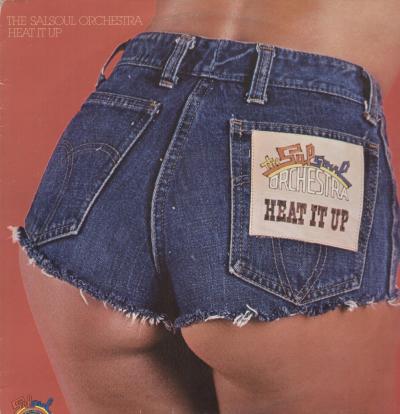
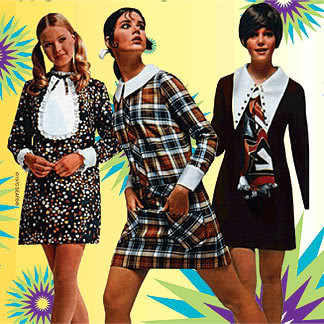
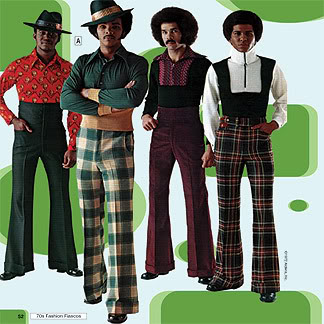
I came across Maureen Valdes Marsh’s 70s Fashion Fiascos one evening while doing research for That 70s Show, my tribute to New Yawk in the the decade that launched hip hop, punk, disco, and graffiti to the world. By random chance I knew the publisher, who introduced me to Maureen. Our connection was instantaneous, and since then I have enjoyed her brilliance, wit, and aesthetic sensibility. She wrote this essay on 70s fashion for me, and for the first time I am publishing it in full, along with a selection of images from her book, as well some album covers that illustrate her point.

.

.

70s Fashion Fiascos
By Maureen Valdes Marsh

.

Like a slow turning storm, it spread further and further out from the hub of urbanity until slowly—carefully—it rolled under the crack of suburbia’s front door. Like smoke, like mist, it couldn’t help but leave its fingerprints on everything it touched.  “I am here,” fashion whispered. “I am here.”

.

In between the free love of Woodstock ‘69 and the 1980 death of John Lennon lay a decade that would come to be remembered not only by its historical events—the shootings at Kent State, the end of the Vietnam War, the resignation of a president—but also for its pop culture.

.

1970s pop culture wasn’t simply about the excesses of Studio 54 or the squeaky-clean images emanating from the Donny and Marie TV show. The true pop culture of America lay in the day-to-day world of suburbia. As suburbanites, we showed our tender, compassionate side by how we tended and pampered our Pet Rocks. We showed our tolerant side by the patience we exhibited while waiting in endless gas lines. We showed our exuberant nature by the fervor with which we Bumped and Hustled on the disco floor. But perhaps the biggest and most lasting slice of 70s pop culture was in the clothes we wore.

.

Image from 70s Fashion Fiascos

.

Free from the constraints of the 1950s and peppered with the new found spirit of the 1960s, fashion in the 1970s took on a life all its own. Flamboyancy was no longer reserved for the young, rich, or famous. Flamboyant urbanity took a short ride over to suburbia’s neighborhood where it was welcomed with open arms.

.

When you look at the lack of choices women faced in the early 1970s, it’s no wonder they became angry enough to burn their bras in protest. It seems in hindsight, however, that they were burning the wrong garment. Even though bra burning was a symbolic act of women’s liberation, was it really the brassiere that was stifling women in the fashion sense? Or was it the overwhelming, in-your-face choices the fashion industry was rapidly throwing at them that made women strike the first match? There was the mini skirt, the midi skirt, and the maxi skirt. Comical circus-tent palazzo pants, sideshow pantsuits, and who can forget clunky, funky, and chunky—more commonly referred to as platform shoes.

.

.

After years of being regulated to the same look, the same uniform Donna Reed-style apparel, the same rules of acceptable/unacceptable dress norms, women were now being overwhelmed by the choices laid out for them. It’s something that we can’t comprehend today. We are used to a society where individuality is the norm, freedom of choice the rule. But for a woman entering the 1970s, freedom of fashion choice created a kind of culture shock. It was like being a kid set loose in a candy store: At first you can’t get enough; everything tastes sweet and delicious. But sooner than you’d imagine, your stomach (and your wallet) start to ache until at last you scream, “No more, please!”

.

Image from 70s Fashion Fiascos

.

In the meantime, it was no different for the male of the species. They too were under a barrage of rapid fire fashion bullets. The first rounds out of the chamber were, fortunately, blanks such as the uninspiring “Unsuit”— take one men’s suit jacket, remove the sleeves, scoop the front, slap a hip belt around it and voilà!, the Unsuit. The hot and lethal hits came in the form of plaids intense enough to be seen from the Concorde and platform shoes high enough to garner the American Medical Association’s official disapproval. But none left a lasting impression quite as strong as the posthumously awarded ‘king of the ‘70s’—the leisure suit.

.

Once hailed by top designers John Weitz and Calvin Klein as a garment with staying power, the leisure suit was ostracized from the kingdom of en vogue before the 1970s ever came to an end. Just as it had swiftly risen to the top of fashion, it fell into the leagues of comic relief twice as fast.  Today we laugh at the cheesy styles, feminine colors, and garish plaids. But what we seem to have forgotten is that the leisure suit did more than just provide us with years of laughs. The leisure suit helped men open themselves up to new ideas in clothing. It allowed them to experiment outside of the style box they’d been locked in for too many years. If the 1970s had passed without the leisure suit, “business casual” for men might never have developed as soon as it did. The leisure suit may have been a fashion catastrophe, but it laid the groundwork for men to strut their fashion stuff for decades to come.

.

.

As the decade came to a close, the fashions we now so closely associate with the era began to lose their staying power. Polyester garments were cast aside for a return to natural fibers. Women set aside their Day-Glo jumpsuits in exchange for tailored suits. Men replaced their loud, garish, wild-print shirts with muted earth tones and subtle patterns. Sky-high platform shoes were brought back down to earth in the form of comfortable flats. And all those millions of polyester leisure suits? Well, they were shuttled off to the Salvation Army, to await a time when, thirty years later, a new generation would rediscover disco, funk, and That 70s Show.

.

I LOVE CHARO

Don’t Stop, Get It, Get It

Categories: 1970s, Art, Fashion, Photography

My Man, Nat Finkelstein 1933–2009, May He Rest in Peace

Posted on October 7, 2009

© Nat Finkelstein

© Gerard Malanga

.

Lemme tell you about my man Nat Finkelstein the kinkiest kid Brooklyn has ever seen. I met him in 2000, he called the office one day to talk with the bosses about his new book for Fall, a Warhol book about the Factory’s earliest days, when the original King of Pop still made his own paintings. Days of desultory decadence that Nat cuts to shreds in his book, The Factory Years, which is now out of print. He signed my book: Heed the cry of the mutant “I need others like me”.

.

Indeed.

.

Born in Coney Island, Brooklyn in 1933, Nat Finkelstein was a graduate of Stuyvesant High School and attended Brooklyn College. He blew me away when he dropped this gem on me: homeboy studied photography and design under Alexey Brodovitch, the legendary art director of Harper’s Bazaar. What was this crazy BK boy up to anyway ? How did he connect with Warhol ?

.

Turns out Nat worked as a photojournalist for the PIX and Black Star photo agencies. In 1964, he got an assignment to enter Andy Warhol’s Factory as a journalist. He didn’t leave for three years. Not until he left his mark, with the first photos of the Velvet Underground, who he called “The Psychopath’s Rolling Stones,” then with shots of Edie Sedgwick, and then finally for being the dude who introduced Valerie Solanis to Andy Warhol. A big mark indeed.

 .

© Nat Finkelstein

© Stephen Shore

Finkelstein abruptly retired from photography in 1969, when a federal warrant was issued for his arrest, due to the incendiary nature of his civil rights activity. He left the United States, and lived as a fugitive for fifteen years, following the Silk Road through the Middle East. I’ve read some of the stories: Morocco in the late 60s, Kandahar in 71; the sort of things you’d never believe, except Nat had proof. He had his photos.

Eventually, all charges against Finkelstein were dismissed, and he returned to New York City in 1982, resuming his photographic career in galleries worldwide. While best known for his images of Warhol’s Factory, Finkelstein’s documented stories as wide ranging as civil rights protests for Life Magazine in the 1960s to the “club kid” scene of the 1990s. His monographs include The Andy Warhol Index (with Warhol, 1968), Girlfriends (1991), Merry Monsters (1993), Andy Warhol: The Factory Years (2000) and Edie Factory Girl (2006).

© Nat Finkelstein

Flickr

.

Finkelstein’s photographs are in the permanent collection of The Metropolitan Museum of Art, New York; the Andy Warhol Museum, Pittsburgh; The Victoria & Albert Museum, London; The Ludwig Museum, Cologne; Centre Georges Pompidou, Paris; and the Smithsonian Institute, National Portrait Gallery, Washington DC, among many other public and private collections. His work can be seen in upcoming exhibitions, including “Who Shot Rock” at the Brooklyn Museum this Fall, and a retrospective at Idea Generation, London in December 2009.

.

Nat Finkelstein passed peacefully at his home in Upstate New York on Friday October 2, 2009. He was 76. Rest in Peace, Nat. You were a true original. A rebel and a renegade, an artist and a ladies man, a brilliant thinker, a crazed Tasmanian devil, and one of the funniest, most on-point people I have ever had the pleasure to know. And I am so glad you had the good sense to marry Elizabeth, as she will carry the torch and torch the flag. Whatever it takes to make things happen.

 .

© Nat Finkelstein

Artnet


Categories: 1960s, 1970s, 1980s, 1990s, Photography

Godlis Shot Debbie Harry and Patti Smith

Posted on September 1, 2009

Godlis - Blondie

Godlis – Blondie

 .

Godlis began photographing at CBGB’s in 1976. As a refugee of the New York City street photography scene, his work reveals an infatuation with Leica cameras, long handheld exposures, and Brassai’s classic night photographs of the 1930s. His work has been exhibited at the Museum of Modern Art, in the landmark 1981 show “New Wave/New York: at P.S.1, New Museum of Contemporary Art, CBGB 313 Gallery, and Pace MacGill Gallery, all in New York; and at Rencontres Internationales de la Photographie, Arles.

 .

Godlis discusses his work, Blondie, CBGB’s, New York City, 1977, and Patti Smith Outside CBGB’s, Bowery and Bleecker Street, New York City, 1976, selected for publication in Who Shot Rock & Roll by Gail Buckland (Knopf, October 2009, $40).

 .

What lead you to study photography at Imageworks and what were your aspirations when you first entered the discipline?

 .

Godlis: Well, seeing Antonioni’s “Blow Up” was probably pretty key to me getting interested in photography. David Hemmings as David Bailey in his darkroom in swinging London, with the club appearance by the Yardbirds—not to mention Vanessa Redgrave and Jane Birkin; that made photography look pretty cool.

.

I got my first camera at the end of the summer of 1970. I was living in Boston and immediately began shooting black & white pictures of all my friends. I became fascinated by the cult of the camera itself.  I started educating myself by picking up old Photography Annuals and hanging out looking at photo books at the library. I was clearly obsessed with what this “photography” thing was, so I took a basic course in 1972 to actually get inside a darkroom.

 .

Right around that time, I took a trip to NYC to the Museum of Modern Art, where I was stunned by the Diane Arbus 1972 exhibition.  For me that was a defining moment, where my fascination with photography crossed paths with the rock aesthetic I had grown up around. Bob Dylan’s “Ballad of a Thin Man” was cut from the same cloth as Diane Arbus’ “Jewish Giant with Parents.” So that exhibition, along with the first time I saw Cartier-Bresson’s “Decisive Moment” was the turning point for me.

.

After that I needed a place to really learn how to learn about the art of photography. Imageworks was where I landed in the fall of 1974. Imageworks was in East Cambridge, Massachusetts. It was the kind of experimental photography school that really flourished in the early 70s—an art school devoted totally to photography—where a group of like-minded kids with cameras showed up to pick up skills and share ideas. Teachers came in from RISD in Providence and SVA in NYC. My first class, my first day—Nan Goldin and Stanley Greene were both beginner photographers in that class—was like jumping into a cold pool. It was all photography all the time, and I couldn’t get enough of it.

 .

Imageworks was where that I began to learn how to really look at photographs—Robert Frank, Walker Evans, Lee Friedlander, Garry Winogrand, Brassai, Kertesz, Atget, Weegee. My greatest teacher was Paul Krot from RISD, who invented the Sprint chemicals I still use. He cut through all the crap and made it very clear what was important to know. And there really was a cult of straight “street photography” at Imageworks.  That’s what really interested me, and that’s how I saw myself, in that pre-Post Modern era: the lonely street photographer with camera conquering the world.

.

I hung around Imageworks until it imploded and shut down during the recession of 1975, and then packed up my gear and headed to NYC to shoot on the streets of New York and look for work as an assistant.

 .

NYC, 1976, Abbie Hoffman’s old St. Marks Place apartment!! It couldn’t be more fitting. Gail quotes you as saying, “I wasn’t a rock photographer. I photographed a scene.” What attracted you to the East Village in 1976, and to its underground HQ, CBGB’s?

.

When I got to NYC in 1976, I was looking for work as a photographer’s assistant to pay the bills.   Eventually I landed a steady job, and looked for a place to hang out and hear music. There weren’t very many clubs that didn’t have cover bands, and I’d seen that picture of Patti Smith and Bob Dylan that kind of tipped me off to CBGB’s, so I went in there to see what was going on. I had also seen copies of Punk magazine and Rock Scene at a newsstand at Penn Station. The first time I went to CBGB’s I saw Television and figured out pretty quickly that there were some like-minded Velvet Underground fans in this place. I had found my new hangout. It didn’t hurt that I got in for free.

 .

But I didn’t really go there to photograph, I went there to hear music and meet people. It was late one night at the bar that I had this epiphany that maybe I should be photographing the place. If I could photograph it at night under natural light exactly the way it looked—I had been looking at Brassai’s night pictures of Paris in the 1930s  at the time—that would be something no one else was doing. And if I didn’t do it who would? I didn’t want to be a rock photographer. I didn’t want to be Annie Liebowitz. I wanted to be Brassai!

.

As far as St. Marks Place goes, I used to go down there in the 60s when I was a teenager and always loved the block so it wasn’t that far fetched to go looking for an apartment there. It was close to the Bowery and CBGB’s where I was spending all my time, and the rent was cheap. Roberta Bayley lived upstairs in the same building, so we could share darkroom chemicals. What I didn’t expect was that I would end up in Abbie Hoffman’s old apartment. I found that out years later, when we went on rent strike and one of my neighbors told me that Abbie had gone underground from there. It’s always felt like a lot of history passed through that place.

 .

Your epiphany, to photograph New York at night, and to explore the issues of film, paper, and exposure, are what set apart your work from so many others. Your work with light at night is exciting, can you speak about the different challenges you faces with the conditions of the street and nightclub environments?

 .

I was committed to shooting by natural light at night—no flash—so I was already painting myself into a corner. But it was my corner and no one else’s. If you use a flash, it’s like turning a light on in a room that’s already lit a certain way and I definitely didn’t want to do that. But I made it work for me. I wanted my pictures to look exactly the way things looked at CBGB’s, at that time and place.

 .

I was already shooting with a Leica camera, which I could hold steady at slow shutter speeds. But the problem was determining the right combination of shutter speeds, f/stop, and film developing. That took weeks of testing. I was like a mad scientist in the darkroom, trying variations of mixing chemicals to push the Tri-x film until I got enough on the negative to make a good print. Then testing out papers to come up with the right look. It really paid off, in that it gave my pictures a unique look. I didn’t even know what they would look like until I figured it all out. But once I figured it out, I was free to shoot at night indoors, onstage and off, and outdoors with people lit up by the Bowery streetlights.

 .

I had to shoot at ¼-second exposure handheld, so I had to remind people—drunk people—to hold still. But that worked to my benefit too. What was great was that the prints glowed. They looked great at night, when I showed them to people in the club. The darkroom light was the same as the club lighting. The magazines in America thought they were blurry grainy shots because they didn’t look like flash photos but in England and France they loved them.

 .

Now for the people who were there in 1976-79, they tell me the pictures look exactly like what they remember of CBGB’s. And for people who weren’t there, the pictures show them what it would have been like to be there. That was what I wanted to do—to show what the present will look like as the past. That’s the essence of my type of photography.

 .

How did the people on the scene connect to the work you were doing?

 .

I used to go down to CBGB’s every night with a box of pictures to show people what I was doing. Inevitably I left with fewer pictures than I showed up with—I gave many away. But over time, everyone in the club knew what I was doing and wanted to be part of it. There were no digital backs on the cameras back then. So you had to develop and print the work yourself every day.

 .

The way the pictures were printed made them look especially good under the club lighting. I remember Bob Gruen telling me one night—I was so impressed that this was the actual Bob Gruen—that he used to do the same thing, bringing pictures down to clubs and showing them to everyone when he started out.  That meant a lot to me, and everyone’s reaction at CBGB’s spurred me on.

.

Handsome Dick Manitoba’s finding my stolen wallet and returning it to me at CBGB’s one night in 1976 led me to do that picture of him and his girlfriend Jody in front of CB’s to return the favor. Television called me to do their photograph for the second album, which led to the pictures of Richard Lloyd at in the hospital. Tapping Patti Smith on the shoulder one night outside CBGB’s and asking to take her photograph lit up by the Bowery streetlamps led to one of my most memorable photographs. I remember talking with Alex Chilton in 1977 and being totally impressed by his stories of photographer William Eggleston, whom he’d known in Memphis—which led to us doing the photograph of him where a drop of rain magically landed on the lens.  We really all worked off of each other every night at CBGB’s—just like the bands worked off of their audiences.

 .

I love your little story about Robert Frank, could you retell it here?

 .

Well I was such a big fan of Robert Frank since my time at Imageworks and so much of what I was doing at CBGB’s was influenced, both consciously and unconsciously, by him. I knew The Americans and Lines of My Hand inside out. His photograph of the kids with the jukebox from The Americans, I wanted to make that photograph inside CBGB’s. I had seen him speak in 1975 at Wellesley College right after Walker Evans had died, when he showed a reel of the banned Rolling Stones film.

 .

But now here I was shooting at CBGB’s in 1977 and in walks Robert Frank, right past the front desk. I was stunned. I was the only one there who recognized him. But to me, one of my biggest influences had just walked into the place, where I was shooting pictures totally influenced by him. At that time I didn’t have any idea that he lived around the corner on Bleecker Street! I remember he asked me what was going on here, and he said in his Swiss accent, “It looks like de way people dress here is very important.”

 .

Then everyone around me wanted to know who is this guy. I said incredulously, “That’s Robert Frank!” Well no one knew who that was. So I said, “Robert Frank, The Americans?” No reaction. “Cocksucker Blues”? Still no reaction. Then “Exile on Main Street?”  Well that was a pretty influential album on the punk scene in 77, so when I said he did the cover for that album, it clicked and people said, “Oh yeah—he’s very cool! What’s his name?”

.

Godlis - Debbie Harry

Godlis – Debbie Harry

Categories: 1970s, Art, Books, Brooklyn, Exhibitions, Manhattan, Music, Photography

Kate Simon Shot Bunny Wailer

Posted on August 25, 2009

kate simon - Bunny Wailer

kate simon – Bunny Wailer

 .

Kate Simon was born and raised in upstate New York. Her father, medical doctor and amateur photographer, introduced her early on to photography. In the late 1970s Simon photographed the pioneers in Reggae Music including Bob Marley, Lee “Scratch” Perry , Bunny Wailer, Peter Tosh, Burning Spear, and many more. She took some of the most amazing documentary photographs of Bob Marley and the Wailers during various tours and day-to-day life. Simon’s shots are occasionally candid, catching her subjects in intensely personal moments. She has captured photographs of almost every occasion in Bob Marley’s life including celebrations, shock, football games, his funeral and more. She can name claim to the most famous portrait of Bob Marley ever taken, the front cover of the “Kaya” album. Her photos of the 1977 Exodus tour are perhaps the most astonishing of all and are a tour de force in documentary photography.

.

Simon discusses her work, Bunny Wailer, Kingston, Jamaica, 1976, selected for publication in Who Shot Rock & Roll by Gail Buckland (Knopf, October 2009, $40).

 .

In the book, Gail quotes you as saying, “You can’t make a picture happen. [the person has to] give it to you and you have to be ready for it.” I would love if you could talk about that shoot with Bunny Wailer, about your experience, about who you are and who he is, and how your collaboration made that image possible.

.

Kate Simon: Well that is a damn good question. Certainly a picture of its time, it was shot in 1976. First of all it is certainly that Bunny Wailer had just put out one the absolute hallmark corner stone record of Roots Rock Reggae called “Blackheart Man.” Bunny Wailer was one of the original Wailers with Peter Tosh and Bob Marley. His singing and his falsetto and his heart, it was just an unbelievable voice. It’s nothing like what his face in that photograph would suggest because it is really soft and just angelic. You can really hear it in “Reincarnated Souls,” “Hallelujah Time,” and “Pass It On” and in the other really well known Wailer songs.

 .

I was living in England at the time as a photographer for one of the weeklies in the music business. Chris Blackwell, the founder of Island Records, sent me down to Jamaica. I got there as the sole photographer and there were two journalists and all three of us were waiting for Bunny to come down from the hills, because he lived in Bull Bay, about nine miles outside Kingston and we waited at Tommy Cowan’s yard. Tommy Cowan was literally the Bill Graham of Jamaican Roots Rock Reggae circuit 1976. He had this office where Jacob Miller, Gregory Isaacs, Peter Tosh, Robbie Shakespeare—everyone that created this genre of music hung out.

 .

I had to wait for Bunny for a week. I waited and when he got there I was ready and I would say so was he. This whole week that  we were waiting he was thinking about what he wanted to project to us journalists who were waiting for him. Bunny finally did come with the intention to give me photographs. He was really pitching these really intense images my way. What a face, what intelligence, what fire beneath. He was really clear in regard to who he was and who he was going to give to me. It was not a game face though; it felt very authentic. The only thing that I would say that was to my credit is that I was not intimidated. I will never forget it. It was to this day one of my favorite sessions.

 .

Most of the people that lived then are dead now: Peter Tosh, Dennis Brown, Jacob Miller, Augustus Pablo, Bob Marley, the fathers of this genre of music. Bunny Wailer is extremely alive right now, and he was alive then. I am so grateful to him. It was a really effective exchange. He could tell I was getting it and that is why he gave me some more. Every shot was good and every picture was good. One shot builds to the next shot, and with the energy you know when it is working. The subject knows when it is working and you know when it is working. It is hard work for both, but it is great. You are in the zone.

 .

I want to talk to you about what Gail is doing with the book. Her idea is to move past the genre of rock photography. One of the things that I got really into when talking with her about it, was the idea that with music and photography that there is actually a place where the two meet. The image is so essential to our understanding of music. You as a photographer become a contributor, a collaborator in the experience of the music.

.

Arguably, a lot of us photographers who are drawn to shoot these musicians have their own kind of rhythmic sense. Don’t you think there is a rhythm to communication, don’t you think a stranger picks up. As a photographer it is your job to make a stranger trust you, respect you and like you, I mean instantaneously. You are throwing your own rhythm to the subject and then they are responding to it, it is utterly rhythmic and it is energetic and it is an exchange of energy. Being sensitive and appreciative of the music makes you be able to approach them.

 .

You shot Bob Marley’s album cover. This is before the Internet and before CDs. One part of a record before the 80s was not just the packaging of it but the communication of their message.

 .

I can remember the person who showed me the “Are You Experienced” album cover, delivering it like it was the tablets of Moses. The famous cover that you are referring to is “Kaya” after which they started to use my pictures on other albums. As an artist it feels great to me, Bob Marley was the unbelievable photo subject because he was completely respectful of photography as a vocation, he understood that it was real work. He really let me know that I was welcome whenever he was around. That was just so freeing and so helpful. It was significant to me in regard to my growth as a photographer because I tried all these new ways of shooting and new kinds of film because this subject Bob Marley so inspired me and I knew that he would not stop me, I knew that he would be with me and encourage me. He was a sent-from-heaven subject. He was just like you would imagine: a very conscious, empathetic, spiritual, really positive person. I think it is a gift from God to be identified with a person that I think so highly of, so many years later.

Categories: 1970s, Art, Books, Exhibitions, Music, Photography

Robert Bayley Shot The Ramones & The Heartbreakers

Posted on August 20, 2009

Roberta Bayley – Heartbreakers

Roberta Bayley – Heartbreakers

 .

Roberta Bayley reigns supreme as one of the principal photographers who served as a significant visual chronicler of the punk rock music movement that lasted from the mid-70s up until the early-80s. Bayley worked as a door person at the legendary CBGB’s where she befriended the scene’s most significant figures. Among the punk music artists she has photographed are Iggy Pop, Blondie, Richard Hell, Elvis Costello, The Sex Pistols, Johnny Thunders and The Heartbreakers, Joe Strummer, The Ramones, Nick Lowe, The Damned, The Clash, The Dead Boys, and The New York Dolls. The chief photographer for Punk magazine, Bayley’s photographs have appeared in countless publications including Blank Generation Revisited: The Early Days of Punk, Please Kill Me: The Uncensored Oral History of Punk, and CBGB and OMFUG: Thirty Years from the Home of Underground Punk, among others. Bayley co-wrote the book Patti Smith: An Unauthorized Biography with Victor Bockris, and is author of Blondie: Unseen 1976–1980. Her photographs have been exhibited in such major cities as New York, Los Angeles, Sydney, Austin, Paris, Portland, Amsterdam, Tokyo, Hong Kong, London, Mexico City, and Pittsburgh.

 .

Bayley discusses her work, The Heartbreakers, 1975, and The Ramones, New York City, 1976, selected for publication in Who Shot Rock & Roll by Gail Buckland (Knopf, October 2009, $40).

 .

The images Gail selected for the book, The Heartbreakers and The Ramones, are among the most iconic images of punk. Your personal history, working at CBGB’s and photographing the artists (your friends) at the dawn of their careers, put you at the eye of the hurricane (a position I, and many others I am quite sure, look at with envy and awe). Your work is as essential to the scene as the music itself. What did these pictures mean to you when you made them, and has that meaning changed over time, as the photographs have grown into icons?

 .

Roberta Bayley: I made the Ramones image for a shoot for Punk magazine. It was never meant to be the album cover, so there was no pressure on me. John Holmstrom and Legs McNeil were there and we knew the Ramones so it wasn’t a high stress session.  The Ramones record company, SIRE, had already hired a “professional” photographer to shoot the album cover but the band hated the photos and were desperate enough to call me! I was paid $125 for that image and one other to be used for publicity—take it or leave it. I took it. As soon as it was released I knew somehow that it was iconic. Over the years many people, especially in England, told me they were “gobsmacked” seeing the cover, and bought the record just because of that image. There has never been another image of the Ramones that captures that particular perfect moment.

 .

The Heartbreakers “blood” photo is completely different in it’s origin than the Ramones image.  This image was taken from a session that was (literally) the fourth roll of film through my camera! It was taken in my then-unfurnished, brand new apartment on St. Marks Place (where I still live). The blood concept was Richard Hell’s, taken from the product used to simulate blood in 50s B-movies (it was actually Hershey’s syrup).  The photo was used for a New Year’s Eve poster with the phrase “Catch Them While They’re Still Alive”—playing on the band’s reputation as heavy drug users.

 .

The Heartbreakers image did not become “iconic” until it was used for the cover of Please Kill Me in 1996. That book was issued in England, France, Germany, Japan, and Finland, and is still in print. So the image has become associated with that classic book about punk.

.

I have always loved the dirty glamour, casual formality, and inescapable individuality your subjects exude. As much as these two images were photo shoots for the bands, there’s nothing contrived about these images. Whether it’s Joey Ramone’s smirk or Johnny Thunder’s bravado, the images feel like they are playing to you, connecting to you, rather than to the camera. What was the energy on these shoots, and how did your personal relationships affect your connection to them?

 .

The people I photographed back then were people I knew, and had known, for a few years. Most of them (all of them?) were not experienced in front of the camera, nor was I experienced behind the camera. We were all winging it. I had a natural talent for relaxing my subjects. Also I worked quickly. Most of my subjects didn’t really love the photo experience. They were musicians and not models. So I tried to relax people, take the photo and end it.  I’m sure there was also an element of flirtation involved, which is part of relaxing your subject, along with humor.

 .

Punk came out of NYC at its grimiest. How did your work reflect the times you were living in (and by that I mean, how did you make a living being a photographer in NYC back in the 70s)?

.

I had no idea that New York was at its nadir when I arrived in 1974. I had just arrived from London and New York seemed vibrant and fabulous to me!


I did NOT make a living as a photographer in the 70s!  I always had another “day job.” Until 1978 it was CBGB’s and then I worked for Blondie for a year (for $150 a week!). It was only in 2004 that I quit my various day jobs and have made a living solely from my “art”!

 .

You describe working at Punk as a form of “creative insanity.” Can you add to this, I am curious as to how the insanity nurtured and impacted your work?

 .

John and Legs were both a few years younger than me, and they brought a lot of originality and enthusiasm to what they were trying to do with Punk. They didn’t break the rules so much as they had no idea there WERE any rules! Plus there was zero money, which always fuels creativity. Hey, the magazine’s original headquarters was called “the dump” and it was. Three of them lived there and there was no shower. They used to go over to Nancy Spungen’s to bathe. The most fun came out of the “fumettis” which were like movies or comic books in still-photo form. We tried to shoot “on location” as much as possible but if something didn’t work out John could always draw in the special effects later. It was damn good fun and everybody on the scene wanted to be involved. We got people to do crazy things in the name of “art.”

.

Roberta Bailey - The Ramones

Roberta Bailey – The Ramones

Categories: 1970s, Art, Books, Exhibitions, Music, Photography

   Newer entries »

Categories

Archives

Top Posts

  • Home
  • About
  • Marketing
  • Blog
  • Azucar! The Life of Celia Cruz Comes to Netflix in an Epic Series
  • Eli Reed: The Formative Years
  • Bill Ray: Watts 1966
  • Jonas Mekas: I Seem to Live: The New York Diaries 1950-1969, Volume 1
  • Mark Rothko: The Color Field Paintings
  • Imprint

Return to top

© Copyright 2004–2025

Duet Theme by The Theme Foundry